


Table of Contents
What if you could see exactly which personal injury keywords a prospect types into Google or an AI tool like ChatGPT before they hire a PI lawyer?
- "Best personal injury lawyer near me."
- "Car accident attorney Dallas."
- "Average settlement for a motorcycle crash."
Normally, you’d need a crystal ball, but not today. In this article, we break down the top 100 personal injury keywords trending in 2026, i.e., the exact terms your potential clients will look up.
Add them to your law firm SEO for personal injury plan, and you'll attract highly qualified visitors and consultations, month after month.
What Are Personal Injury Keywords & Why They Decide Who Gets the Client
Personal injury keywords are the exact phrases people type into Google or ChatGPT when they need a PI lawyer, like "what do I do after a car accident in Dallas?"

Why are personal injury lawyer keywords important? Because keywords you target don't just affect your rankings. They influence your caseload.
Ahrefs reports that 96.55% of web pages get zero traffic. The wrong keywords (or none at all) are a primary reason why.
Since 2008, we’ve seen this play out repeatedly. Two firms in the same city with similar websites; one targeting high-intent, locally modified keywords fills its calendar, the other targeting broad national terms gets buried.
Good personal injury SEO starts with knowing which keywords bring in the kind of cases you want.
Here's what separates a top-converting personal injury SEO keyword from a research keyword:
- Intent is crucial. "Best personal injury lawyer near me" means someone is ready to hire. "Average settlement for a car accident" means someone is still in research mode. Both matter, but they belong on different pages.
- Go local over national. A firm in Houston has no realistic shot at ranking for "personal injury lawyer" nationwide, but they can rank for "car accident lawyer Houston TX.”
- Specificity (usually) means urgency. The more specific the search, "truck accident attorney Dallas," "dog bite lawyer near me,” the closer that person is to hiring.
How to Do Personal Injury Keyword Research: Step-by-Step
Most PI firms that come to us have either skipped keyword research entirely or hazard a guess at a handful of terms.
This is a mistake. As an SEO expert, Neil Patel, rightly points out, "Creating content without keyword research is a gamble."
And taking a gamble won’t bring you cases. Here's how the 18 SEO experts at Grow Law tackle personal injury keyword research:
Step 1: Start With Core PI Terms and Practice Areas
What cases does your firm take? List every practice area, like car accidents, truck accidents, slip and fall, wrongful death, dog bites, and medical malpractice. Each one becomes a keyword cluster. Each cluster becomes its own page.
And take this seriously. AISEO points out 94.74% of keywords see less than 10 monthly searches. They point out, "This reinforces the value of targeting niche, low-volume terms."
Be sure to build out variations to boost your personal injury lead generation. "Car accident lawyer" becomes "car crash attorney," "auto accident lawyer," "vehicle accident attorney."
Tools like Ahrefs, SEMrush, and Google Keyword Planner will surface dozens of variations you'd never think of manually.
Step 2: Layer In Local Modifiers
Local terms are where the clients are. Once you have your core list, append every relevant geography: city, county, metro area, and nearby suburbs. "Car accident lawyer" becomes "car accident lawyer Houston TX," "car accident attorney Harris County," "auto accident lawyer The Woodlands."
Marketing LTB reports that local keywords see a 15-30% higher conversion rate than general terms.
Step 3: Classify by Intent
Before you assign a term to a page, know the searcher’s desire:
- Hire-intent (ready to hire): "best personal injury lawyer near me," "car accident attorney Dallas TX,” these belong on practice area pages and homepage.
- Research-intent (gathering info): "how long does a personal injury case take," "average settlement for slip and fall,” these belong on blog posts and FAQ pages.
- Comparison-intent (weighing their options) : "personal injury lawyer vs insurance settlement," "do I need an attorney after a car accident," personal injury blog topics that move prospects toward a decision.
Do not get your wires crossed. Putting research keywords on a practice area page, or hire-intent terms on a blog post, is bad for conversions.
Step 4: Evaluate Keyword Difficulty vs. Case Value
We’ve made this mistake before. A high search volume doesn't automatically mean high priority.
A term like "personal injury lawyer" has 88,000 monthly searches nationally, and a keyword difficulty score that makes it virtually impossible for a newer or mid-size firm to rank for.

Meanwhile, "truck accident lawyer Dallas TX" has a fraction of the volume but a realistic path to page one and a case value that can justify $800+ per click in PPC.
The right question isn't "how many people search for this?" It's "can we rank for it, and is the case worth the effort?" Read that last one again.
Step 5: Map Keywords to Pages
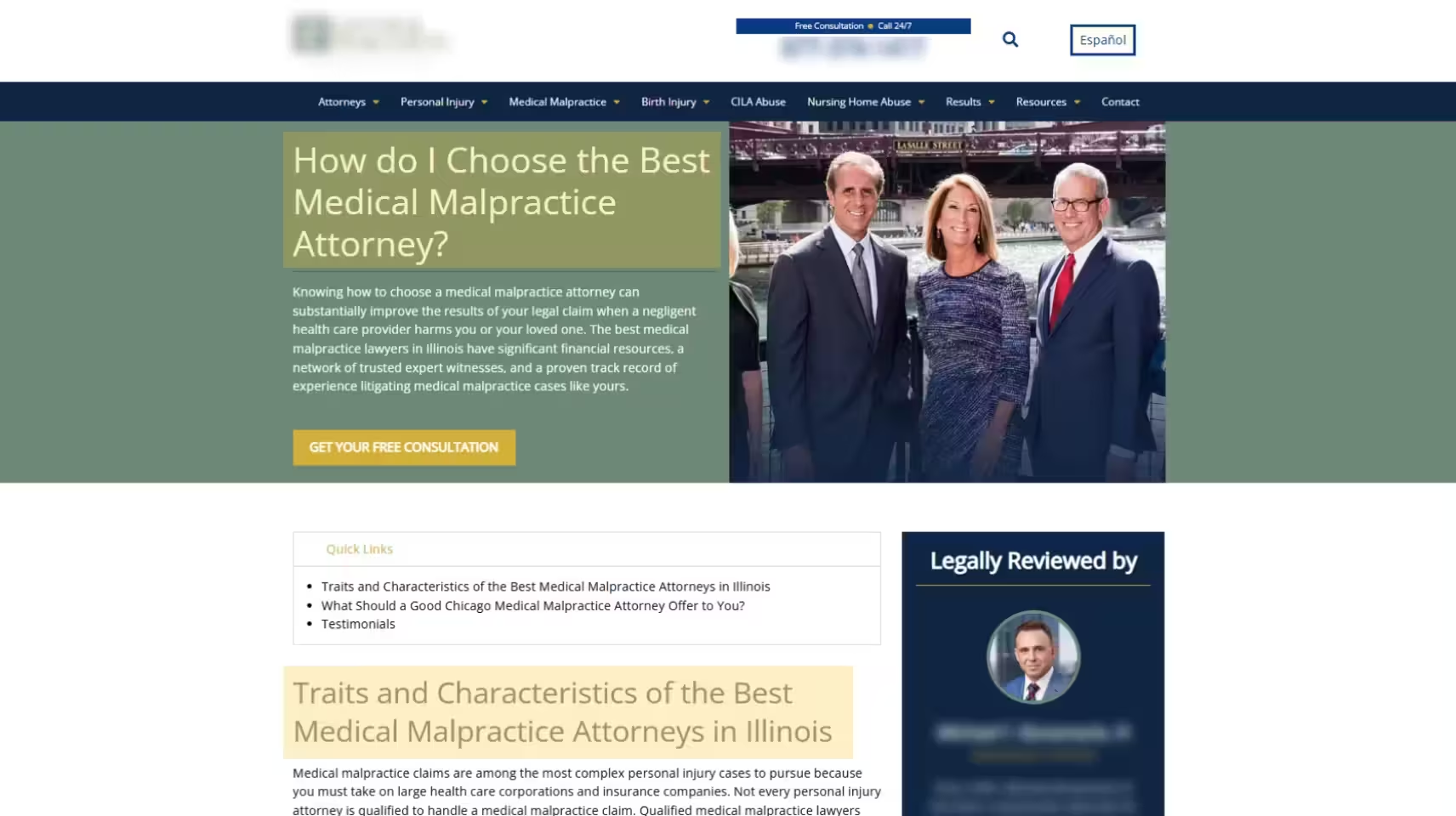
Every target keyword needs a home.
A PI firm from Dallas came to us in 2024, targeting only the 5 highest-volume PI terms: "personal injury lawyer," "car accident attorney," and similar, all funneled to a single homepage.
They were stuck on pages 3–5 for every one of them. After building 12 practice-area-specific pages with segmented local keywords like "truck accident lawyer Dallas TX," "slip and fall attorney Fort Worth," the firm hit page one for 9 of those 12 terms within 7 months.
Monthly organic leads went from 4 to 37, just by using the right personal injury law firm keywords.
Keywords are a critical part of your personal injury lead generation. Check out the attorney SEO basics in our 2026 guide.

Grow Your ROI Faster Than Ever
Our PI lawyers see up to 800% ROI with our SEO services!
Get Your Free Growth Plan
Top 100 Personal Injury Keywords: Volume, Intent, and CPC
This is the full list of the top 100 personal injury keywords ranked by monthly search volume and max bid (cost-per-click in Google Ads).
These 2 numbers tell you almost everything you need to know about a personal injury attorney keyword before you invest a dollar:
Volume shows how many people search for that term each month in the U.S. High volume means high competition, and usually a harder path to page one for organic SEO. But it also tells you where the demand is.
Max Bid is what advertisers are currently willing to pay per click in Google Ads. Think of it as a proxy for case value. When "truck accident lawyer" carries an $800 max bid, that's the market signaling that a signed truck accident case is worth the spend.
Read the 2 columns together, and you’ll see which ones you can realistically rank for right now versus build toward over time.
This keyword list is your 'what.' Our local SEO checklist for lawyers guide provides the 'how' to use them and win the Local Pack.
Personal Injury SEO Keywords: What to Prioritize for Organic Rankings
Thankfully, you don't need to go after all 100 keywords today. Organic SEO in the PI space is a tiered game.
Think of PI keywords in 3 tiers:
Tier 1 — High competition, high volume.
Terms like "personal injury lawyer" 88,000/mo) and "car accident lawyer" (108,000/mo). These are dominated by large multi-location firms and heavily funded SEO campaigns. A newer or mid-size firm targeting these exclusively will wait 2+ years to hit page one, if ever.
Tier 2 — Medium competition, practice-area specific.
Terms like "motorcycle accident lawyer" (59,000/mo), "dog bite attorney" (23,000/mo), "wrongful death attorney" (41,000/mo). Winnable for firms with 3+ years of domain history, a domain authority of 35–50, and well-built practice area pages.
Tier 3 — Lower competition, high conversion.
Long-tail and locally modified terms like "truck accident lawyer Dallas TX," "slip and fall attorney near me," "best motorcycle accident lawyer in [city]." Lower search volume, but these people are close to hiring.
Long-tail personal injury attorney keywords typically convert at 2.5x the rate of short-tail keywords, according to AISEO.
We’ve seen this Tier build momentum with newer firms (and bring cases to established firms when their competitors overlook it).
— New Site vs. Established Site
If your firm's website is under 2 years old or has limited backlink authority, start in Tier 3.
Build practice-area pages around locally modified long-tail terms. Use the traffic and engagement signals to build authority, then work up toward Tier 2.
If your firm has an established site with consistent traffic and a healthy backlink profile, pursue Tier 2 aggressively while maintaining Tier 3 pages.
Tier 1 terms are worth targeting through supporting content (blog posts, FAQs, internal linking) but rarely as standalone page targets unless you have significant SEO investment behind you.
— Local Keyword Structure
Every national keyword on the top 100 list has a local version waiting to be built. This is the structure we recommend:
- [Practice area] + [lawyer/attorney] + [city]: "car accident lawyer Austin TX"
- [Practice area] + [lawyer/attorney] + [near me]: "slip and fall attorney near me"
- [Practice area] + [lawyer/attorney] + [county/region]: "wrongful death attorney Harris County"
- Best + [practice area] + [lawyer/attorney] + [city]: "best motorcycle accident lawyer in Denver"
- [Practice area] + [law firm] + [city]: "personal injury law firm Chicago IL"

P.S. Pages with these types of long-tail keywords typically climb by 11 positions, compared to just 5 positions for shorter keywords.
— Content Mapping: Which Keywords Go Where
Our rule at Grow Law is simple. Match the keyword's intent to the right content type:
Practice area pages get hire-intent keywords. "Car accident lawyer Houston TX," "truck accident attorney Dallas," "slip and fall lawyer near me."
Blog posts and guides get research-intent and comparison-intent keywords. "How long does a personal injury case take," "what is the average settlement for a car accident in Texas," "do I need a lawyer after a minor fender bender."
FAQ pages and schema get question-based keywords. "How much does a personal injury lawyer cost," "what does a PI attorney charge," "how do I file a personal injury claim." These also feed directly into Google's featured snippets and AI Overviews.
With one of our PI clients, Omar Ochoa Law, we followed this exact content mapping system as part of a broader SEO for personal injury lawyers strategy, and they saw a 919% increase in organic traffic.
Book More Local Clients Faster
More calls. More jobs! 100+ happy lawyers saw an average of 400%+ ROI with our SEO.
Get Your Free Growth Plan

Personal Injury PPC Keywords: How to Pick Terms That Lower Your Cost Per Lead (CPL)
Personal injury attorney keywords are among the most expensive in the Google Ads marketplace.
Clicks for terms like "Los Angeles truck accident lawyer" can cost $500, and even generic phrases like "car accident lawyer" regularly exceed $300 in competitive markets.
We’ve personally seen lawyers blow $10,000+ on PI PPC due to a faulty keyword list that was too broad or too vague.
Here's how to build a personal injury law firm keyword strategy that lowers your CPL.
— Match Types
Google gives you 3 ways to bid on a keyword.
Use exact match on your highest-value terms, phrase match to capture local and long-tail variations, and broad match (very) sparingly.
— Negative Keywords
This is important. Every search that triggers your ad but doesn’t convert is money gone. In PI PPC, the most common budget killers are:
- DIY legal searches: "how to file a personal injury claim myself," "personal injury forms," "legal aid"
- Research-only searches: "personal injury law school," "personal injury paralegal jobs," "PI lawyer salary"
- Low-value intent: "free personal injury advice," "personal injury settlement calculator," "do I have a case"
- Competitor and review searches: "personal injury lawyer complaints," "is [firm name] good"
Build your negative keyword list before you go live. This tells Google what keywords you don’t want to show up for.
— Bid Strategy by Keyword Tier
Not every keyword deserves the same budget. We personally align our bids based on case value:
High-bid terms ($300–$800+ CPC): "truck accident lawyer [city]," "18 wheeler accident attorney," "wrongful death lawyer near me." These are expensive because the cases are worth it. A single signed truck accident case can generate 6 figures.
Best for: Bid competitively, but only with exact match and a tight landing page.
Mid-tier terms ($100–$300 CPC): "car accident lawyer near me," "motorcycle accident attorney [city]," "slip and fall lawyer near me." Your bread and butter.
Best for: Phrase and exact match, strong ad copy, dedicated practice-area landing pages.
Lower-tier terms ($20–$100 CPC): Long-tail and question-based terms. "Dog bite attorney near me," "best injury lawyer in [city]." Lower competition, lower cost, and often higher conversion rates because the searcher is specific about what they need.
Best for: Ideal for newer firms building PPC momentum without wasting money on the most competitive terms.
— How Smart Keyword Selection Surged Leads by 440%
Back in 2023, a 2-attorney PI firm in Atlanta came to us, bidding on just 2 keywords; "personal injury lawyer" and "accident attorney.” They had no negative keyword list and no match type strategy. Their average cost per click was $47, and cost per lead was $680.
Our team added exact match targeting, a negative keyword list, and layered in long-tail injury-specific terms like "motorcycle accident lawyer Atlanta GA."
Just with that alone, their CPC dropped to $21 and CPL dropped to $195 within 3 months.
For KJT Law Group, we ran a similar playbook as part of their SEO for personal injury lawyers strategy. They saw a 440% increase in PPC qualified leads alongside a 50% decrease in cost per lead.
The keyword tactics we gave you are make-or-break for PI PPC. Even the best ad copy will fail if you don’t dial this in first.
AI Search and GEO: The New Frontier for Personal Injury Keywords
As of early 2026, ChatGPT alone has 900 million weekly active users. AI search now recommends lawyers directly to stressed clients.
A prospect might ask: "What should I do after a car accident that wasn't my fault?" Within seconds, they receive a detailed answer, including recommendations for law firms in their city.
Only a handful of firms get cited. Be sure you’re in there because traffic from AI platforms converts at 3 times the rate of other channels.
— How ChatGPT and Google AI Overviews Surface PI Attorneys
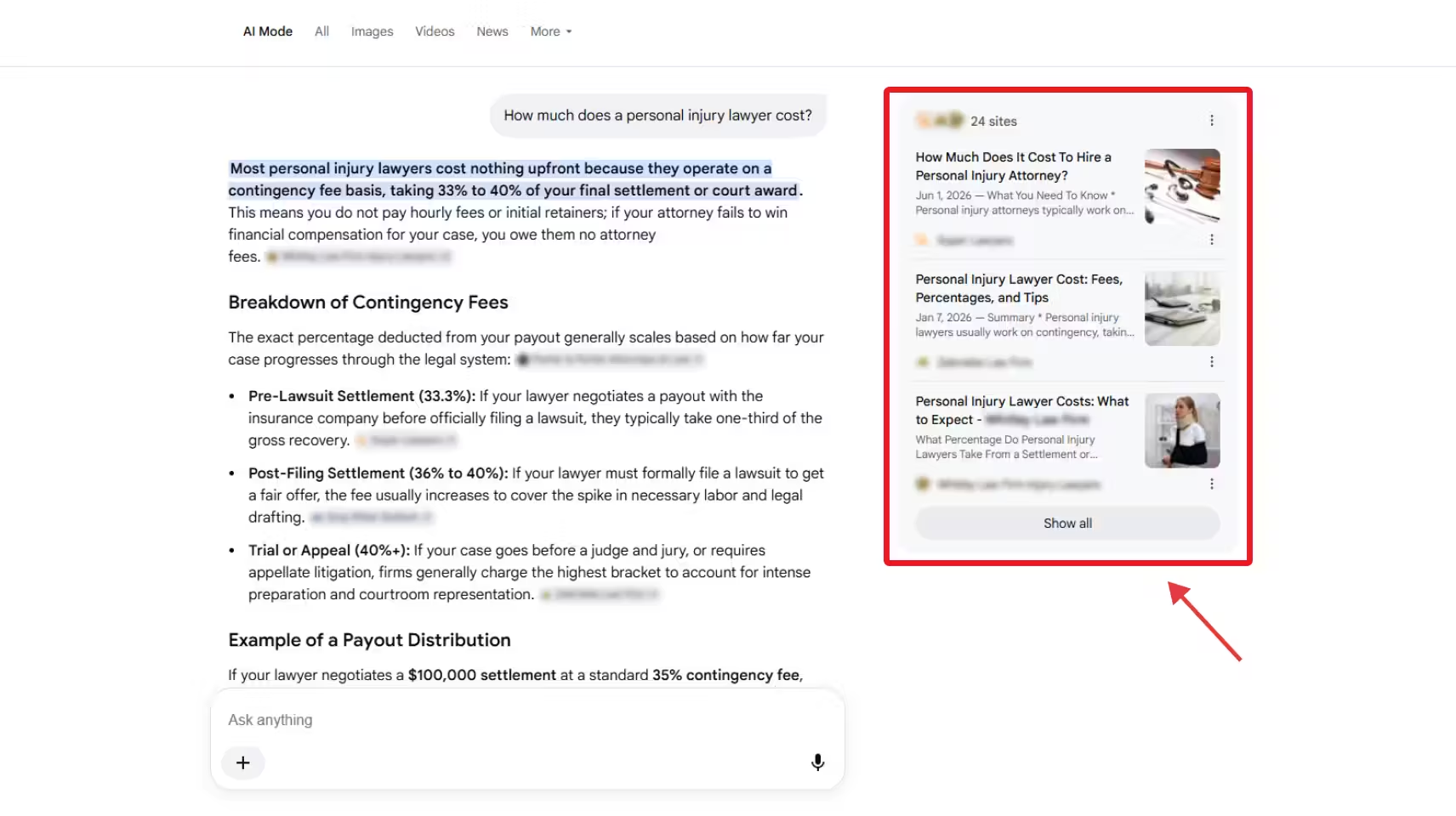
AI tools don't rank websites the way Google does. They synthesize answers from what they've encountered across the web, and they cite sources they deem credible, specific, and authoritative.
This means AI draws on your firm's reviews, the authority and specificity of its published content, the volume of press coverage, the quality of attorney profiles in legal directories, and the density of its presence in the market.
On Google’s side, the numbers are stark. Around 78% of legal-related queries now trigger AI-generated Overviews on Google.
Make no mistake, your organic rankings and AI citations are intertwined. Through mid-2025, roughly 75% of URLs cited inside AI Overviews also ranked in the organic top 12.
— What Query Types Trigger AI Overviews for PI
AI Overviews and ChatGPT responses tend to surface for question-based and research-intent queries:
- "What should I do after a car accident?"
- "How long do I have to file a personal injury claim in [state]?"
- "Do I need a lawyer if the other driver was at fault?"
- "What is the average settlement for a slip and fall?"
- "How much does a personal injury lawyer cost?"
These are an entry point to the funnel where a future client forms their first impression of you.
— How to Optimize PI Content in the Age of AI
When writing content, specificity is a must.
Bad example: "Statutes of limitations vary by state.”
Good example: "In Georgia, the statute of limitations for a personal injury claim is two years under O.C.G.A. §9-3-33.”
Beyond specificity, we have a few more core optimization tips:
Structured Q&A content. Build FAQ sections on every practice area page that directly answer the questions above. Use plain language. AI systems extract clean, direct answers.
Schema markup. Attorney, LegalService, FAQPage, LocalBusiness, and BreadcrumbList schemas together let AI systems map your firm into a structured graph.
Author credentials and E-E-A-T signals. AI tools favor content attributed to named attorneys with verifiable credentials. Make sure your blog posts have a licensed PI attorney author bio.
Directory and citation presence. Avvo, Justia, FindLaw, and Martindale-Hubbell are the sources AI tools pull from when building recommendations.
You’ve seen how powerful the right personal injury keywords can be. But keywords alone won’t attract cases. You need the right execution.
As a next step, we suggest looking at our personal injury law firm SEO services. We also offer proven GEO optimization, building the content architecture, schema, and citation infrastructure to get you cited in AI responses. 98% of our clients now get AI-driven leads.
We’ve delivered 758% increase in qualified leads for lawyers like Jacob D. Fuchsberg in just 12 months.
Take action to fill your caseload.
Book Your Free Keyword & SEO Audit Today
Personal Injury Keywords Frequently Asked Questions

Compare Your Practice Instantly
Stay Ahead of the Competition!
Compare your law firm's performance to Local competitors with our instant assessment tool
Get a clear picture of your firm's performance
Boost your online presence
Compare My Firm
Compare Your Practice Instantly
Stay Ahead of the Competition!
Compare your law firm's performance to Local competitors with our instant assessment tool
Get a clear picture of your firm's performance
Boost your online presence
Compare My Firm
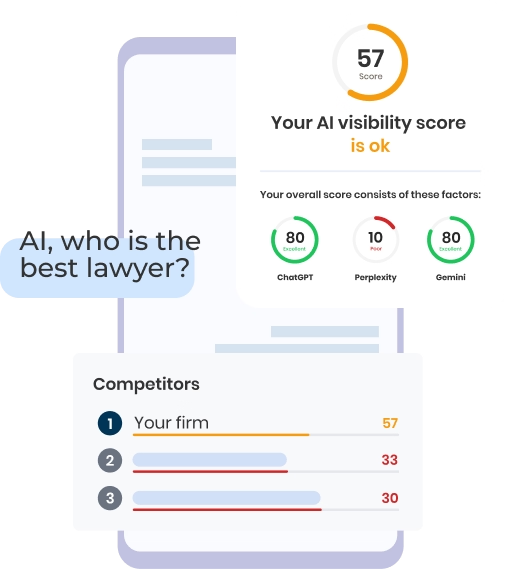
Check Your AI Visibility Instantly
Find Out What AI Is Telling Your Potential Clients
Run our free AI Visibility Report to:
See how often top AI tools mention your law firm
Spot which competitors show up first
Get the next steps to capture more cases
Run My Free AI Report
.avif)
.avif)
.avif)

