


Table of Contents
Your caseload swings between packed and painfully quiet. Leads come in, but too many are a bad fit. You still cannot tell whether your spend produced enough signed cases.
The problem: the lack of a solid law firm marketing strategy. Like most firms, you're probably running disconnected tactics.
Upmetrics reports that businesses with a plan grow 30% faster. If you have a strategy, an executable plan, the right channel mix, a website and intake process, and clear measurement, you can transform your caseload in as little as 6 months.
In this guide, we give you a practical, 7-step framework to sign more cases, courtesy of our experts who have been doing law firm marketing for over 18 years. Let's go.
Key Takeaways
- Strategy vs. plan: strategy defines who you serve and why; the plan defines the actions, owners, timing, and metrics that execute it.
- Qualified leads and signed cases are more important than tracking traffic or visibility alone.
- Budget from the bottom up: build from required signed cases and cost per signed case, rather than a percentage of revenue.
- Select channels by objective, speed, and market fit, not by running every channel at once.
- Connect calls, forms, chat, and intake to your CRM so every signed case traces back to its source. For a deeper breakdown, see our guide to legal client intake.
- Match your execution model (in-house, specialist, or integrated agency) to how many moving pieces your plan has.
What Is a Law Firm Marketing Strategy?
A law firm marketing strategy is the set of decisions that determines who you serve, how you position your firm, and where you invest your marketing budget to get the most valuable cases.
Think of it as the "why" behind everything you do. Your law firm marketing plan, law firm marketing campaign, and legal tactics are the "how."
These terms get used interchangeably, but they are not the same thing. You’re probably mixing them up, which is why your marketing feels scattered.
Without a legal marketing strategy, your plan has no direction. You end up choosing tactics because a competitor is using them or because they sound current.
This is why systematic marketing is important. It is not about visibility for its own sake. It’s a mechanism to grow your caseload.
Firms with clear law firm marketing strategies use that visibility to connect their expertise to the clients who need it, and turn that into a caseload they can sustain.
Build the Strategy First, Choose the Channels Second
Before you touch a single channel, ad platform, or content calendar, you need to make 5 decisions.
1. What Are My Business and Signed-Case Goals?
Start with a number you can act on. "Grow my firm" is not a goal. "Sign 15 additional personal injury cases this quarter, worth an average of $12,000 each, without exceeding current intake capacity" is how you build smarter law firm marketing goals.
Tie every goal to 4 elements: revenue, case mix, capacity, and time frame. If your intake team can only handle 20 new client calls a week, a goal that assumes 40 is a capacity problem you need to account for in your lawyer marketing plan.
2. Which Case Types Are Most Valuable to My Firm?
Are all cases worth the same to your firm? Most likely no. Marketing your law firm should reflect that.
Weigh expected case value, margin after cost to acquire and service, your team's current capacity, and geographic or jurisdictional constraints.
For example, if your firm can staff 5 active mass tort cases at a time, you should not be spending your budget generating 10. Move your spend toward the case types that produce the best return for your firm's capacity. That’s key when developing marketing strategies for law firms.
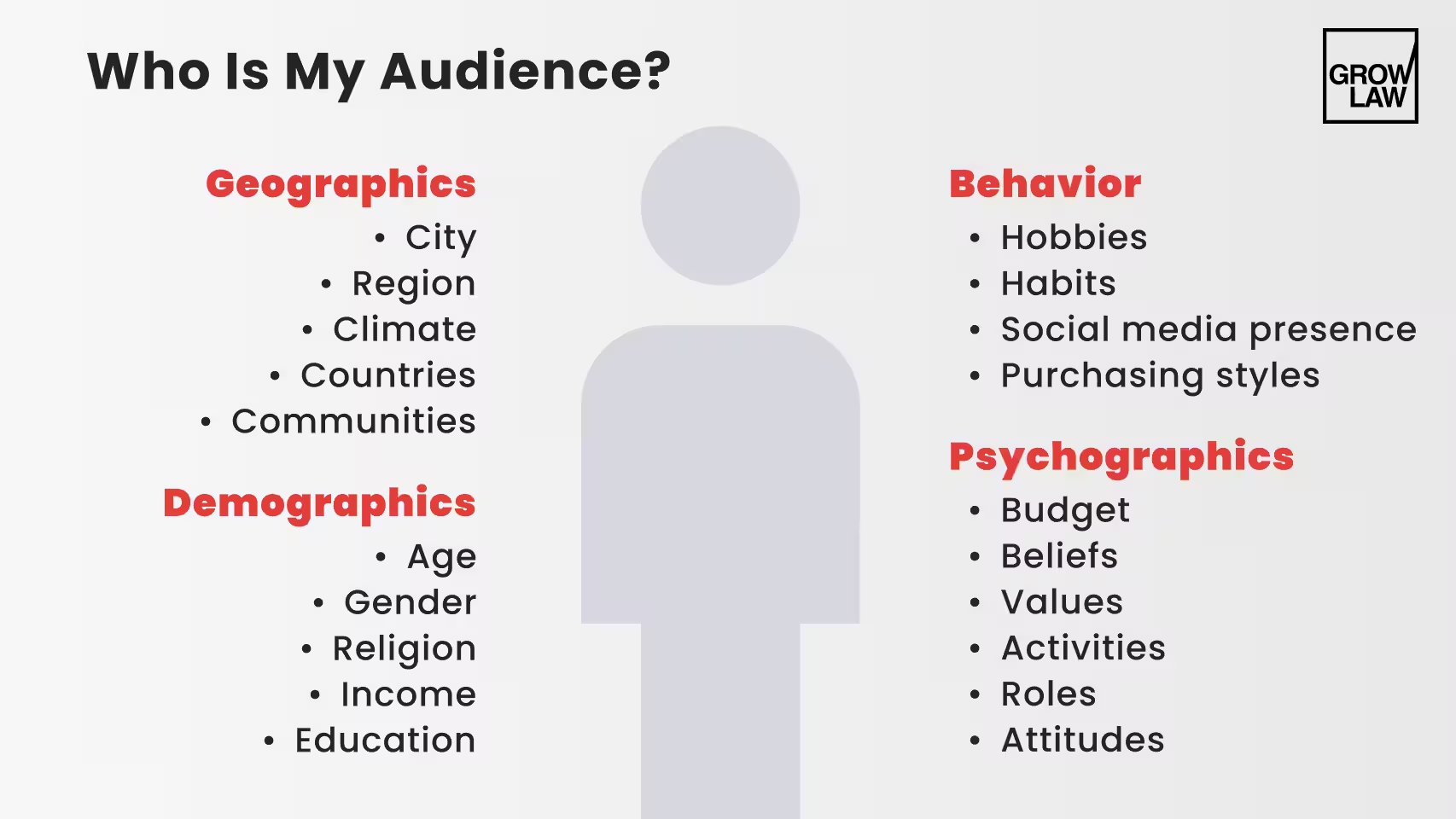
3. Who Is My Audience? What Is Their Client Journey?
"Everyone who might need a lawyer" is not your audience. You are marketing to a specific person at a specific moment. Map the path they take:
- Trigger event — a car accident, a layoff, an arrest
- Research — searching "car accident lawyer near me" or asking for recommendations
- Comparison — reading reviews, comparing websites, checking case results
- First contact — a phone call, a web form, a live chat
- Intake process — the initial consultation and paperwork
- Signed case — the retainer agreement
Your marketing will shift at each stage. A trigger-stage prospect needs clarity and reassurance. A comparison-stage prospect needs proof and differentiation. This is why you must understand where a given piece of content or channel fits in that journey.
4. Where Are the Gaps in My Market and Competitors?
Look at what firms in your practice area and market are already doing. Review their search visibility, their offers, their reviews, their content, their advertising, and how they position themselves.
This is not about copying competitors. Find the gap. If every firm in your market leads with the same claim ("aggressive representation," "we fight for you"), that message no longer stands out. Instead, build your message around something responsive, like "We return every client call within one hour.”
5. What Is My Positioning? Can I Prove It?
Positioning tips the scales. It makes a prospect choose your firm over the next.
Reviews and case results are some of the strongest proof in your marketing strategy for law firms. But they have to be used carefully. A vague "we get results" claim is weak. "We secured a $1.4M settlement for a client with a similar injury" is better.
Note: Just be sure every result, review, or endorsement you cite is accurate and follows your jurisdiction's professional conduct rules. See ABA Model Rules 7.1–7.3.
How to Create a Law Firm Marketing Plan
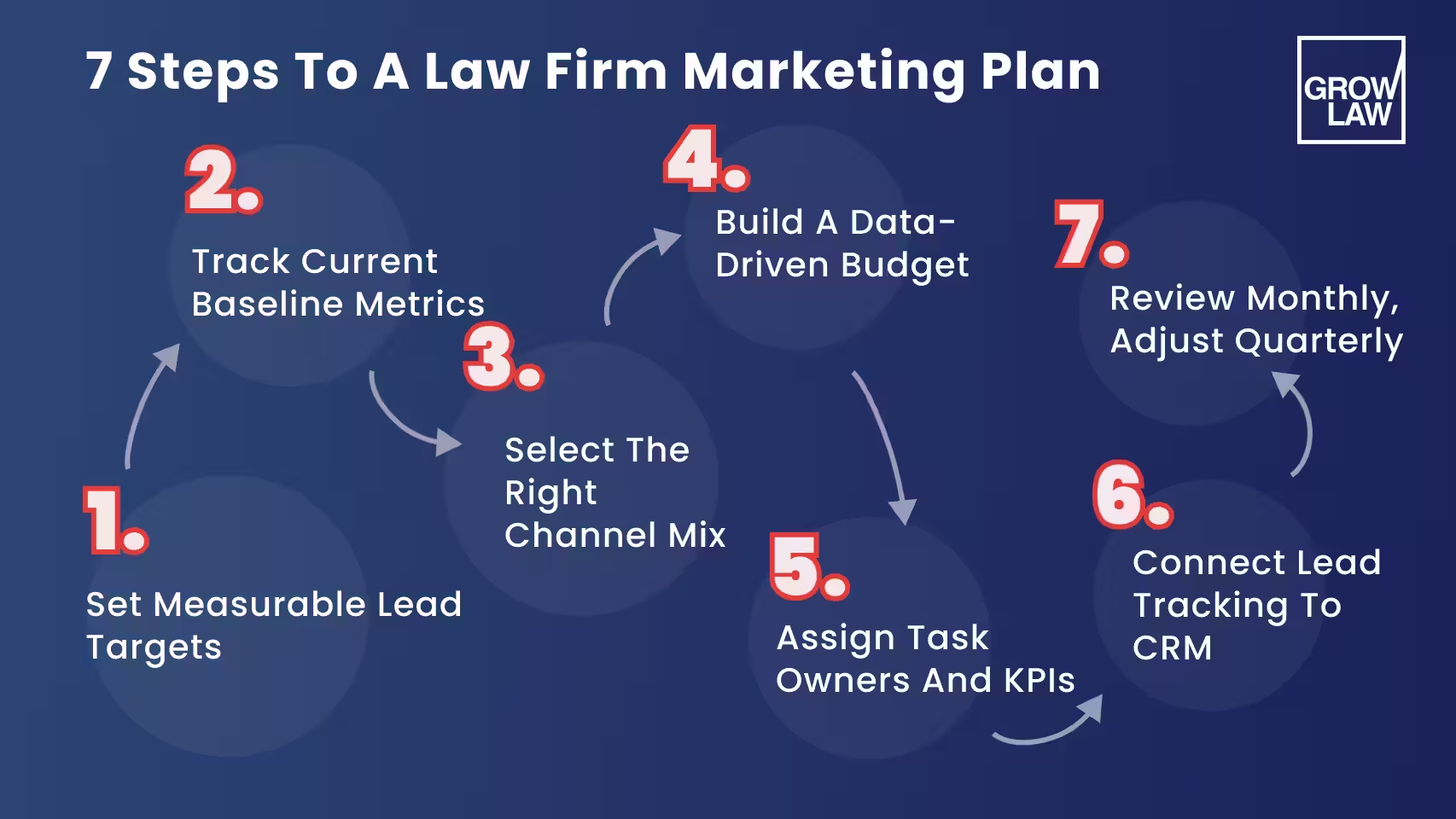
Your strategy tells you what to prioritize. Your plan turns that into action. Here are the 7 law firm marketing ideas that convert your goals into signed cases.
1. Convert your business goals into measurable marketing targets
"Sign 15 more personal injury cases this quarter" becomes a marketing target once you work backward: how many qualified leads that requires, at what conversion rate, through which channels.
2. Establish your baseline
Before you change anything, pull your current numbers for qualified leads, signed cases, conversion rate, and cost per signed case by channel. You cannot measure improvement against a number you don’t know.
3. Select a channel mix
Your stage matters as much as your goal. A solo or small firm usually needs fast, low-cost wins: Google Business Profile, reviews, and referrals, before investing heavily in SEO. An established firm with steady case flow can afford to build long-term channels like SEO and content while paid ads fill short-term gaps.
4. Build your budget from the numbers
Start from your required signed cases and your cost per signed case by channel. For example, if your goal is 15 signed cases this quarter and your average cost per signed case through SEO is $2,000, you need roughly $30,000 allocated to that channel alone. A budget built this way tells you what you need to spend.
5. Assign an owner, deliverable, deadline, and metric to every initiative
"Improve our SEO" is an initiative, albeit a bad one. "Marketing manager publishes 4 practice-area pages by March 31, targeting a 20% increase in qualified leads" is one someone can actually be held accountable for.
6. Connect calls, forms, chat, intake, and CRM
If a call comes in and no one logs which channel it came from, you lose the ability to know what is working. Every qualified lead should flow into a system that tracks it from first contact through signed case.
7. Review monthly, reallocate quarterly
Want to spot problems early? Check your performance by channel every month. If your cost per signed case from PPC jumps from $2,000 to $4,000 in March, you want to catch that in April itself. Make budget and channel-mix decisions quarterly.
— A 90-Day Example
You do not need 12 months to start seeing whether your law firm marketing strategy template is working.
We’ve broken down what a law firm marketing plan example can look like in the first 90 days:
- Days 1–30: Establish your baseline, set up tracking, review your market and competitors, and fix the most urgent website and intake gaps.
- Days 31–60: Launch or improve your highest-priority channel for qualified leads, and publish or update the conversion pages that support it.
- Days 61–90: Assess lead quality, intake conversion, and cost per signed case. Use what you learn to set next quarter's allocation.
Choose Your Marketing Channels by Objective and Timeline
The reality is, no firm needs every channel running in tandem.
How do you find the right mix? This depends on 3 things: how urgently you need results, how much serious buying intent the channel captures, and what your market responds to.
Use this matrix to match each channel to its actual job, then follow the "next step" to decide if it belongs in your plan right now.
In 2026, your potential clients are also using AI-powered search tools like ChatGPT to find and vet firms. Similar fundamentals that work with traditional search: a strong brand, expert content, a technically accessible site, and consistent name, address, and practice-area information across your web presence, are what AI tools draw on.
Your Intake Has to Keep Up With Your Traffic
Visibility doesn't fix a slow response. Or a weak service page. Or even a confusing intake process.
Ask yourself honestly, "Is my site ready to convert the traffic it gets?" Any channel you pick just means more people hitting the same friction.
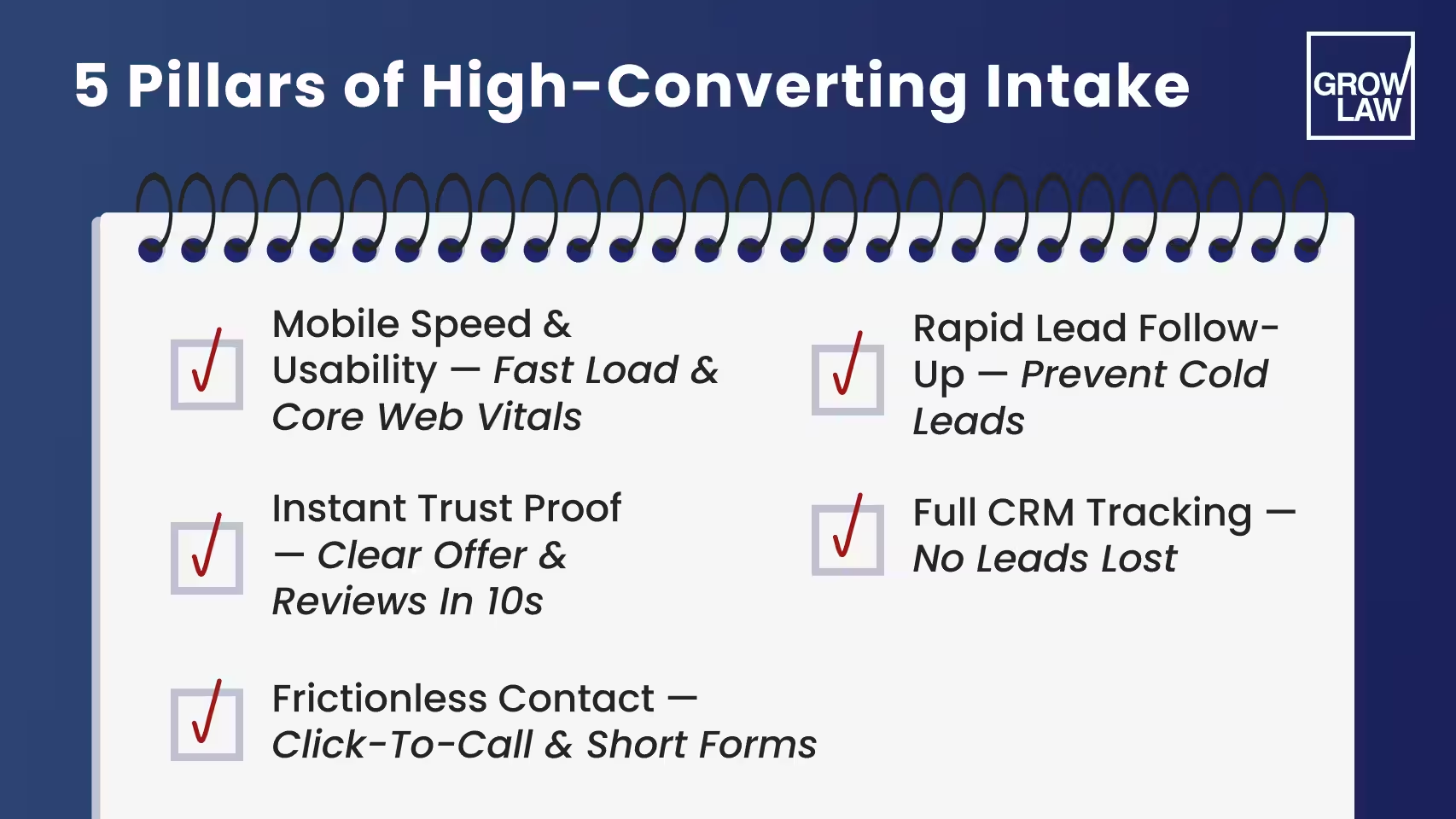
- Mobile usability: your pages need to load fast and function cleanly on mobile, hitting current Core Web Vitals targets: Largest Contentful Paint under 2.5 seconds, Interaction to Next Paint under 200 milliseconds, and Cumulative Layout Shift under 0.1, each measured across real visitor sessions.
- Clear offers and trust proof: your service pages need to state the offer plainly and back it up with credentials, results, or reviews. A visitor needs to know what you do and why to trust you in the first 10 seconds.
- Click-to-call and short forms: every extra field or buried phone number is a chance for your prospect to leave. Create a frictionless path from interest to contact, making it as short as possible. For a deeper breakdown, see our guide to law firm contact form optimization.
- Response-time ownership and call handling: a lead goes cold fast without a consistent, owned process for following up.
- CRM capture: every lead gets logged and tracked. Nothing should fall through the cracks between first contact and follow-up.
Not sure how to tackle this? Our conversion-focused law firm website design page goes through what to do next.
Set Your Budget Then Measure What Produces Signed Cases
We won't hand you a made-up percentage of revenue.
That number has no connection to what you need to spend to hit your goal. Instead, build your budget from the bottom up: start with the signed cases you need, then work backward using your conversion numbers.
The logic, from first click to signed case:
- A prospect clicks into your site from a channel. That click becomes a lead once they contact you.
- A lead becomes a qualified lead once it matches your case criteria (the right practice area, jurisdiction, and case value).
- Your qualified-lead rate tells you what share of total leads clear that bar.
- A qualified lead becomes a signed case once intake converts it. Your intake conversion rate tells you how well that handoff is working.
- Divide total spend on a channel by the signed cases it produced, and you get your cost per signed case, the number that actually tells you whether a channel is worth funding.
- Multiply signed cases by expected case value to estimate revenue, and compare that to spend to calculate marketing ROI.
- Track lead-response time alongside all of this. A slow response can quietly sink your qualified-lead rate and intake conversion rate before either metric tells you why.
Know your cost per signed case by channel? The budget question is simple math.
Review monthly. Reallocate quarterly. You can catch a channel going off course with monthly reviews, like a rising cost per signed case.
This is exactly what disciplined measurement and reallocation can produce. Yarborough Law Group, a family and criminal defense firm in Norman, Oklahoma, saw qualified leads increase by 452%, organic traffic surge by 2,938%, and marketing ROI reach 857% after rebuilding its local SEO, website, and tracking around these same metrics.
Like Yarborough, every quarter, act on what the data showed you. Shift your spend away from the channels with a high cost per signed case. Then, put more behind the ones consistently landing signed cases at a cost you're comfortable defending. This is one of the best law firm marketing tips we can hand you today.
Proof of Success: When Every Piece Works Together
Grow Law worked with Omar Ochoa Law on exactly this kind of connected system. The results, over the course of the engagement:
- Organic traffic: up 655%
- Qualified leads: up 1,087%
- Cost per qualified lead: down 86%
None of these numbers stand alone. More traffic without a stronger website would have produced more visitors, not more signed cases.
Moreover, a better-converting website without the demand behind it would have had little to convert.
The results came from demand capture, conversion improvements, and intake working as one connected system, tracked back to source. Omar Ochoa knew exactly what produced signed cases.
This is the mechanism behind every section in this guide. Strategy sets the direction. The plan puts it into motion. Channels bring in demand. Conversion and intake turn that demand into signed cases. Attribution shows you which of it is working so you can double down. See how this works end to end in our attorney lead generation system.
Choose One: In-House, Specialist Vendors, or an Integrated Agency
Who actually executes all of this? Once your law firm digital marketing strategy and small law firm marketing plan are set, you still have to decide: do you handle it yourself, bring in a specialist, or hand the whole system to an agency?
There's no single right answer. It depends on your scope, your team's capacity, and how many moving pieces your plan has.
- Keep it in-house when the scope is narrow, and you have a person who can own it end to end. If you just need someone managing your Google Business Profile and requesting reviews, a capable staff member with a few hours a week can handle that without outside help.
- Bring in a specialist when you need deep expertise in one clearly bounded channel. A PPC specialist who lives in ad platforms every day, or an SEO consultant focused solely on technical fixes, can outperform a generalist in that one lane.
- Consider an integrated agency when your plan spans multiple channels, and your website conversion, intake, and attribution all need to work together as one system. This is usually the case once you're running SEO and PPC at the same time, trying to connect calls and forms to a CRM, and reviewing cost per signed case across channels every month.
At that point, coordinating several vendors becomes its own full-time job, and gaps between them are where signed cases quietly slip through.
Not sure which of these fits your firm right now? Start with a complimentary growth assessment with a senior Grow Law expert.
We’ll show you where your biggest gaps are, before you commit a budget to fixing the wrong one.
Law Firm Marketing Strategy FAQs

Compare Your Practice Instantly
Stay Ahead of the Competition!
Compare your law firm's performance to Local competitors with our instant assessment tool
Get a clear picture of your firm's performance
Boost your online presence
Compare My Firm
Compare Your Practice Instantly
Stay Ahead of the Competition!
Compare your law firm's performance to Local competitors with our instant assessment tool
Get a clear picture of your firm's performance
Boost your online presence
Compare My Firm
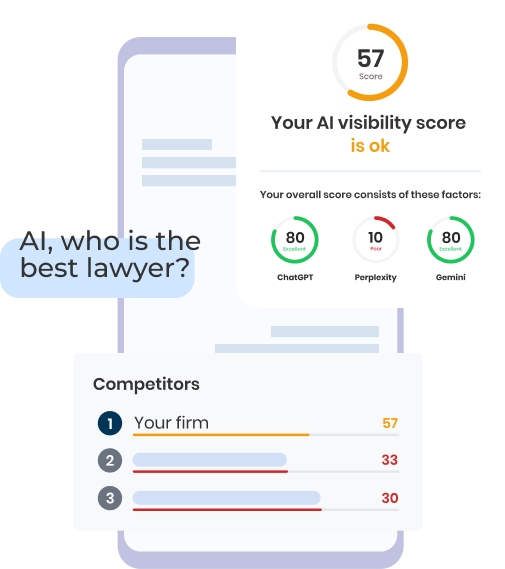
Check Your AI Visibility Instantly
Find Out What AI Is Telling Your Potential Clients
Run our free AI Visibility Report to:
See how often top AI tools mention your law firm
Spot which competitors show up first
Get the next steps to capture more cases
Run My Free AI Report
.avif)
.avif)
.avif)
- Legal marketing https://en.wikipedia.org/wiki/Legal_marketing
- Marketing plan https://en.wikipedia.org/wiki/Marketing_plan
- Marketing strategy https://en.wikipedia.org/wiki/Marketing_strategy
- Search engine optimization https://en.wikipedia.org/wiki/Search_engine_optimization

