


Table of Contents
Ranking a personal injury law firm is highly competitive.
Your firm could invest heavily in SEO and still struggle if your pages do not match search intent or your local and technical foundations are weak.
The stakes are high as competitors continue investing in content, local visibility, links, and conversion improvements.
In this guide, we’ll walk through the seven-step personal injury SEO blueprint we used to help clients like Omar Ochoa Law achieve a 1,087% increase in qualified leads.
Key Takeaways
- SEO helps personal injury firms reach people who are actively looking for legal help.
- Complete and maintain your Google Business Profile so your information is accurate and useful.
- Build separate service and location pages only when each page adds distinct value.
- Build focused pages for case-type and location searches, and use guides and FAQs to answer research questions.
- Improve mobile usability and monitor real-user Core Web Vitals. Our guide to law firm website accessibility explains how to apply this in practice.
- Track rankings and traffic together with qualified leads, signed cases, and revenue.
- Plan for at least six months of consistent SEO work before expecting significant results.
How Personal Injury SEO Works
Imagine someone gets into a car accident. Their family may pull out a phone and search for a nearby lawyer who handles that type of case.
If your firm is difficult to find or the page does not answer the searcher’s immediate questions, you may lose the opportunity.
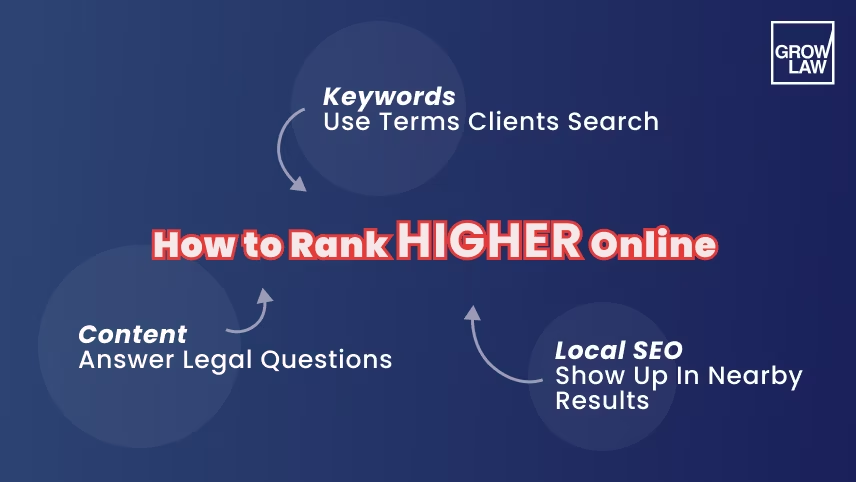
Personal injury SEO helps your website appear for relevant service, location, and research searches. It combines keyword mapping, local SEO, useful content, technical performance, reviews, and clear conversion paths. Our guide to improving a legal website’s conversion rate explains how to apply this in practice.
Why is Personal Injury Lawyer SEO So Competitive?
Personal injury SEO is competitive because many firms are trying to reach the same local prospects.
- High-value cases encourage firms to invest consistently in search visibility.
- Larger competitors may have established content libraries, strong local profiles, and more referring links.
- Paid search can be expensive in many PI markets, which makes organic and local visibility important over time.
- Legal content should be accurate, trustworthy, and reviewed carefully because it can influence major decisions.
For local results, focus on the three factors Google uses most: relevance, distance, and prominence. Strengthen these signals by ensuring your business information is complete, and you have reviews, links, and locally relevant pages.
But ranking is NOT impossible. Our experts have ranked PI firms like Jacob D. Fuchsberg in very competitive markets like New York, bringing them 196% more qualified leads.
They were able to secure page-one positions for keywords like "civil liberties lawyer" and "federal civil rights attorney" on Google.
Ultimately, SEO for personal injury lawyers takes some work, but it’s very doable!
Ready to attract clients consistently with SEO? Review our personal injury lawyer SEO services for implementation support and a clear breakdown of deliverables
What Makes PI SEO Different from General Law Firm SEO?
Is corporate law SEO the same as personal injury SEO? Not at all.
Think about it.
People looking for an estate planner take weeks to research their options. Accident victims are operating in a state of high stress.
Here is exactly how personal injury lawyer marketing is different from general SEO.
We’ll say it again: Every landing page, keyword, and local map listing must cater directly to an emergency mindset.
That is key with personal injury lawyer marketing.
How Personal Injury Lawyers Can Improve Local SEO
Local SEO helps nearby prospects find your firm when they search for a personal injury lawyer or a specific case type.
- Complete your Google Business Profile with accurate contact details, hours, categories, services, photos, and other relevant information.
- Build city and practice-area pages only when each page includes useful, location-specific content.
- Use service and location phrases naturally in titles, headings, and copy.
- Match each page to the searcher’s intent instead of choosing keywords by volume alone.
- Keep important business information consistent across relevant directories and listings.
- Ask for honest reviews and respond helpfully without coaching clients to use specific keywords.
- Use LocalBusiness structured data only when it accurately reflects visible page content.
Ultimately, local SEO for personal injury lawyers can make or break your business. The Ahearne Law Firm is a shining example.
After we improved its website, local visibility, and broader marketing program, The Ahearne Law Firm increased qualified leads by 400% and organic traffic by 1,827%.
7 Core SEO Strategies for Personal Injury Law Firms
Over the last 18 years, we’ve cracked the code to SEO for personal injury lawyers.
Through literally hundreds of algorithm shifts, we perfected this exact 7-step framework that every personal injury firm needs to attract high-value cases.
Step 1: Rank in the Local Map Pack with a GBP
Do you have a Google Business Profile (GBP)? You literally cannot rank in the local Map Pack without it.
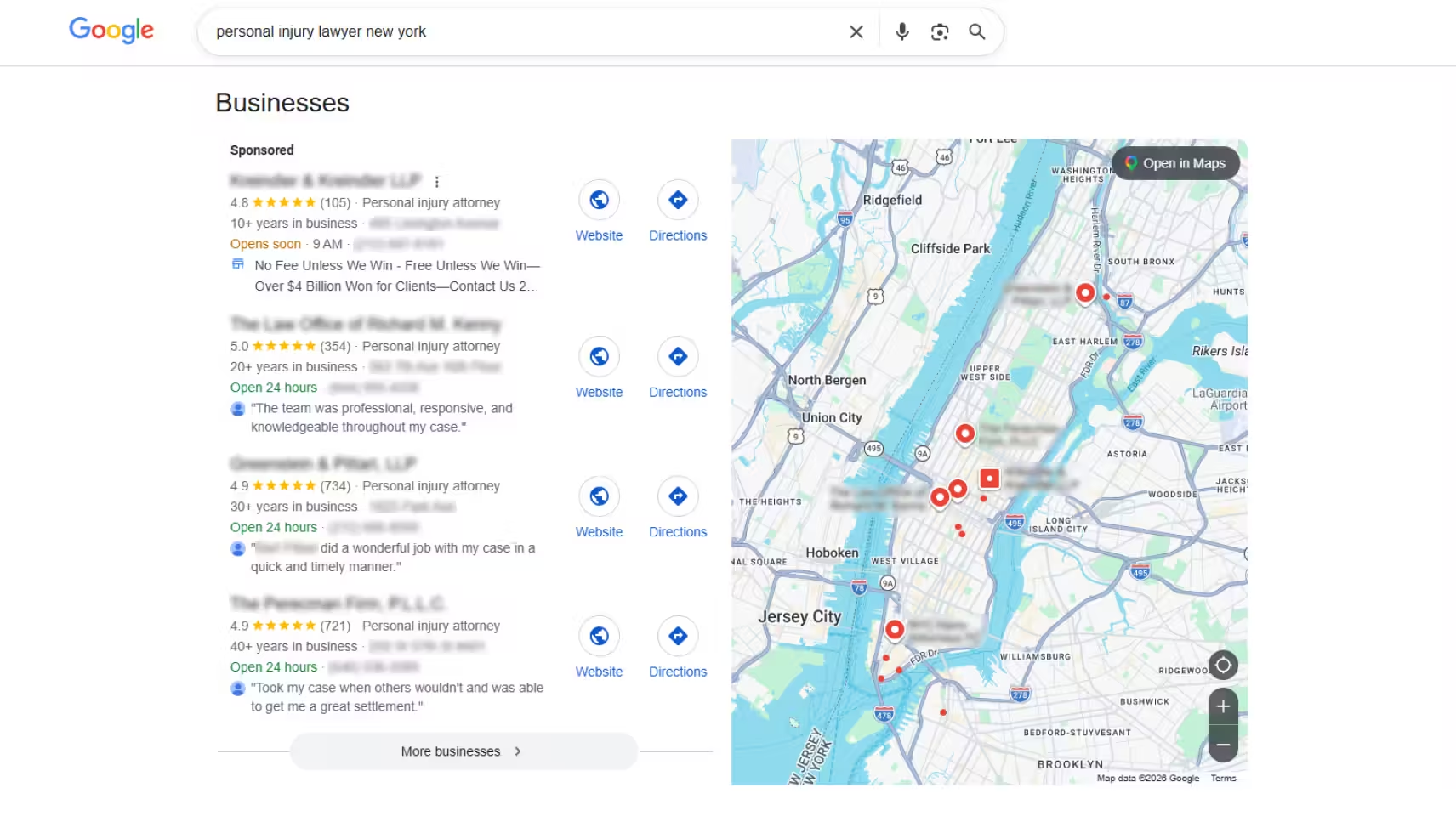
First things first, review your Google Business Profile.
- Choose the most accurate available primary and secondary categories.
- Add the services that genuinely apply to your firm rather than trying to fill every available field.
- Keep your business name, address, phone number, hours, and website accurate and current.
- Create a repeatable process for requesting honest reviews without suggesting keywords or a rating.
- Add authentic photos and videos when they help prospects understand your team and office.
- Use posts when you have something useful to share, not because of an arbitrary weekly quota.
Trust us, this approach to SEO for personal injury lawyers works. Period!
Check out Rice & Kendig’s success. This Louisiana-based PI firm used local SEO and a Google Business Profile to attract 537% more qualified leads. They went from relying on referrals to getting cases non-stop!
Step 2: Target Commercial Personal Injury Keywords
Keywords are not like glitter. You can’t just sprinkle them everywhere and hope something sticks.
In personal injury SEO, long-tail keywords can be valuable because they often reveal the case type, location, and intent behind a search.
To choose useful personal injury keywords:
- Group terms by case type, location, and stage of the search journey.
- Match high-intent searches such as “truck accident lawyer in Dallas” to a focused service or location page.
- Use guides and FAQs for questions about process, timelines, audits, and common mistakes.
- Avoid unrelated informational terms that attract job seekers or other low-value traffic.
- Use Search Console, a keyword platform, and intake data together; volume and difficulty are inputs, not fixed cutoffs.
- Write natural titles and headings instead of forcing exact-match geo phrases.
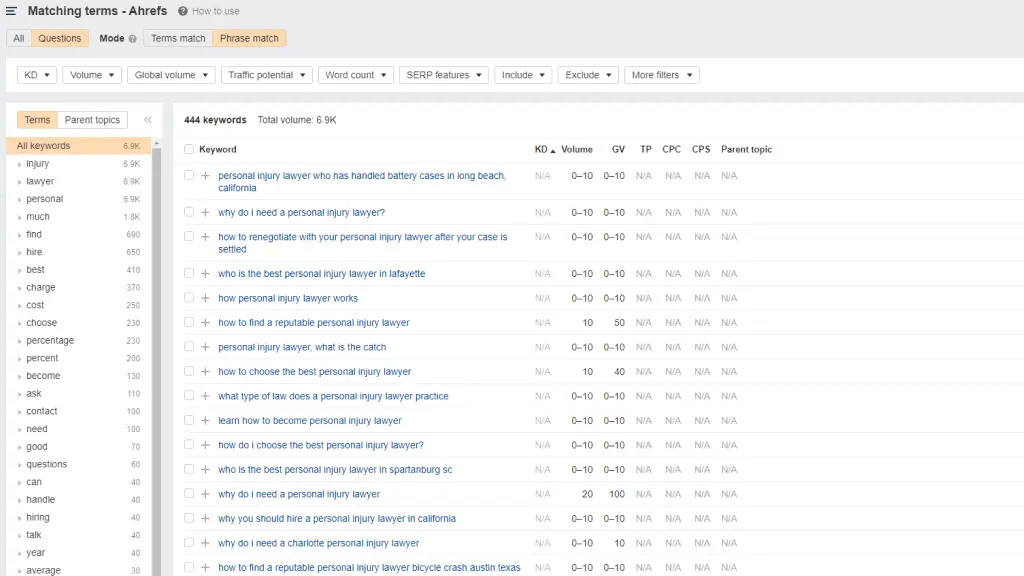
Take your time with this step, as keywords are the lifeblood of a solid personal injury lawyer marketing SEO strategy.
Step 3: Target Informational and Emergency Intent
You are a personal injury lawyer. Who would you rather attract?
- Client A who searches "best injury lawyer near me."
- Client B who searches "how to file a claim after insurance denial."
Trick question — you need both!
But they are at entirely different stages of the client journey. To attract the right cases, you must target the entire spectrum of intent.
- Anticipate every intent. The goal of getting compensation leads to many searches. Accident victims may ask, "Who pays my medical bills?" and "How long does a lawsuit take?"
- Be present at every touchpoint. Visibility on Google Maps, local listings, and legal directories like FindLaw is essential. Clients should be able to find you everywhere.
- Communicate with empathy. Search queries reflect fear, frustration, and stress. Content should be written with clarity and empathy, addressing both the physical pain and providing a clear path to relief.
- Optimize for AI-assisted search by strengthening the same foundations you use for standard SEO. Keep important pages crawlable, use clear internal links, make key information visible in the page text, maintain a strong page experience, and ensure structured data matches the content users can see. Google does not require special AI schema or a separate machine-readable file for AI Overviews or AI Mode. AI-feature traffic is included in Search Console’s Web performance reporting
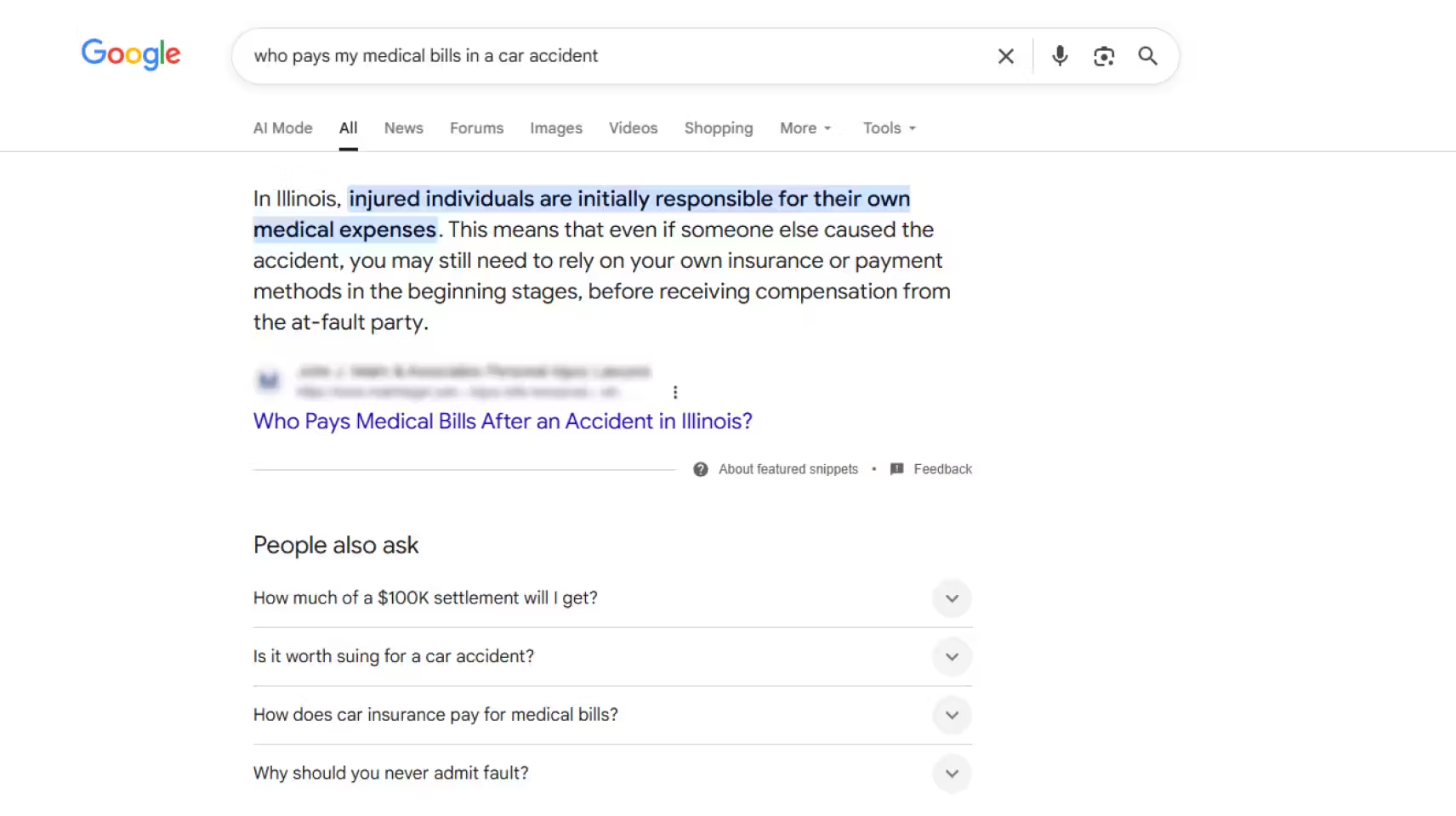
KJT Law Group is living proof of targeting intent.
This California PI firm aligned its site content with its audience’s frustrations, and saw a 405% increase in qualified leads, cutting cost-per-lead by half within 9 months.
If the audit reveals technical, content, local, or measurement gaps your team cannot address internally, review our personal injury lawyer SEO services for implementation support.
Step 4: Build Hyper-Local PI Practice Pages
You have to avoid the fatal mistake of creating a "catch-all" page.
We know, it’s convenient and easy… but trust us, it’s detrimental to your personal injury lawyer SEO!
Google loves relevance and depth in search engine optimization for personal injury lawyers.
If you dump all your services into one massive page or list 20 different towns in a single bulleted list, Google may avoid ranking you altogether.
We suggest building hyper-local landing pages:
- Build separate pages for every service; one for car accidents, one for slip and falls, and one for truck wrecks.
- Create city and service combinations naturally in your headlines, like "Car Accident Lawyer in Dallas" or "Slip and Fall Attorney in Austin".
- Mention local landmarks and neighborhoods (like "near the Dallas Museum of Art" or "serving clients in Downtown Austin") to prove to Google that you have actual physical prominence in that specific community.
- Write useful, location-specific content for each city page rather than swapping only the place name.
- Explain the relevant services and how the firm serves that location.
- Include office or service-area details, intake information, and local proof when appropriate.
- Mention landmarks or neighborhoods only when they genuinely help the reader.
- Add maps or directions when they improve usability, not as a ranking shortcut.
- Use structured data only when it accurately reflects visible business information
- Each location page should give visitors a real reason to use it: local service details, office or service-area information, relevant proof, and a clear next step.
- Feature reviews from local clients on that specific city page to inspire trust with local searchers
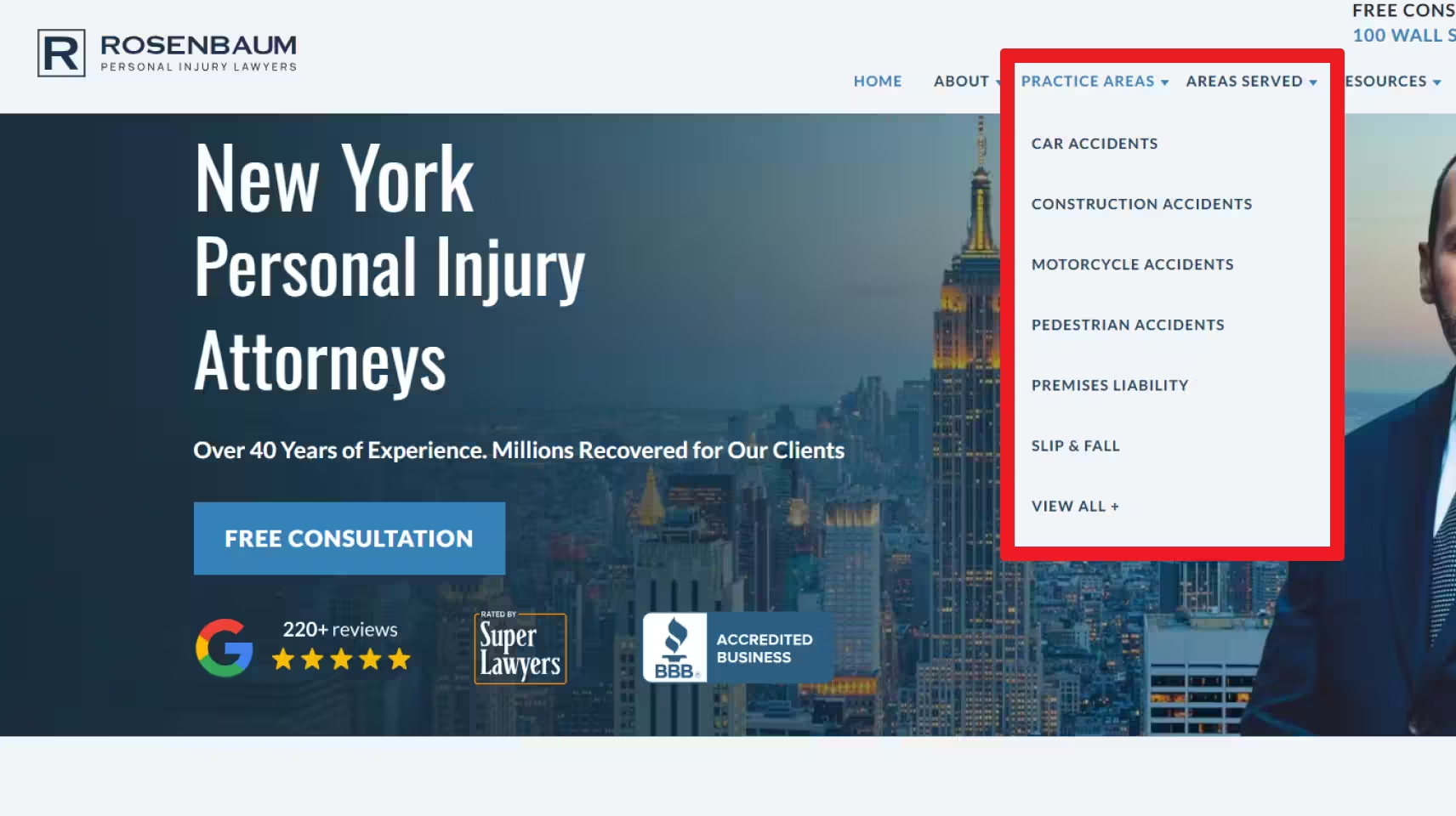
Rosenbaum Law does a fantastic job with 6+ dedicated practice area pages for every service they offer. Take note!
Step 5: Systemize a Robust Review Acquisition Process
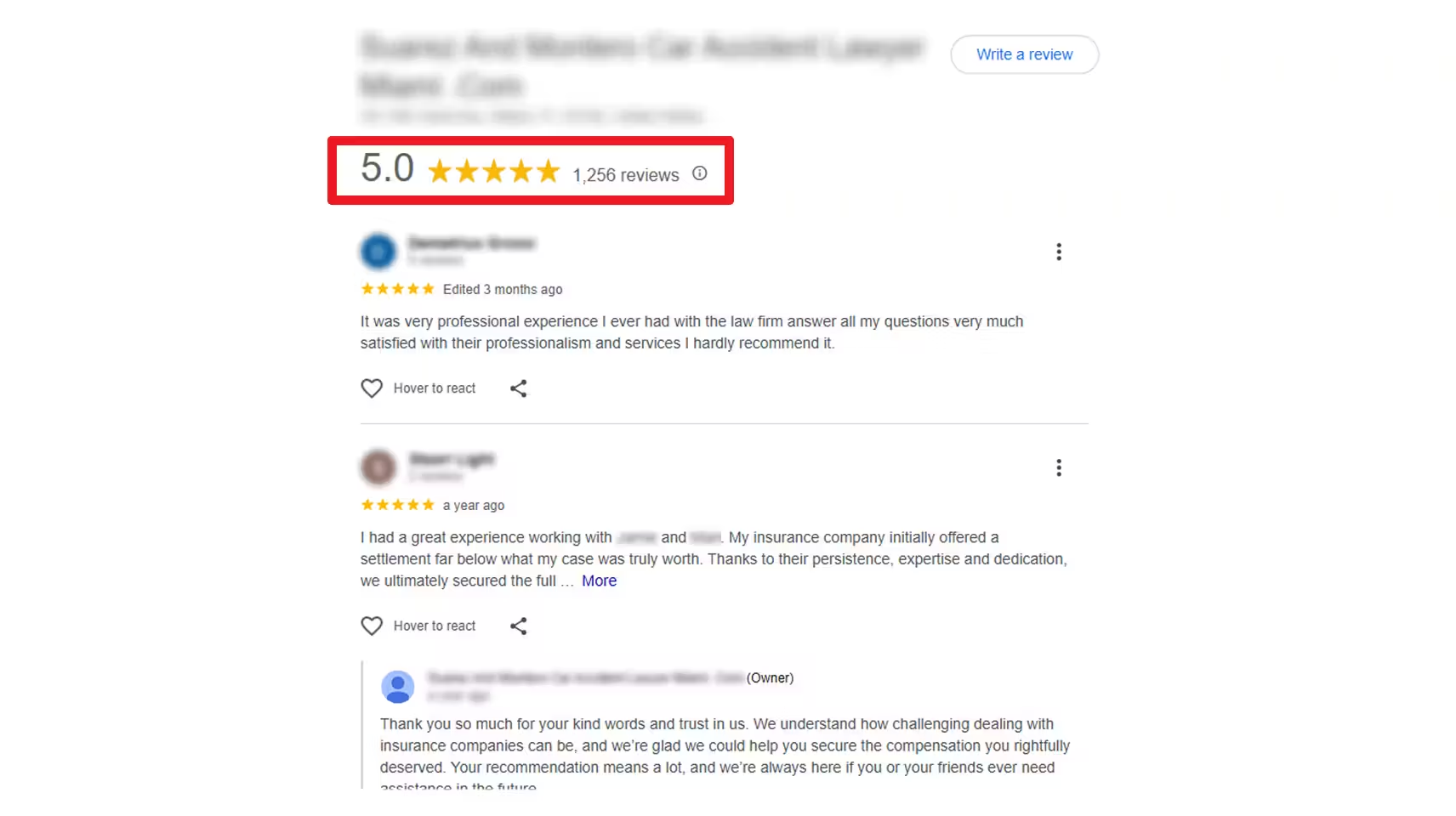
BrightLocal points out that 71% of clients read reviews before hiring a lawyer.
If you do not have a repeatable system for getting those reviews, oof, that’s a major problem.
Asking for a review is awkward and uncomfortable (we know). You do not want to sound desperate or bother a client who just went through a traumatic crash.
But when you do not systemize it, your competitors outpace you on Google Maps, and you lose the trust of high-value leads looking for a proven advocate.
Here’s what we tell all our clients:
- Use 40–80 reviews as an initial benchmark, then compare your profile with the firms ranking in your market. Aim to add 3–5 genuine reviews per month if your case volume supports it.
- Ask clients for honest feedback after an appropriate milestone.
- Make the request easy through the channels your firm already uses.
- Do not ask clients to include specific case-type keywords or a particular star rating.
- Respond helpfully to reviews while protecting client confidentiality.
- Compare your review count, recency, and rating with the firms appearing most often in the local results.
Google says more reviews and positive ratings can help local visibility, but quality, pace, and volume vary by firm and market.
Need a hand? Feel free to copy-paste this review template:
"Hi [Client Name], we are so glad we could successfully wrap up your case and get you your settlement check! If you have 60 seconds, would you mind leaving us a quick Google review? Your feedback helps other people affected by similar accidents find the right support."
Step 6: Optimize for Mobile Conversions
The little metal device in your hand holds power.
It’s where your next client will find you!
So ask yourself: Does my website force a stressed accident victim to pinch, zoom, or fill out a massive 15-field contact form?
If yes, they WILL click the "Back" button and call another lawyer.
Personal injury SEO needs a frictionless mobile conversion path so that highly emotional traffic (like an accident victim) contacts you first.
Apply these strategies to optimize your mobile conversions:
- Implement a sticky "Click-to-Call" button at the bottom of the mobile screen so victims can reach your intake team with a single thumb tap.
- Limit your contact forms to 3 fields (name, phone number, and a brief accident description) to prevent form abandonment from stressed users.
- Feature your "No Fee Unless We Win" promise directly above the fold so desktop and mobile users immediately know there is no financial risk to calling you.
- Add an auto-responder text message to your contact forms so incoming digital leads get an immediate reply before they continue calling other local firms.
As of June 2026, mobile devices generated 51.51% of worldwide web traffic, according to Statcounter. That makes mobile performance impossible to treat as a secondary concern.
- Compress and properly size heavy images.
- Keep click-to-call buttons, forms, and navigation easy to use on smaller screens.
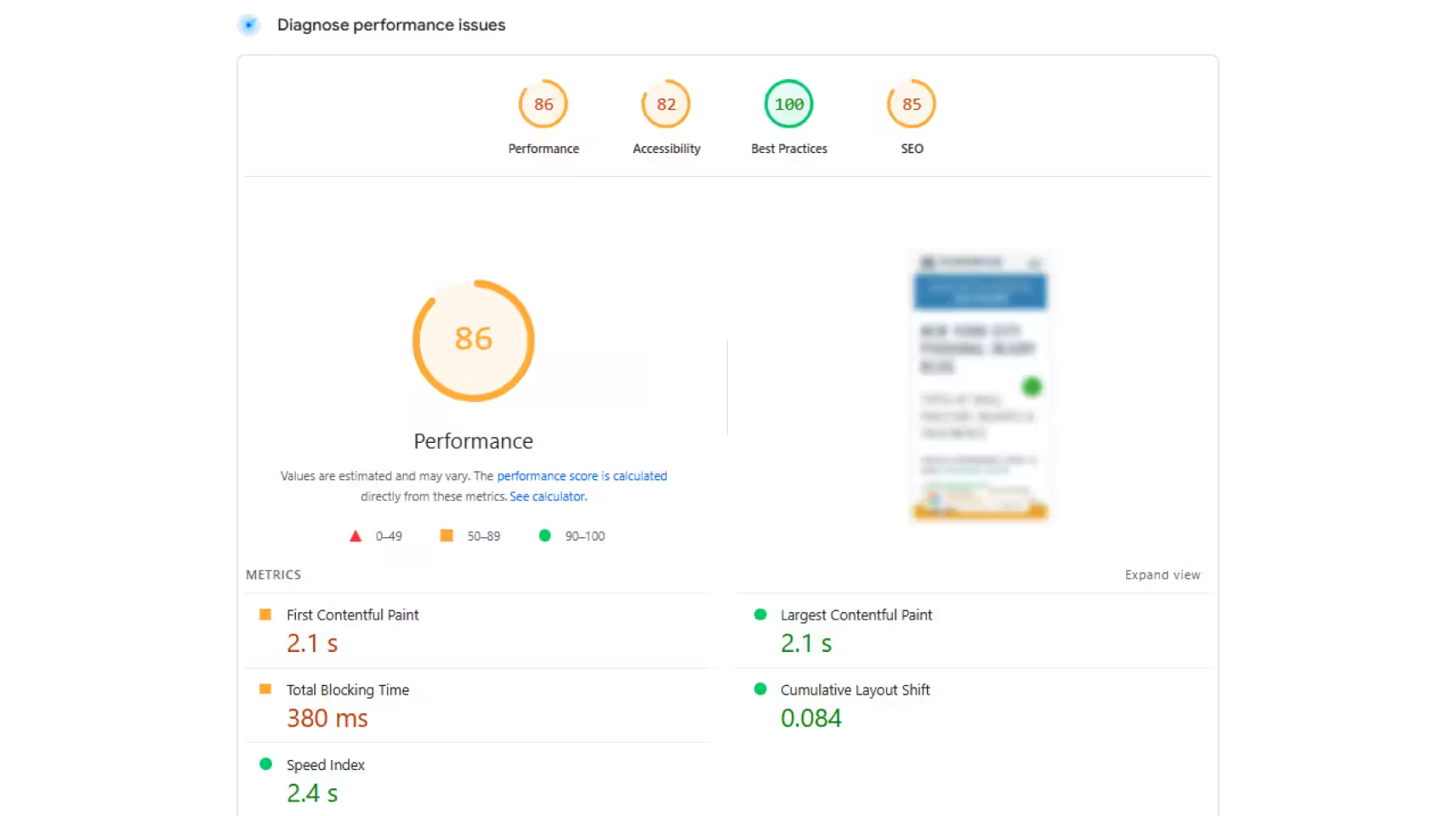
- Use PageSpeed Insights and Search Console to monitor real-user Core Web Vitals.
- As a current reference, “good” thresholds are LCP within 2.5 seconds, INP at 200 milliseconds or less, and CLS at 0.1 or less at the 75th percentile.
- Use the Core Web Vitals thresholds as your technical benchmark and test the real mobile experience on key service and location pages.
Step 7: Track Signed Cases
All that work… but did it bring you clients? Let’s find out.
We always judge our clients’ marketing by signed retainers, never by "vanity metrics" like website traffic, clicks, or rankings alone.
To make sure you are getting an actual return on your investment, follow these steps:
- Use call tracking, analytics, and your CRM to connect SEO activity with business outcomes.
- Track Search Console clicks and queries, Business Profile interactions, calls, and forms.
- Connect qualified leads and signed cases to consistent source and campaign fields where possible.
- Expect some attribution gaps because of privacy and platform limits, and use consistent source and campaign fields across every lead.
- Calculate cost per qualified lead as spend ÷ qualified leads, and cost per signed case as spend ÷ signed cases.
AI Overviews and AI Mode traffic is included in Search Console’s Web performance data rather than a separate AI report.
When these metrics perform well, so does your lead flow!
Grow Law’s Omar Ochoa Law case study reports a 1,087% increase in qualified leads, an 86% decrease in cost per qualified lead, and a 655% increase in organic traffic. It informs you where your next dollar needs to go.
Keep these 7 steps in mind for your search engine optimization for personal injury lawyers.
Critical Website, Content, and Conversion Elements for PI Lawyers
Good SEO depends upon a good website.
There are a couple of key elements you MUST have on your site.
- Use your website to make the next step clear and reduce friction.
- Show relevant results, credentials, and trust signals accurately and in line with advertising requirements.
- Keep the primary call-to-action easy to find without crowding the page with competing pop-ups and forms.
- Make forms and click-to-call actions easy to use on mobile.
- Use real team and office imagery where it improves trust.
- Add captions or transcripts to important video content.
- Monitor Core Web Vitals and avoid intrusive overlays that block the main content.
— A Quick Psychology Lesson…
People don’t read websites. They scan them.
Their eyes move in an F-pattern across the top, then down the side. That means your best stuff (keywords, headlines, offers) should always sit where the eye naturally lands.
That’s exactly how we rebuilt Jacob Fuchsberg's law firm site.
We reorganized their content, structured the keywords around how real humans read, and Jacob Fuchsberg's success spoke volumes. They saw a 196% increase in qualified leads!
So, yes — where you put your words matters. When you speak Google’s language and match how people actually read, you stop chasing clients… and start attracting them.
Still Relying on Referrals?
Risky move! Those could dry up at any moment… taking your business with it. Get a steady, consistent, reliable caseload at Grow Law.
Give Me Leads

Common PI SEO Mistakes That Hurt Rankings and Leads
SEO for personal injury lawyers is a tough nut to crack.
There are about 100 different ways you can jeopardize your own rankings. After reviewing several legal websites, here’s what we see most often.
- Stop chasing generic keywords that do not match your services or market.
- Avoid duplicate location pages that only swap the city name.
- Compress large images and fix technical issues that slow the site down.
- Choose the most accurate available Business Profile category rather than following a universal category rule.
- Review AI-assisted content for accuracy, originality, and usefulness before publication.
- Fix broken internal links and 404 errors.
- Make sure the blog and service landing do not compete for the same commercial keyword.
Google’s spam policies specifically warn against doorway abuse (creation of repetitive pages), scaled content abuse (mass production of low-quality web pages), and keyword stuffing.
Bookmark this page and come back to it when you publish every new piece of content. Make sure you check all of the above boxes.
How Long Does PI SEO Take and What Results Can You Expect?
Personal injury SEO often requires several months of consistent work, but the exact timeline depends on your site’s starting point, competition, technical condition, existing authority, and implementation speed.
A practical planning range is:
- Months 1 to 3: complete the audit, fix priority technical issues, improve tracking, and begin updating key pages.
- Months 4 to 6: look for stronger indexing, visibility, and qualified-lead trends.
- Months 7 to 12: continue expanding useful content, local visibility, and authority while measuring signed-case and revenue impact.
In our experience, established websites may need about six months to see significant SEO results, while a new site in a highly competitive market may need up to a year.
When to Consider Outside SEO Support
You can handle parts of SEO internally, but outside support may make sense when:
- your team is running out of time;
- technical or indexing issues remain unresolved;
- you rely heavily on referrals or paid ads and need a more balanced channel mix;
- you lack capacity to create useful service, location, and educational content;
- traffic is growing but qualified leads and signed cases are not; or
- reporting does not connect marketing activity with intake and revenue.
For an implementation plan, review Grow Law’s personal injury lawyer SEO services.
Turn Your Personal Injury SEO Plan Into Action
Personal injury SEO requires consistent work across local search, content, technical performance, authority, and measurement.
Start by mapping page intent, reviewing your Business Profile and local signals, checking Core Web Vitals, and confirming that leads and signed cases are attributed consistently. Fix the issues that block crawling, local visibility, or conversion before expanding content.
If your team needs help implementing the full program, explore Grow Law’s personal injury lawyer SEO services. For a broader channel plan, see our personal injury marketing services.
Book Your Free Growth Plan Today
Frequently Asked Questions About Personal Injury SEO
Compare Your Practice Instantly
Stay Ahead of the Competition!
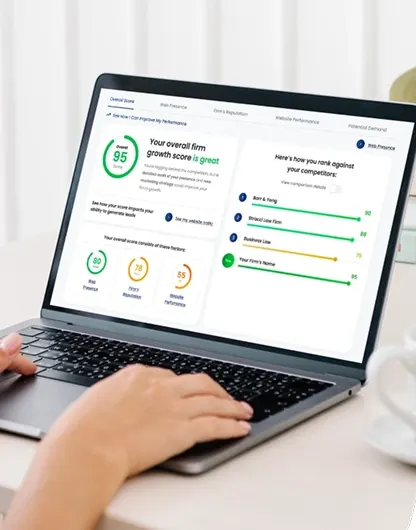
Compare your law firm's performance to Local competitors with our instant assessment tool
Get a clear picture of your firm's performance
Boost your online presence
Compare My Firm
Compare Your Practice Instantly
Stay Ahead of the Competition!
Compare your law firm's performance to Local competitors with our instant assessment tool
Get a clear picture of your firm's performance
Boost your online presence
Compare My Firm
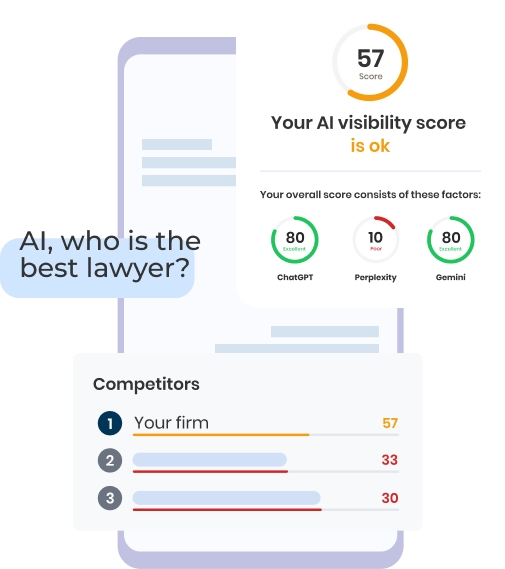
Check Your AI Visibility Instantly
Find Out What AI Is Telling Your Potential Clients
Run our free AI Visibility Report to:
See how often top AI tools mention your law firm
Spot which competitors show up first
Get the next steps to capture more cases
Run My Free AI Report