





Table of Contents
Lawyer SEO, Answered: The 4 Questions Every Firm Asks
1. What Is SEO for Lawyers?
Attorney SEO (search engine optimization) is the process of getting your firm found by people (i.e., potential clients) searching for the exact legal help you offer. Not everyone and not every keyword is a fit. The goal is to show up when a prospective client in your area is ready to talk to a lawyer, then turn that moment into a qualified call. See the 7 factors Google looks at when ranking your firm in our Google ranking factors for lawyers guide.
2. Why Is Legal SEO Different?
Legal SEO is different because people usually search for a lawyer at an urgent moment, often in a crisis. Google treats that content as “Your Money or Your Life” and scrutinizes you more closely for experience, expertise, and trust. You also compete with directories and advertisers for local, high-intent searches. Moreover, your SEO for attorneys must comply with bar advertising rules and attract cases your intake team can sign. Learn more in our E-E-A-T and YMYL for lawyers guide.
3. Where Can a Law Firm Appear?
A law firm can appear in 3 places: organic search results, the Local Pack and Google Maps, and selected AI answers from tools like ChatGPT and Google's AI Overviews. Organic results reward depth and authority, while the Local Pack leans on proximity, your Business Profile, and reviews. AI tools pick their own sources, so no one can guarantee an AI mention, but strong signals improve your odds. Read more in our local SEO for lawyers guide.
4. How Long Does It Take?
SEO timelines depend on where your firm starts and who you're up against. An established site in a mid-sized market can often move faster than a brand-new site in a crowded metro. Technical problems, missing practice-area pages, and inconsistent execution all slow things down. Rather than circling a calendar date, watch for milestones that show real progress. Learn which ones matter in our guide to tracking SEO results.
How SEO Moves a Search to a Signed Case
How does SEO work for lawyers? It begins the moment a prospective client searches for help on Google, often in a crisis.
Your rankings and visibility dictate whether you get found. SEO is responsible for that. Rankings open the door; intake and follow-up close it. The 5 stages below trace the path from search to signed case, and show you where qualified leads can be lost.
- Search demand. A prospective client searches Google, Maps, or an AI assistant for a lawyer or for answers to a legal problem.
- Visibility. Your firm appears in relevant organic results, the Local Pack and Maps, or selected AI answers for that search.
- Qualified inquiry. The prospect contacts your firm by phone or form with a matter that fits your practice areas, geography, and case criteria.
- Consultation & intake. Your intake team qualifies the matter, from a prompt first response through the consultation and clear next steps.
- Signed case. The prospect signs a retainer or engagement agreement, and your CRM or verified intake record links the retained matter to its marketing source.
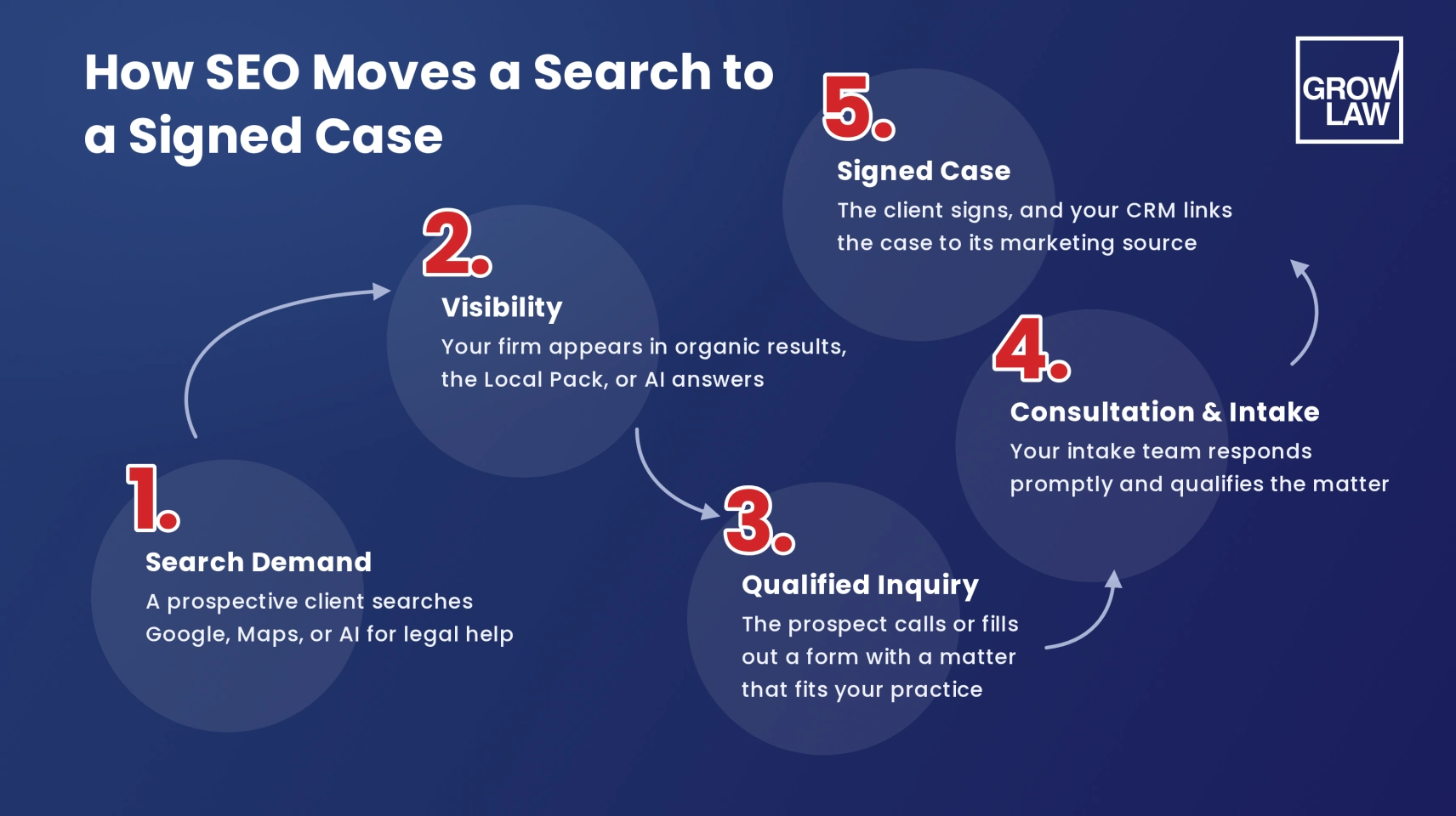
While traffic and form fills are encouraging, the ultimate success of your law firm SEO strategy depends on tracking SEO results through intake and CRM records. That shows which inquiries became retained matters.

Is AI Sending Clients to Your Firm or a Competitor?
Prospective clients now ask ChatGPT and Gemini which lawyer to call. Find out in 2 minutes whether your firm shows up in your market.
Get My Free AI Report
How a Firm's Case Priorities Change Its SEO Plan
Which pages should your firm build first? For one personal injury firm, the answer came from its own caseload: how many matters came in, how quickly they resolved, and which cases it wanted to accept. Here's how those business priorities reshaped its SEO page priorities.
Client input. In October 2024, the firm told us motor vehicle accident cases resolved faster and brought steadier monthly income, while medical malpractice cases moved slowly and often arrived through attorney referrals. So motor vehicle matters took priority.
Priority changes from the October 17, 2024 strategy update (Tier 1 = higher priority, Tier 2 = secondary priority):
- Bus accidents removed from the plan; amputation raised to Tier 1.
- Electrical shock removed; nursing home abuse added.
- Dram shop moved to Tier 2; dog bites moved to Tier 1.
- Boating kept in Tier 2, based on low recorded demand.
Implementation. The October 17, 2024 decisions showed up in the content system months later: amputation and dog-bite pages published in February 2025, nursing home abuse that same month, and 2 city-specific car-accident pages by July.
- Feb 5, 2025: Amputation and dog-bite pages published
- Feb 24, 2025: Nursing home abuse page published
- Jun 3, 2025: City-specific car-accident page published
- Jul 16, 2025: Second city-specific car-accident page published
Takeaway. The lesson: set your page priorities around the cases you actually want. Avoid generic lists. A published page shows the work got done. Only performance measurement shows whether it brings in qualified leads.
Source: anonymized personal injury engagement. Strategy records: October 2024. Publication records: February–July 2025. The example documents delivery, not the SEO lift caused by these changes.
SEO vs PPC for Law Firms
Should you invest in SEO or pay for placement? The honest answer depends on your goals, budget, and timeline.
Either way, you'll need conversion tracking and effective intake to generate more cases from your lead flow. Neither channel always brings in better cases.
Firms often run both, using law firm PPC management for visibility now while SEO builds authority that can compound, and judging both channels by the same lead data.
What Growth Portal Data Shows
Want to know what SEO might realistically do for your firm? Don't judge it by one standout case study. Look at the full picture. Below, you'll see our Growth Portal data from dozens of Grow Law engagements, including firms that later left and months that went backward. For industry-wide numbers on how clients search for lawyers, see our legal SEO statistics.
We track organic-discovery qualified leads (Organic Search + Organic GBP + Organic AI), because that's how law firms measure SEO results worth trusting: by qualified leads and signed cases.
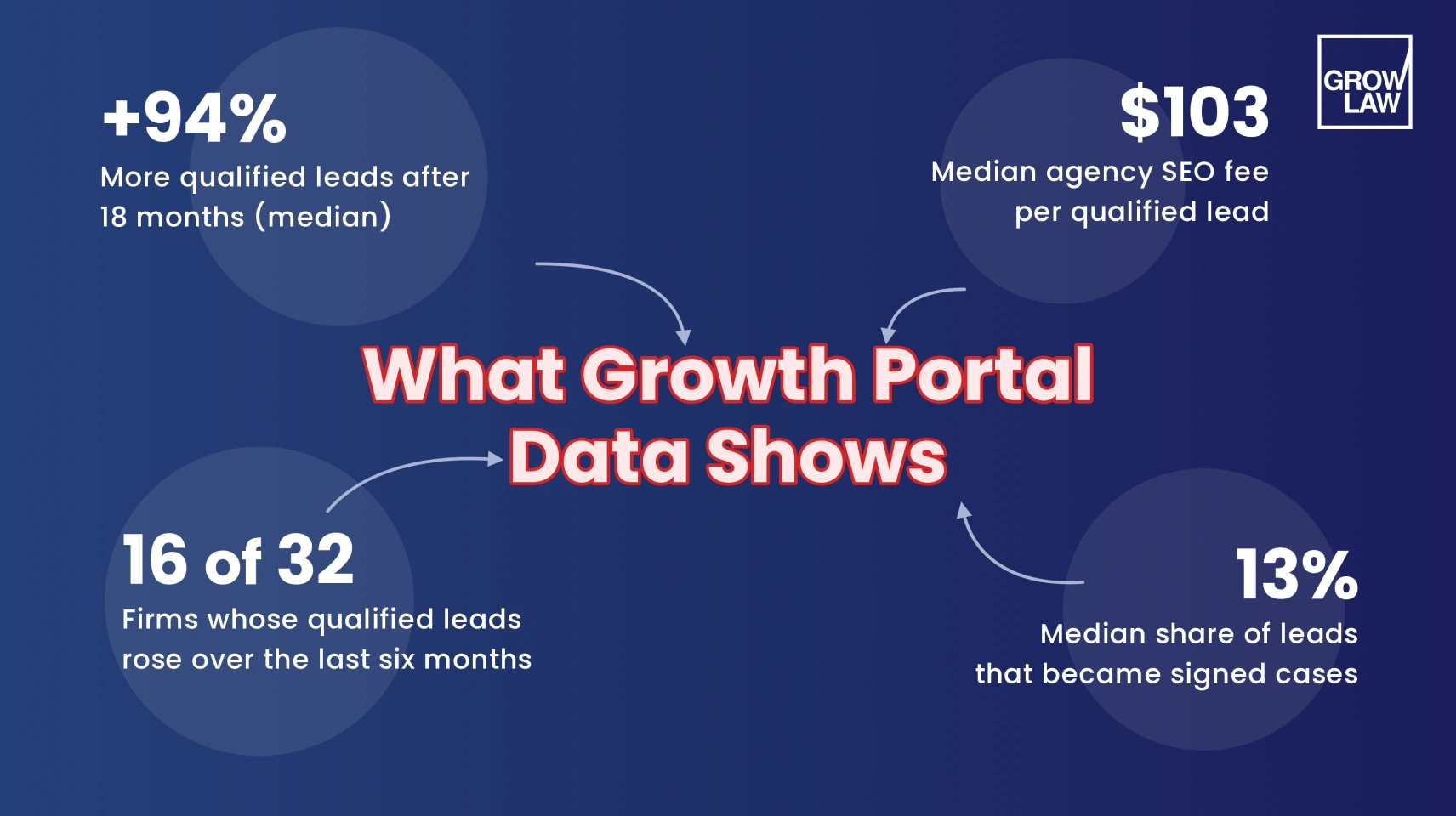
+94%: Median Increase in Monthly Organic-Discovery Qualified Leads After 18 Months
Sample: 17 firms. Period: months 16–18 vs. each firm's first 3 months.
Among law firms with at least 18 consecutive months of organic search delivery, including firms that later ended the engagement, the median firm's monthly qualified leads from organic discovery (Google Search, Google Business Profile, and AI assistants) were 94% higher in months 16–18 than in its own first 3 months; 15 of 17 firms improved.
At 12 months (33 firms): Across 33 active and former engagements with clean baseline alignment, the median firm increased monthly organic-discovery qualified leads by 132% between its first quarter and months 10–12; 29 of 33 improved.
When the lift started (22 firms): Of 22 firms tracked month by month, 20 reached a sustained lift. The median and 75th-percentile firm both reached it in month 4, the earliest point the method can flag. The slowest reached it in month 15.
$103: Median Agency SEO Fee per Organic-Discovery Qualified Lead
Sample: 32 engagements. Period: September 2025–August 2026.
Across 32 engagements, the median agency SEO fee per organic-discovery qualified lead from September 2025 through August 2026 was $103; the middle 50% ranged from $72 to $139. Client-side costs and separately billed website builds are excluded.
16 of 32: Firms Whose Organic-Discovery Qualified Leads Rose From September 2025–February 2026 to March–August 2026
Sample: 32 firms. Period: March–August 2026 vs. September 2025–February 2026.
From March–August 2026 versus September 2025–February 2026, 16 of 32 firms improved, and 16 did not. The median change was +2%, ranging from −59% to +190%.
13%: Median Share of Organic-Discovery Qualified Leads That Became Signed Cases
Sample: 13 firms (13/32, 41% complete data). Period: September 2025–June 2026.
Among law firms with a continuously reporting CRM, a median of 13% of organic-discovery qualified leads became a signed case, with half of firms between 7% and 24%.
Based on the 41% of engagements that have a CRM reporting continuously, measured over 10 months to June 30, 2026. Leads and signed cases are matched on the same channels and the same lead-creation month. Firms that connect a CRM are not a random sample of law firms.
— How to Read This Data
This data comes from Grow Law's Growth Portal, queried September 14, 2026. Direct and other non-paid sources are excluded.
Each firm is aligned to the first month when its SEO project and qualified-lead classification were both live, then compared with its own first 3 aligned months, not a no-SEO control.
The 18-month panel includes 6 later-cancelled engagements, and most engagements also included paid media or a website build.
Lead metrics end August 2026; signed-case metrics end June 2026 so recent lead cohorts can mature. Organic Search alone is too volatile to publish as a benchmark. Read more in tracking SEO results.
— How to Interpret This Data
So, does SEO work for law firms? Over longer engagements, the answer is often yes: 15 of 17 firms with at least 18 months of delivery ended that stretch with more organic-discovery qualified leads than they started with, and 29 of 33 improved by the end of their first year.
Short windows tell a messier story. Over the most recent 6 months, half the firms improved, and half did not, with swings from −59% to +190%. Over shorter periods, competition, algorithm updates, and seasonality can move results in either direction.
These figures describe integrated engagements, most with paid media or website work running alongside SEO, so they show what changed during the engagement, not what SEO caused on its own.
Want to Know Where Your Firm Would Land?
Get a free 30-minute Growth Plan that measures your visibility, lead tracking, and intake against the benchmarks above. No obligation, and you keep the plan.
Get My Growth Plan

SEO Success Stories
— Jacob D. Fuchsberg Law Firm: A $295 Million Track Record, Invisible on Google
If your reputation is stronger in court than on Google, this story will hit home.
Jacob D. Fuchsberg Law Firm, a New York personal injury firm, has 3 generations of legal success, but online, its larger competitors kept taking the spotlight.
Since November 2022, Grow Law has run an integrated organic-growth program for the firm, combining SEO, AI search optimization, web design, content, CRO, and lead generation. Here's what we did, step by step, and what changed.
- Baseline (November 2022). A respected firm, outranked online. The previous agency's spend wasn't paying off, acquisition costs were climbing, the website wasn't converting, and larger competitors dominated search.
- Website redesign and conversion (2023). Rebuilt the site into a conversion-focused platform, with case results and client testimonials placed up front, new funnels and calls to action, and call tracking across every channel.
- SEO and content marketing. Rewrote content, restructured the site architecture, and earned backlinks from reputable legal and local sources to compete in local and statewide search.
- AI search optimization. Structured the firm's content to surface in AI-generated answers and Google AI Overviews.
Results by reporting period:
- +196% monthly qualified leads (Grow Law Growth Portal, February 2023–January 2026; absolute values are under NDA).
- +200% monthly organic traffic, 2,473 → 7,426 (Semrush estimate, February 2023–January 2026).
- Ranking keywords: roughly 2,000 → 14,000+ (Semrush, over the engagement).
- AI-driven monthly traffic: 170 → 1,200 (+606%) (Grow Law Growth Portal, 2024–2025).
- 980% average marketing ROI (published success story, February–April 2026).
Partner since November 2022. Results updated June 2026. Data last verified June 2026. All figures reflect non-paid channels.
Read the Jacob D. Fuchsberg Law Firm Success Story
— Omar Ochoa Law Firm
Context: A McAllen, Texas firm with a strong local reputation wanted to reach clients across Texas, beyond the McAllen/Brownsville area.
Intervention: New SEO-focused practice-area pages and an ongoing content campaign built to raise the firm's visibility statewide.
- +331% ranking keywords, 1,000 → 4,307 (Semrush, July 2023–June 2025).
- +655% estimated organic traffic, 939 → 7,089 (Semrush, July 2023–June 2025).
Semrush figures are third-party estimates, not the firm's own analytics. The engagement also included a website redesign, so these results reflect the full program, not SEO alone.
Read the Omar Ochoa Law Firm Success Story
— Newlin Law Offices
Context: A Portland personal injury firm with a 15-year track record trailed larger competitors online and wanted to reach clients across Oregon.
Intervention: Restructured the website to target local and statewide personal injury searches, with a dedicated, location-optimized page for each practice area.
- +575% organic traffic (Grow Law success story, first 10 months of the engagement).
- 106% increase in conversion rate (Grow Law success story, first 10 months of the engagement).
Results cover the first 10 months of an engagement that also included a website redesign and bilingual outreach, so they reflect the full program, not SEO alone.
Read the Newlin Law Offices Success Story
— What Our Clients Say
Hear from our clients directly. These lawyers shared their experience with Grow Law on camera. Each quote links to its original source, so you can watch or read it in full.
“We have actually seen a marked increase, probably 200–300% in qualified leads.”
Mark D. Hodgson, Founder, Hodgson Law Office. Source: Grow Law About Us page · Watch the video
“They have not disappointed at all. My experience has met and even exceeded my expectations.”
Omar Ochoa, Founder, Omar Ochoa Law Firm. Source: Omar Ochoa Law story · Watch the video
“It’s hit the revenue side and helped drive our profitability.”
Andrew Lopez, Founder, Sequoia Legal. Source: Grow Law About Us page · Watch the video
Frequently Asked Questions
Author and Methodology
Written by Sasha Berson. Sasha is Grow Law’s Chief Growth Officer and co-founder; he leads its 95+ person legal-marketing team, co-authored Successonomics with Steve Forbes, and hosts the Grow Law Podcast.
The approach in this guide draws on the experience of Grow Law's leadership team: Ivan Vislavskiy, Co-Founder & CEO, who leads operations, technology, and service delivery; Andy Goldstrom, Principal Advisor, who leads Grow Law Advisory and has spent more than a decade advising professional-services owners; and Mary Grinnan, Law Firm Growth Expert, who brings more than 20 years in sales, marketing, and business development.
The benchmark uses Grow Law Growth Portal data, pulled on September 14, 2026. The main panel includes engagements with at least 18 consecutive months of SEO delivery, including 6 that were later cancelled. Signed-case figures use only the 13 firms with a continuously reporting CRM.
Each firm is measured against its own first 3 months after its SEO project and lead tracking both went live, not against firms without SEO. Lead data runs through August 2026; signed-case data runs through June 2026.
Most engagements also included paid media or a website build, so results show what changed during the engagement, not what SEO caused alone. Last editorial review: October 6, 2026.
Find Out Where Cases Are Slipping Away
Rankings are only the start. You've now seen how SEO for lawyers works, from the first search to the signed retainer.
Where does your firm stand? Get a free Growth Plan.
We'll measure your visibility, qualified-lead tracking, and intake path against the framework on this page, then show you where cases may be slipping away.
Not ready to talk? Explore our law firm SEO services.
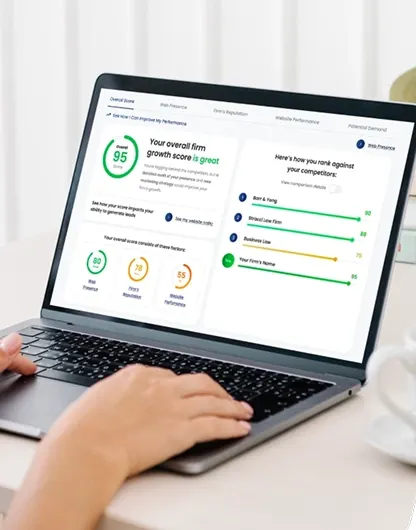
Compare Your Practice Instantly
Stay Ahead of the Competition!
Compare your law firm's performance to Local competitors with our instant assessment tool
Get a clear picture of your firm's performance
Boost your online presence
Compare My Firm
Compare Your Practice Instantly
Stay Ahead of the Competition!
Compare your law firm's performance to Local competitors with our instant assessment tool
Get a clear picture of your firm's performance
Boost your online presence
Compare My Firm
