


Table of Contents
Two agencies can quote the same monthly retainer. One buries their deliverables in vague language. The other spells out page counts, GBP cadence, link quality, and who owns your reporting.
So the question is: How to compare SEO proposals for personal injury law firms? If you're a managing partner, firm owner, COO, or marketing leader, this article will answer that. We’re about to cover how to:
- Document your target case types, markets, and current baseline
- Score every proposal on the same weighted scorecard
- Convert vague deliverables into measurable units before comparing price
- Separate SEO activity metrics from signed-case ROI
- Confirm ownership, contract terms, and cancellation access before you sign
Below, we’ll also break down our personal injury lawyer SEO approach and what an end-to-end practice-specific plan should include.
Key Takeaways
- Score every PI SEO proposal on the same 100-point weighted scorecard: strategy, PI deliverables, specificity, measurement, proof, pricing/ownership, team.
- Document your baseline first (case types, markets, signed-case goals, intake conversion, budget) so every agency responds to the same problem.
- Convert vague phrases like "content marketing" into measurable units (pages/month, GBP posts/week, link source quality) before comparing price
- Separate leading SEO indicators (rankings, traffic, indexation) from business KPIs (signed cases, cost per case, case-value-adjusted ROI)
- Require source-to-signed-case attribution and factor in SEO lag (3-12 months) before judging a new agency's ROI
Define Your Goals and Baseline Before You Compare Proposals
Before you request a single proposal, get specific about what a practice-specific plan needs to solve. You can't score a proposal against a problem you haven't defined.
Our personal injury SEO approach only works because it starts from your baseline.
If you skip this step, every agency you talk to will build their pitch around their own default scope. That's how you end up comparing 3 completely different plans instead of 3 answers to the same question.
Start by writing down what you're trying to fix with your personal injury SEO proposal components:
- Case types and locations. Which practice areas and cities matter most right now? Auto accidents in one metro look nothing like mass tort intake across 5 states. Our guide to a mass tort client acquisition strategy explains how to apply this in practice.
- Signed-case goals. How many new signed cases do you need per month or quarter, not just leads or calls.
- Current organic performance. How many organic leads are you generating today, and from which pages.
- Intake conversion. What percentage of your leads actually convert to signed cases. This number matters more than most agencies will tell you.
- Site condition. Is your current site fast, mobile-friendly, and structured around case types and cities, or is it built around generic service pages.
- Budget. What can you actually commit to monthly, and for how long.
Send agencies the same input table and require them to respond to it directly. If a proposal doesn't reference your numbers, it wasn't built for your firm. Every agency should be solving for the same set of numbers.
| Input | Example Baseline |
|---|---|
| Target case types | Auto accidents, premises liability |
| Target locations/markets | Two metro areas, three surrounding counties |
| Signed-case goal (monthly/quarterly) | 15 new signed cases/month |
| Current organic leads/month | 40 leads/month |
| Intake conversion rate | 25 percent |
| Site condition/platform | Mobile-friendly, built on generic service pages |
| Monthly budget range | $3,500 to $5,000 |
100-Point Personal Injury SEO Proposal Scorecard
Once you have your baseline, score every proposal against the same scale. No exceptions; no proposal gets graded on a curve because you were impressed with the sales deck.
Rate each category from 0 to 5 based on how thoroughly the proposal addresses it. Multiply that score by the category weight to get weighted points.
What is the formula for how to compare SEO proposals for a personal injury law firm?
Formula: Weighted points = (score ÷ 5) × category weight
| Category | Weight | Score (0-5) | Weighted Points | Evidence Notes |
|---|---|---|---|---|
| Strategy and baseline diagnosis | 15 | |||
| PI-specific deliverables | 20 | |||
| Practice and market specificity | 15 | |||
| Measurement and attribution | 15 | |||
| Comparable proof | 15 | |||
| Pricing, contract, and ownership | 10 | |||
| Team and governance | 10 | |||
| Total | 100 |
Use the evidence-notes column to write down exactly where in the proposal you found support for each score.
A proposal that scores a 5 on "measurement and attribution" should have a specific paragraph, table, or reporting sample backing it up, not just a mention of "detailed reporting."
What each category should reward:
- Strategy and baseline diagnosis (15 points). Does the proposal reference your actual numbers, or does it read like a template with your firm's name swapped in?
- PI-specific deliverables (20 points). This is the largest category for a reason. Ranking-gap diagnosis, case-type and city architecture, attorney-reviewed content, local SEO and Map Pack work, relevant authority building, AI-search positioning, CRO, and signed-case tracking should all be named.
- Practice and market specificity (15 points). Generic "law firm SEO" language is a red flag here. You want language built around your case types and markets.
- Measurement and attribution (15 points). Does the proposal separate SEO activity metrics from actual signed-case ROI, and can leads be traced to source.
- Comparable proof (15 points). Are case studies from firms with similar practice areas, market size, and timeframe, not just impressive percentages with zero context.
- Pricing, contract, and ownership (10 points). Total cost, contract length, and what you actually own if you leave.
- Team and governance (10 points). Who is named on strategy, content QA, links, technical work, and reporting, not just a generic account manager.
- Deal-breakers sit outside the score. Some issues should disqualify a proposal regardless of how high it scores elsewhere: guaranteed rankings, no data ownership, no named team, or no case studies showing SEO ROI for personal injury attorneys with no attached timeframe. Track these separately from your 100-point total.
| Deal-Breaker | Present? (Y/N) |
|---|---|
| Guaranteed rankings or traffic promised | |
| No ownership of website, content, or data | |
| No named team members | |
| Case studies without dates or timeframes | |
| No access to performance/reporting data |
A proposal can score 85 out of 100 and still be disqualified by a single deal-breaker. Score first, then check deal-breakers before you make a final call.
Skip the Scoring. Start With a Proposal That Already Passes.
Every category on this scorecard is already built into how we scope PI proposals and campaigns from day one.
Skip the read and take action.
Get Your Free Growth Plan

What Every Personal Injury SEO Proposal Should Include
Now you know how to score a proposal; here's what should be on the page you're scoring.
9 personal injury SEO proposal components make up a complete personal injury SEO proposal.
For each, you want 5 things defined: scope, cadence, owner, acceptance criteria, and KPI. A proposal that names the deliverables but skips these details hasn't committed to anything.
| Deliverable | Scope | Cadence | Owner | Acceptance Criteria | KPI |
|---|---|---|---|---|---|
| Baseline audit | Technical, content, and competitive gap analysis specific to your case types and markets | One-time, before strategy is finalized | Named SEO/technical lead | Written audit report with prioritized findings | Audit completion date |
| Case-type + city strategy | Content and page architecture organized by practice area and location | Defined at kickoff, revisited quarterly | Strategy lead | Documented site architecture and target page list | Pages live per case type/city |
| Technical and on-page work | Site speed, indexation, schema, on-page optimization | Ongoing, monthly | Technical SEO specialist | Passing Core Web Vitals, clean crawl reports | Technical issues resolved/month |
| Local SEO and GBP | Google Business Profile management, citations, local pack visibility | Weekly GBP activity, monthly citation audit | Local SEO specialist | GBP posts published, citation consistency score | Map Pack rankings for target terms |
| Attorney-reviewed content | Case-type and city pages, blog content reviewed for legal accuracy | Monthly page/content output | Content writer + attorney reviewer | Attorney sign-off documented per page | Pages published/month |
| Relevant link building | Links from legal, local, or industry-relevant sources | Monthly, quality over volume | Link building specialist | Link source quality report, relevance rationale | Referring domains/month from relevant sources |
| CRO (conversion rate optimization) | Landing page and intake form testing | Ongoing test cycles, monthly reporting | CRO/UX specialist | Documented test results and implemented changes | Conversion rate change over time |
| GEO (AI-search positioning) | Structuring content for AI search engines and answer engines | Ongoing, reviewed quarterly | SEO/content strategist | Visibility in AI search results for target queries | AI-search mentions/citations |
| Reporting | Leads, signed cases, cost per case, ROI, not just clicks and rankings | Monthly, with portal/dashboard access | Account/reporting lead | Client has direct portal access, not just PDF reports | Dollars, leads, signed cases reported monthly |
A proposal that hands you 9 deliverables without cadence, ownership, or acceptance criteria attached is really just a list of SEO services for personal injury law firms.
You should be able to hold every line in this table against what the agency actually sends you.
If any row comes back blank, ask why before you sign.
Normalize SEO Deliverables Before Comparing Price
"Content marketing" is not a deliverable. Neither is "link building." Neither is "ongoing SEO support."
These phrases sound like scope, but they're not. They're placeholders that let an agency price anything and deliver almost anything.
Let’s look at a hypothetical. Say you're comparing 2 proposals:
- $2,800/month for "content and links."
- 3,500/month for “6 attorney-reviewed pages, 2 GBP posts/week, and 4 relevant links"
You're not looking at 2 prices for the same thing.
On price alone, the first looks like the better deal. But it's not comparable yet, because you don't know what "content and links" actually buys you.
Normalize both into the same units before judging which one costs less. Once you do, the higher retainer may turn out to be the cheaper option.
| Vague Wording | Questions to Ask | Comparable Unit |
|---|---|---|
| "Content marketing" | How many pages per month? Blog posts or service pages? Who writes and reviews them? | Pages/month, content type, review owner |
| "Ongoing site updates" | What counts as an update? How many hours are allocated? | Update hours/month |
| "Link building" | What's the source quality? Legal, local, or industry-relevant only? How many per month? | Links/month, source/quality standard |
| "Local SEO" | How often is the GBP profile updated? Posts, photos, Q&A management included? | GBP activity/week |
| "Reporting" | How often do we receive reports? Portal access or PDF only? What's included? | Reporting cadence, access type |
| "Conversion optimization" | How many tests run per month? What's tested, landing pages or intake forms? | CRO tests/month |
| "AI search optimization" | What's tracked? Which queries or AI platforms? How is visibility reported? | AI-search queries/platforms tracked |
Once you have real units, price comparison gets simple. A $2,500/month plan with 4 pages and weekly GBP activity might beat a $4,000/month plan with 2 pages and monthly GBP activity, even though the second number looks bigger on paper.
You're not just buying a service. You're buying a specific, measurable amount of work.
Make every agency tell you exactly what that amount is before you compare what it costs.
Compare Pricing, Contract Terms, and Asset Ownership
Once your deliverables are normalized into real units, price comparison gets easier. But price is still only part of the picture.
4 pricing models show up in most PI SEO proposals, and each one carries different risk.
Retainers. A fixed monthly fee for ongoing work. Most common model, easiest to compare once deliverables are normalized.
As a working example, current Grow Law retainer tiers run $2,500/month for up to 50 keyphrases, $3,500/month for up to 100 keyphrases, and $5,000/month for 150 or more, each including strategy, research, local SEO, content, and reporting.
Packages. Tiered plans based on keyword count, page volume, or market size. Compare what's included at each tier, not just the price jump between them.
One-time work. A single project, like a site audit or migration, priced separately from ongoing SEO. Useful for isolated fixes, not a substitute for continuous strategy.
Performance pricing. Fees tied to rankings, traffic, or leads. Read the definition of "performance" carefully. Ranking for an irrelevant keyword is not the same as a signed case.
For a full breakdown of what drives cost across these models, see our guide to law firm SEO cost.
Beyond the monthly number, a handful of contract terms determine what you're actually agreeing to.
| Term | What to Ask |
|---|---|
| Exclusions | What's not included, and does it require a separate fee? |
| Setup fees | Is there a one-time onboarding or setup cost on top of the retainer? |
| Contract term | Month-to-month, or locked in for 6/12 months? |
| Cancellation | What's the notice period, and are there penalties? |
| Renewal | Does the contract auto-renew, and under what terms? |
| CMS risk | Does the agency use a proprietary platform, or an open CMS like WordPress? |
| Content/data ownership | Do you own the content, leads, and data generated, or does the agency? |
| Export/migration access | If you leave, can you export your site and data without a fight? |
CMS risk deserves extra attention. If an agency builds your site on a proprietary platform, leaving them can mean rebuilding your entire site from scratch.
That single detail should function as a deal-breaker. Website, content, and data ownership, along with cancellation and migration access, need to be confirmed before that proposal is scored on anything else.
At Grow Law, we build your site on Webflow or WordPress and give you full ownership, plus ownership of content, leads, and data, month-to-month engagement, and direct access to performance data. Our guide to choosing a law firm WordPress theme explains how to apply this in practice.
That's not a universal standard, but it's a useful benchmark for what reasonable terms look like.
Before you sign, confirm you know what happens if you walk away. If the answer is unclear, that's your answer.
Evaluate KPIs and ROI for a PI Firm
Rankings and traffic are not results. They're indicators that results might be coming.
The difference is critical in personal injury, where one signed case can be worth more than an entire month's retainer.
Separate every KPI into 2 buckets before you evaluate a proposal. Here are the KPIs that are tied to our recommended SEO services for personal injury law firms:
- Leading SEO indicators. These tell you the work is happening. Indexation, keyword visibility, rankings, and organic traffic all belong here. Useful for diagnosing whether the SEO engine is running, not for proving it's making you money.
- Business KPIs. These tell you whether the work is paying off. Qualified leads, consultations booked, signed cases, cost per signed case, and case-value-adjusted ROI belong here. This is what you actually report to your partners.
- Side note: This is what our Growth Portal nails down. Instead of a monthly PDF full of rankings and traffic screenshots, you get direct, real-time visibility into dollars, leads, signed cases, cost per case, and ROI.
- Require source-to-signed-case attribution. Every lead should be traceable back to the channel that generated it, and every signed case should be traceable back to the lead. If an agency can't connect a signed case to an organic landing page, they can't prove the SEO work is working.
- Require intake feedback in the loop. Your intake team knows which leads convert and which don't. That feedback needs to flow back into reporting, not sit in a CRM no one reviews.
Here's a simple ROI formula to apply to any proposal's projections:
ROI = [(Revenue from signed cases − SEO cost) ÷ SEO cost] × 100
- One caveat: SEO has lag. A case signed this month may have started as an organic lead 3, 6, or 12 months earlier. Don't judge a new proposal's ROI in the first 90 days, and don't let an agency claim early credit for a case that started before they touched your account.
Ask every agency how they attribute leads to signed cases, and how they account for lag in their ROI reporting. If they don't have a clear answer, their KPI reporting probably stops at rankings and traffic.
Verify Case Studies, Team Experience, and Reporting
Any agency can hand you a case study with a big percentage on it. Your job is to check what's standing behind that number before you count it as proof.
A real case study answers 7 questions. If it's missing more than 1 or 2, treat the number with caution.
- Same practice area. A mass tort result doesn't tell you much about auto accident performance.
- Comparable market. A single-market small firm result doesn't predict outcomes for a five-state operation, and vice versa.
- Baseline. What were the numbers before the agency started? Without this, a percentage is meaningless.
- Timeframe. How long did it take to get there? A 500 percent gain over three years reads very differently than the same gain over three months.
- Data source. Is the number pulled from Google Analytics, the agency's own dashboard, or the client's CRM? Self-reported numbers deserve more scrutiny.
- Work performed. What did the agency actually do to produce the result? A vague "we did SEO" answer isn't verification.
- Result. The actual outcome, ideally tied to signed cases or revenue, beyond just traffic or rankings.
Not sure what this looks like? Read our own published results as examples of time-bounded proof rather than headline-only claims:
- Jacob D. Fuchsberg Law Firm. 980 percent average marketing ROI between February and April 2026, alongside 200 percent organic traffic growth and 196 percent qualified-lead growth measured from February 2023 to January 2026. Notice the 2 different timeframes attached to 2 different metrics. That specificity is what makes the number checkable.
- Omar Ochoa. 3,345 percent marketing ROI, 1,000 percent more qualified leads, 170 percent higher conversion rate, and 2,592 percent organic traffic growth. These are large numbers, and they hold up because they're attached to a named firm with a documented starting point.
- Newlin Law Offices. A smaller firm example: 550 percent marketing ROI, 300 percent more qualified leads, 106 percent higher conversion rate, and 575 percent organic traffic growth. Useful if you're comparing your firm's size against a proof point closer to your own scale, rather than a headline number from a much larger operation.
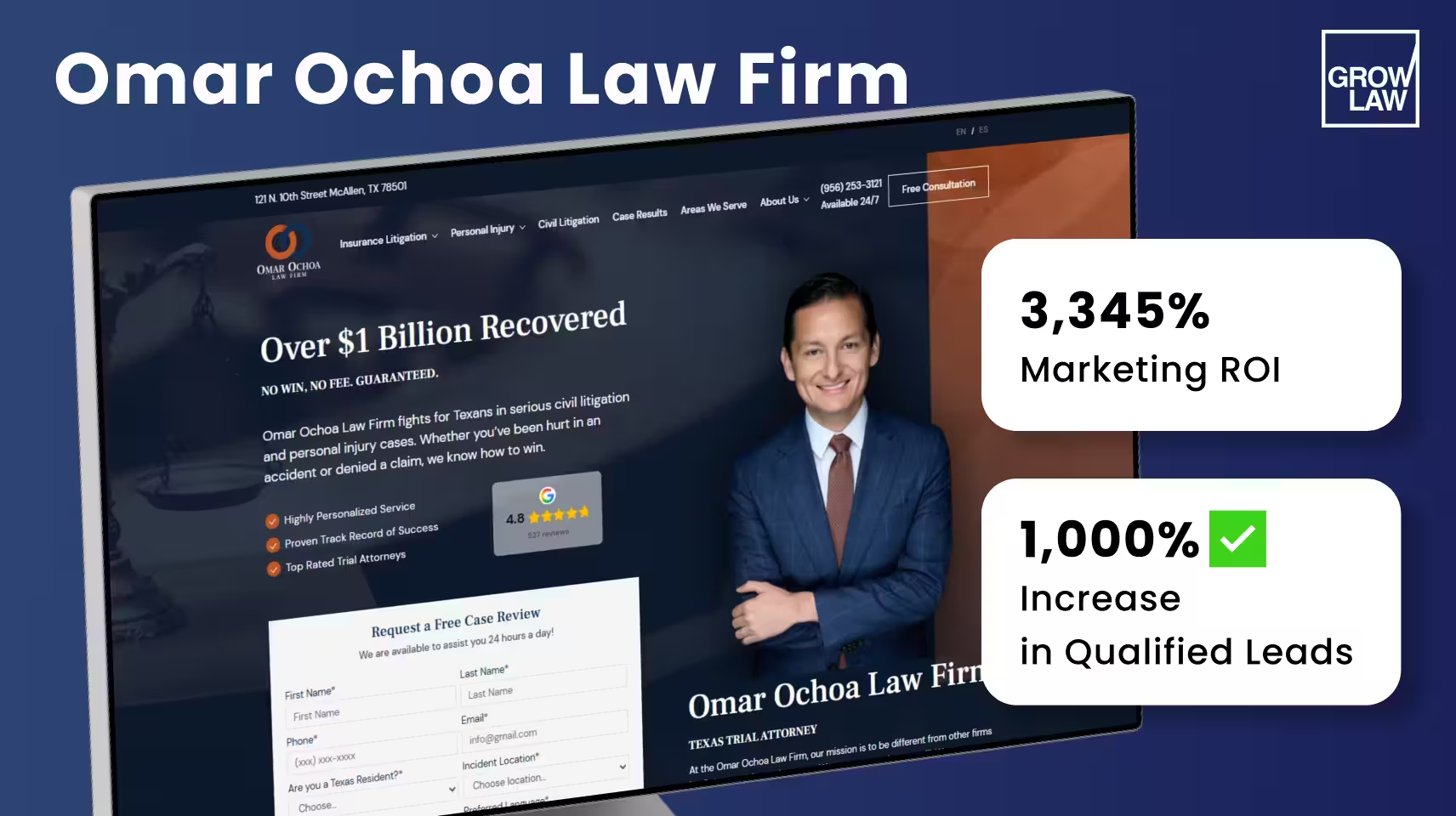
Compare that level of detail against a case study that just says "300 percent traffic growth" with no dates, no baseline, and no named firm. Ultimately, you need to see case studies showing a true, timed SEO ROI for personal injury attorneys.
Ask who's actually doing the work, not just who's presenting it. Get names attached to 5 roles: strategy, content QA, links, technical work, and reporting. A single account manager fielding all 5 questions is a red flag.
If an agency can't name a real person behind each function, you're likely looking at a generalist team stretched across too many accounts.

Want Proof Like Fuchsberg and Ochoa's?
Ask for your own numbers. Every case study in this article comes with a baseline, timeframe, and projected results — the same standard your next proposal should meet.
Get Your Free Growth Plan
9 Red Flags and Questions to Ask Before Signing
Some issues are worth a follow-up question. Others should stop the conversation entirely. Here's how to tell the difference.
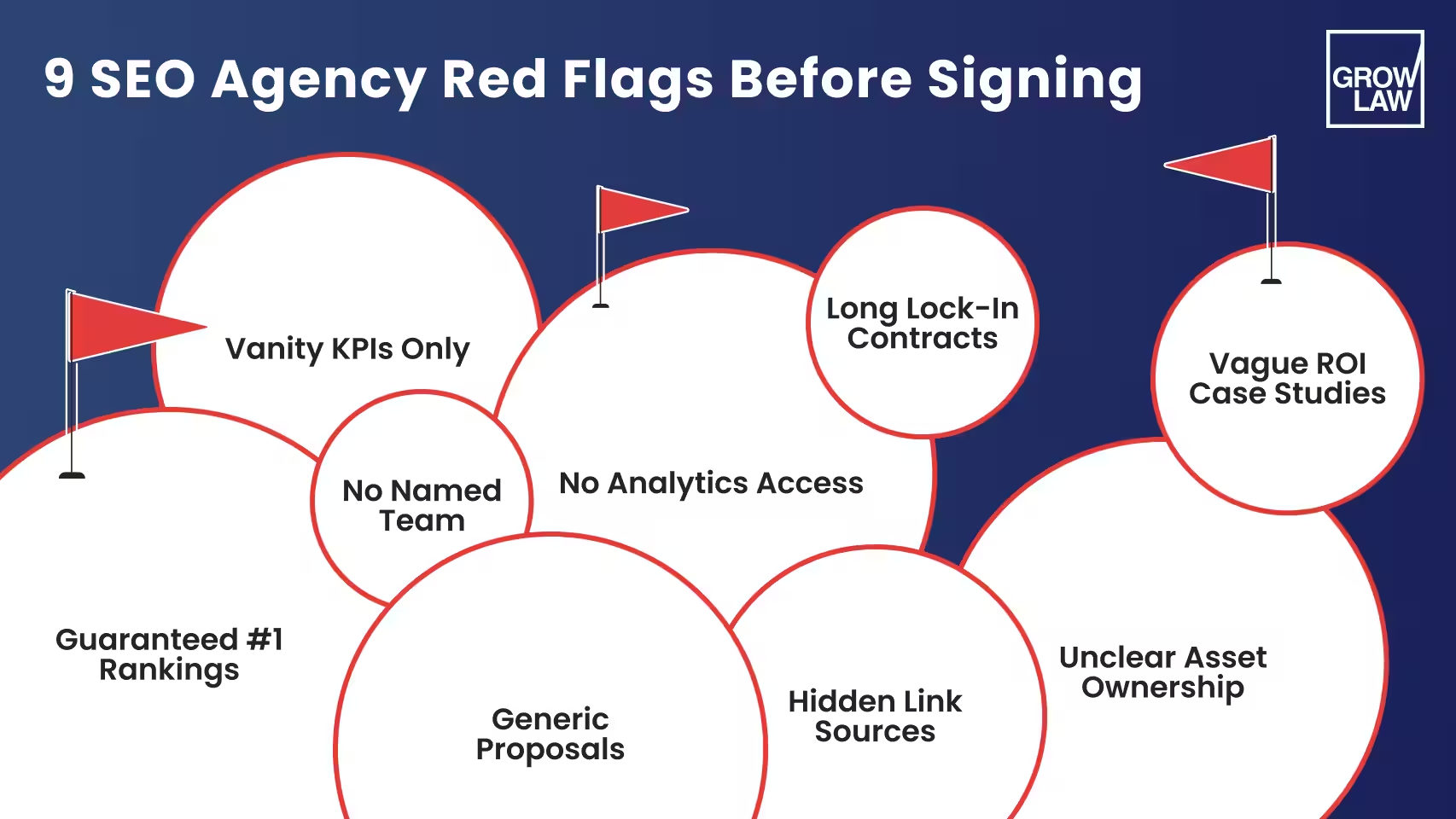
Guaranteed rankings. No agency controls Google's algorithm. A guarantee to rank you #1 is a promise they can't actually keep, and it usually signals tactics that put your site at risk.
Generic scope. Language that could apply to any law firm, or any business at all, means the proposal wasn't built around your case types or markets.
Vanity-only KPIs. If the reporting stops at rankings, traffic, and impressions, with no path to leads or signed cases, you're paying for activity, not outcomes.
Hidden link tactics. Vague references to "link building" with no source or quality standard can mean low-quality or paid links that put your site at risk of a penalty.
No named team. If you can't get real names attached to strategy, content, links, technical work, and reporting, you're likely one of many accounts spread across a small team.
No access. If you don't get direct access to your own performance data, and only receive agency-curated reports, you can't independently verify results.
Long lock-ins. A 12-month contract with no early cancellation option is a bigger risk than a slightly higher month-to-month rate.
Unclear ownership. If it's not explicit in writing that you own your content, leads, and data, assume you don't.
SEO ROI case studies for personal injury attorneys without timeframes. A percentage with no dates attached could represent 3 months of work or 3 years. Don't accept it without both.
Before you sign anything, ask the agency these 10 questions directly:
- What were your baseline numbers before you started work with your most comparable case study?
- How many pages, GBP posts, and links do we get per month, specifically?
- Who is the named person responsible for our content QA?
- How do you attribute a signed case back to an organic lead?
- What happens to our website and content if we cancel?
- Is our reporting a live portal, or a monthly PDF?
- What's included in the base retainer, and what triggers an extra fee?
- How long is our contract term, and what's the cancellation notice period?
- Can you walk us through how you account for SEO lag in ROI reporting?
- What CMS is our site built on, and can we export it if we leave?
If an agency hesitates on more than 2 or 3 of these, that hesitation is itself an answer.
Get an SEO Proposal That Ties to Cases and Revenue
If you want a real ROI from your personal injury SEO, you need an agency that builds around your actual case types, markets, and intake numbers.
At Grow Law, we built every PI SEO growth plan around what this article asks you to score for: practice-specific architecture, attorney-reviewed content, and reporting tied to signed cases, over “vanity metrics” like traffic or rankings.
Our PI clients have seen results like 980% average marketing ROI (Jacob D. Fuchsberg Law Firm, Feb–Apr 2026) and 3,345% marketing ROI (Omar Ochoa), each backed by a documented baseline and timeframe.
Ask for your proposal, and we’ll take it from there. Get Your Free Growth Plan
Frequently Asked Questions (FAQs)
-
What should be included in a personal injury SEO proposal?
A complete proposal includes a baseline audit, case-type and city strategy, technical and on-page work, local SEO and GBP management, attorney-reviewed content, relevant link building, CRO, AI-search positioning, and reporting tied to signed cases. Each deliverable should specify scope, cadence, owner, and acceptance criteria, not just a general description of the service. Our guide to a local page QA checklist explains how to apply this in practice.
-
How to compare SEO proposals for personal injury law firms?
Start by defining your baseline: case types, markets, signed-case goals, and budget. Normalize vague deliverables into measurable units, then score every proposal against the same weighted categories covering strategy, deliverables, measurement, and proof. Compare total cost against contract terms and asset ownership before making a final decision.
-
What should I look for in a law firm SEO proposal?
Look for specificity tied to your practice areas and markets, not generic language. Confirm the proposal names real deliverables with cadence and ownership attached, separates activity metrics from signed-case ROI, and includes verifiable case studies with baselines and timeframes. Unclear ownership or vague scope are signs to dig deeper.
-
How to evaluate SEO deliverables in a proposal?
Convert vague phrases like "content marketing" or "link building" into comparable units: pages per month, GBP activity per week, link source quality, and reporting cadence. A proposal that only describes services without units or ownership attached hasn't actually committed to measurable work.
-
What are red flags in a personal injury SEO proposal?
Watch for guaranteed rankings, generic scope that could apply to any business, KPIs that stop at traffic and rankings, no named team members, no access to performance data, long contract lock-ins, unclear content or data ownership, and case studies with no baseline or timeframe attached.
-
How to compare SEO pricing between agencies?
Normalize deliverables into the same units before comparing monthly cost. Then compare contract terms alongside price: exclusions, setup fees, contract length, cancellation notice, renewal terms, and what happens to your site and data if you leave. A lower price with a long lock-in and unclear ownership can cost more long-term.
-
What SEO KPIs should be included in a proposal?
Separate leading SEO indicators, indexation, rankings, and traffic, from business KPIs: qualified leads, consultations, signed cases, cost per signed case, and case-value-adjusted ROI. A proposal should report both, with clear attribution connecting organic activity to signed cases, not just SEO activity in isolation.
-
How to evaluate SEO ROI for a personal injury law firm?
Calculate ROI as (revenue from signed cases minus SEO cost) divided by SEO cost, times 100. Require source-to-signed-case attribution so leads can be traced to their origin. Account for SEO lag, since a case signed today may trace back to work done months earlier, and avoid judging ROI too early.

Compare Your Practice Instantly
Stay Ahead of the Competition!
Compare your law firm's performance to Local competitors with our instant assessment tool
Get a clear picture of your firm's performance
Boost your online presence
Compare My Firm
Compare Your Practice Instantly
Stay Ahead of the Competition!
Compare your law firm's performance to Local competitors with our instant assessment tool
Get a clear picture of your firm's performance
Boost your online presence
Compare My Firm
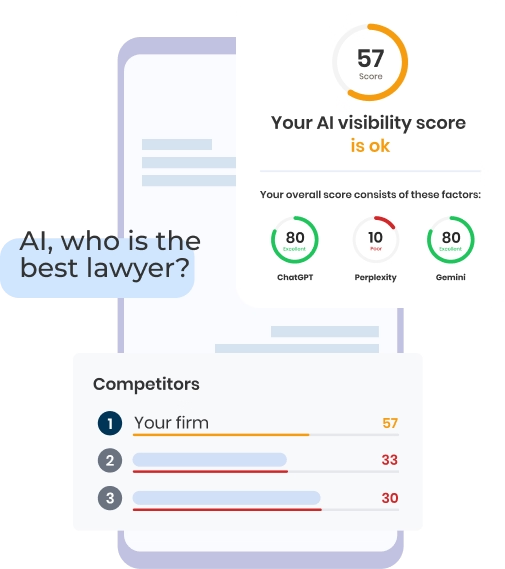
Check Your AI Visibility Instantly
Find Out What AI Is Telling Your Potential Clients
Run our free AI Visibility Report to:
See how often top AI tools mention your law firm
Spot which competitors show up first
Get the next steps to capture more cases
Run My Free AI Report
.avif)
.avif)
.avif)

