


Table of Contents
Service area pages SEO is one of the most misunderstood parts of legal marketing. San Jose law firm marketing needs genuinely local pages built around Bay Area search intent, not templates that simply swap city names. See how San Jose law firm SEO applies that local-first approach beyond templated city copy.
Thin content SEO problems, duplicate location pages with swapped city names, and doorway pages SEO penalties can suppress your law firm's local rankings, not just the pages that triggered the issue.
76% of local searches lead to a direct call or website visit within 24 hours. 75% of users engage only with the top three local pack results.
The difference between a firm that appears in those three results and a firm that doesn't is frequently the quality of their location page content — not their practice area pages, not their GBP, but the specific pages they built for each city they serve.
In this guide, we cover what makes location pages thin, what doorway pages actually are, and why Google penalizes them, what quality local landing pages must include, how to scale location content without duplicating it, how to audit existing location pages, and what mistakes are costing your firm local rankings right now.
Why Local Landing Pages Are the Foundation of Law Firm Local SEO
Without location-specific landing pages, your law firm has no organic entry point for the searches that drive the most conversions: "[practice area] attorney [city]." A GBP listing handles map pack queries — but the organic results that appear beneath the map pack, and the informational queries that precede the hiring decision, require dedicated, indexed location pages with substantive content.
Grow Law built three local landing pages for a law firm and drove 25% of the firm's total organic traffic and 46% of its total conversions through those three pages — in just 3 months. A law firm landing page with a single clear objective can achieve a conversion rate of 8.33%.
Bear in mind, these results aren't from high-traffic broad queries — they're from high-intent location-specific searches that convert because the prospect has already decided they need a lawyer in that city
Grow Law builds local landing pages as part of every local SEO program: Law firm local SEO
Thin Content and Doorway Pages: What Google Penalizes and Why
Google's definition of a doorway page is explicit: pages created primarily for search engines rather than users, designed to rank for specific location or keyword queries without providing meaningful value.
The test is simple — if you removed the city name from the page, would the content be identical to another location page on the same site? If yes, it's a doorway page.
A personal injury firm created 22 location pages by duplicating their main practice area template and swapping the city name in the H1 and a few sentences. Content was 85–95% identical across pages. Within 4 months of publishing, Google began deindexing the thinner variants — only the 3 pages with substantively unique content (local courthouse information, jurisdiction-specific statutes, local case outcome examples) remained indexed.
After rewriting all 22 pages with city-specific content, all pages were reindexed, and local organic traffic increased 180% over 6 months.
| Content Element | Thin Content | Quality Content |
|---|---|---|
| Practice area description | Identical across all location pages — only city name swapped | References local legal landscape, jurisdiction-specific rules, common case types in that market |
| Local information | Generic: "We serve clients in [city] and surrounding areas" | Specific: local courthouse, county court procedures, local statutes, notable local case context |
| Trust signals | No location-specific attorney or office reference | Attorney licensed in that state/county, local bar association, local office if applicable |
| CTA | Generic: "Contact us today" | Location-specific: "Austin clients: call [local number]" or "Serving [county] — free consultation" |
| Internal links | Isolated — no links to or from practice area pages | Bidirectional links to all relevant practice area pages |
The doorway page test is simple: remove the city name from the page. If the content is now identical to another location page on your site, Google sees a doorway — and will eventually penalize or deindex it.
What Every Law Firm Local Landing Page Must Include
To build a quality law firm location page, you must satisfy two standards simultaneously: it provides genuine value to a user searching for legal help in your specific city, and it gives Google enough location-specific signals to rank it for high-intent local queries without triggering thin content or doorway page filters.
| Element | Required | SEO Purpose | Conversion Purpose |
|---|---|---|---|
| Location-specific H1 | Yes | Signals geographic relevance for "[practice area] attorney [city]" queries | Immediately confirms to prospect they found the right page |
| Unique practice area content | Yes | Prevents thin content / doorway page classification | Demonstrates specific knowledge of local legal context |
| Local legal landscape | Yes — at least 1–2 paragraphs | Topical depth for local queries; E-E-A-T signal | Builds trust by showing local expertise, not just presence |
| Local trust signals | Yes | E-E-A-T — bar admission, local court experience, local office | Reduces hesitation; prospect wants a local attorney, not just any attorney |
| Attorney photo + local context | Recommended | Entity recognition for local attorney queries | Humanizes; "X has served [city] clients for Y years" converts |
| Embedded Google Maps | Yes | Local SEO signal; confirms physical/service area presence | Usability — prospect can confirm firm serves their area |
| Location-specific CTA | Yes | Conversion signal | Generic CTAs convert lower; location-specific CTAs feel tailored |
| Internal links to practice area pages | Yes | Passes authority; supports site architecture | Navigation — moves prospect toward most relevant conversion page |
Grow Law builds quality-assured location pages as part of its local SEO programs: local SEO services for law firms
Service Area Pages SEO: How to Scale Location Content Without Thin Content
It’s challenging to scale multi-location firms. A firm serving 20 cities cannot write 20 fully unique 1,500-word pages from scratch in a single sprint. But it also cannot publish 20 near-identical pages without triggering thin content issues. We recommend a tiered content investment model based on market priority.
| Location Type | Content Investment | Minimum Unique Content | Internal Linking Priority |
|---|---|---|---|
| Primary market (firm office location) | Full investment — 1,200–1,500 words, full unique content, attorney photo, local case context | 100% unique — no template carryover | Highest — link from homepage, all practice area pages, and adjacent city pages |
| Secondary market (high-value city, no office) | Medium investment — 800–1,000 words, 50%+ unique content including local legal landscape | At least 50% unique — local statutes, courthouse, local context required | High — link from practice area pages and primary market city pages |
| Tertiary market (served area, lower volume) | Light investment — 500–700 words, 40% unique content minimum | 40% minimum — at least jurisdiction context and local trust signals | Medium — link from practice area pages; omit from homepage nav |
Thin content won’t cut it. You need unique sections to scale your local landing pages SEO. This should cover local legal landscape (jurisdiction-specific laws or procedures), local court or venue context, local case statistics or outcomes, and location-specific attorney context.
These sections cannot be templated — they must be researched and written individually for each market.
Texas Horizons Law Group used a structured local content strategy as part of their Grow Law SEO program and achieved a 510% marketing ROI and 494% increase in qualified leads in 6 months. Yarborough Law Group's location and practice area content architecture produced 857% marketing ROI, 452% more qualified leads, and 2,938% organic traffic growth.
.avif)
How to Audit Law Firm Location Pages
A location page audit covers five dimensions: indexation, duplicate content, conversion performance, traffic performance, and technical quality. Run through them in order — earlier issues often explain failures you find later.
| Audit Area | What to Check | Tool | Red Flag Threshold |
|---|---|---|---|
| Index status | Are all location pages indexed? Are any deindexed or soft-404? | Google Search Console → Pages → Not indexed | Any location page not indexed with no redirect |
| Duplicate content | What % of content is shared across location pages? | Siteliner (free); Copyscape | 70%+ content overlap between any two location pages |
| Conversion rate | What % of location page visitors submit a form or call? | Google Analytics 4 conversion events by page | Under 2% conversion rate (practice area pages typically 3–5%) |
| Traffic performance | Impressions but no clicks = title/meta issue; no impressions = not ranking | Google Search Console → Search Results → filter by page | Pages with 0 impressions after 3+ months indexed |
| Mobile performance | Page load time on mobile; Core Web Vitals | Google PageSpeed Insights | LCP > 2.5 seconds; mobile score < 80 |
A family law firm had 14 location pages generating traffic but converting at 1.2% — far below the firm's 3.8% practice area page rate. An audit found: no attorney photo, generic CTAs, no local trust signals, and page load over 5 seconds on mobile. After adding attorney photos with local context, location-specific CTAs, local trust signals, and technical fixes, location page conversion rate increased from 1.2% to 3.4% — nearly tripling leads from existing traffic without new content or new pages.
Track location page performance in Google Search Console filtered by page URL pattern (e.g., all URLs containing "/locations/" or "/[city]-attorney"). This shows impressions, clicks, and average position for each location page individually. It’s the fastest way to identify which pages are underperforming.
Local Landing Pages SEO: Common Mistakes and How to Fix Them
These five location page mistakes are consistent across law firm SEO audits. Each one either suppresses rankings directly or limits the conversion rate on the traffic the pages already receive.
- Duplicate content across location pages. The single most common issue — city-swapped templates with 80%+ identical content. Fix: audit with Siteliner, prioritize unique rewrites by market value, and invest in local content for primary markets first.
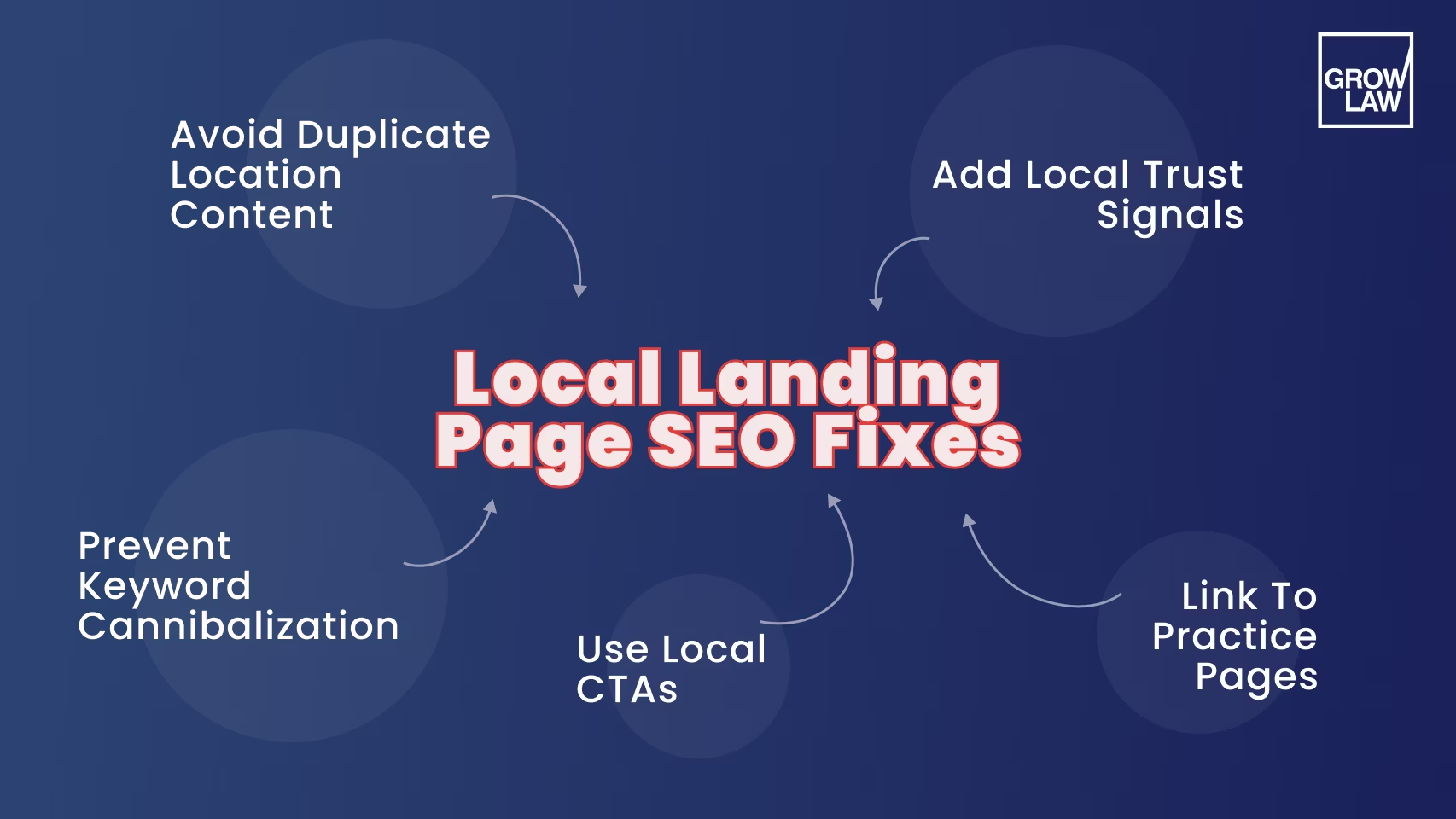
- No unique local trust signals. Location pages that could be for any city with a name change don't communicate local expertise. Fix: add attorney bar admissions for that state/county, reference local courts, and include at least one local case context or statistic.
- No internal links to practice area pages. Location pages isolated from the site's authority structure can't rank for high-intent queries. Fix: add 2–3 internal links from each location page to the corresponding practice area pages with descriptive anchor text.
- Generic CTAs on location pages. "Contact us today" on a location page converts lower than location-specific copy. For Austin law firm SEO, use a location-specific CTA such as "Austin clients: call [local number]" instead of a generic "Contact us today."
- Keyword cannibalization with the main practice area page. If the location page and the main practice area page target overlapping queries, they compete with each other and neither ranks as well as it should. Fix: ensure the location page targets "[practice area] attorney [city]" while the main page targets "[practice area] attorney" broadly.
Summary
- Service area pages SEO requires location-specific content that provides genuine user value, not templates with swapped city names. Google's doorway page filter will deindex thin location pages regardless of GBP strength.
- The doorway page test: remove the city name. If the content is identical to another location page, it will eventually be flagged. At least 40% of content must be location-specific — 50%+ for secondary markets, 100% for primary markets.
- Every quality location page must include: location-specific H1, unique local legal landscape content, local trust signals, attorney photo with local context, embedded map, location-specific CTA, and internal links to practice area pages.
- Location pages SEO scales through a tiered content model: full investment for primary markets, medium for secondary, lighter for tertiary — with minimum unique content thresholds at each tier.
- Location page audit covers five dimensions: index status, duplicate content, conversion rate, traffic performance, and mobile technical quality. Run the audit before building new pages.
- The fastest conversion win on underperforming location pages: add attorney photo with local context, make CTA location-specific, add internal links to practice area pages. One family law firm went from 1.2% to 3.4% conversion rate with these three fixes alone.
Ready to build location pages that rank and convert for every market you serve? Explore our law firm local SEO agency.
Frequently Asked Questions
-
What makes a law firm local landing page thin?
What makes a law firm local landing page thin is content that is predominantly identical to other location pages on the same site, typically a practice area description with the city name swapped in the H1 and opening paragraph. Google's quality systems identify thin content when 70%+ of a page's content is duplicated from other pages. Thin location pages may be indexed initially but are often deindexed or suppressed in rankings as Google's crawling reveals the content pattern across the site.
-
Are service area pages bad for SEO?
Are service area pages bad for SEO — no, when built correctly. Service area pages are essential for law firms serving multiple markets. The issue is not the pages themselves but how they're built. Location pages with substantive unique content (local legal landscape, local court context, local trust signals) rank well and convert high-intent local searches. Location pages built as templates with swapped city names are doorway pages. They either don't rank or get deindexed. The quality of the content, not the existence of the pages, determines the outcome.
-
How to avoid doorway pages for law firm SEO?
How to avoid doorway pages for law firm SEO requires meeting three standards on every location page: meaningful unique content for that specific location (at least 40% of total content unique), genuine user value beyond ranking (the page should help a prospect understand why the firm is the right choice in that specific city), and clear differentiation from other location pages on the same site. The practical test: remove the city name. If the remaining content is identical to another location page, it needs unique content before publishing.
-
How to audit law firm location pages?
How to audit law firm location pages covers five areas: index status (Google Search Console → Pages → Not indexed), duplicate content (Siteliner scan for content overlap across location URLs), conversion rate by page (GA4 conversion events filtered by location page URLs — under 2% needs investigation), traffic performance (Search Console impressions by page — zero impressions after 3 months indexed means not ranking), and mobile technical quality (Google PageSpeed Insights — LCP under 2.5s and mobile score above 80).
-
What should every law firm local landing page include?
What should every law firm local landing page include: location-specific H1 ("[Practice Area] Attorney in [City]"), at least 2 paragraphs of unique local legal content (local statutes, courthouse, jurisdiction-specific context), attorney photo with local context ("Serving [city] clients for X years"), location-specific CTA, embedded Google Maps, local bar admission or trust signal, and internal links to the relevant practice area pages with descriptive anchor text. These elements serve both the user (confirming local expertise) and Google (providing the location-specific signals needed to rank for high-intent local queries).

Compare Your Practice Instantly
Stay Ahead of the Competition!
Compare your law firm's performance to Local competitors with our instant assessment tool
Get a clear picture of your firm's performance
Boost your online presence
Compare My Firm
Compare Your Practice Instantly
Stay Ahead of the Competition!
Compare your law firm's performance to Local competitors with our instant assessment tool
Get a clear picture of your firm's performance
Boost your online presence
Compare My Firm
Check Your AI Visibility Instantly
Find Out What AI Is Telling Your Potential Clients
Run our free AI Visibility Report to:
See how often top AI tools mention your law firm
Spot which competitors show up first
Get the next steps to capture more cases
Run My Free AI Report
.avif)
.avif)
.avif)

