


Table of Contents
Are you an estate planning attorney? Your next potential client is checking out the first page of Google or asking ChatGPT for a lawyer right now.
If your site is buried, you can kiss that client (and that retainer) goodbye.
SEO for estate planning attorneys is a vital investment in 2026. With the right SEO strategy, you can compete for stronger Google visibility, show up on AI tools (which millions of people use!), attract the right traffic, and book more consultations.
In this guide, you’ll learn:
- What estate planning SEO (search engine optimization) is
- How to implement SEO for attorneys and start ranking on Google
- How Grow Law can help you grow your practice using ROI-first SEO strategies
Let's dive right in.
Key Takeaways
- Audit page ownership before adding more keywords or content.
- Separate planning, trust, probate, litigation, and location intent where your firm actually offers those services.
- Check your Google Business Profile, reviews, citations, and location pages as one local system.
- Verify mobile performance, crawlability, indexation, internal links, and structured data.
- Review credentials, authorship, claims, and third-party authority for trust.
- Measure qualified consultations and source alongside rankings and traffic.
- Fix dependencies first: architecture before scale, tracking before ROI conclusions.
What Is Estate Planning SEO?
Ever wonder why some estate planning law firm websites get all the attention online, popping up at the very top of Google?
That’s SEO for estate planning attorneys in action.
It’s how smart firms get found first when people look up wills, trusts, or "local estate planning searches." And in 2026, if you’re not showing up online, you’re bleeding serious revenue.
Good SEO builds trust, gets you in front of the right people, and keeps you ahead of competitors who are fiercely fighting for the same leads you want.
An estate-planning firm can publish more pages, add more keywords, and still miss the real constraint holding back search visibility. The problem may be unclear page ownership, weak local signals, thin matter coverage, technical barriers, or traffic that never becomes a consultation.
Use this 11-point estate planning SEO audit checklist to find that constraint. Each check explains what to review, what a healthy result looks like, and what to fix next.
For a full strategy covering local SEO, keyword tiers, content, technical foundations, timelines, and measurement, use the comprehensive estate planning lawyer SEO guide. This page is the faster diagnostic: audit first, then prioritize.

If you are interested in enhancing your understanding of SEO for lawyers, we recommend reading our comprehensive guide on the topic.
What Is an Estate Planning SEO Audit?
An estate planning SEO audit is a structured review of whether your firm’s website can be discovered, understood, trusted, and measured across planning, trust, probate, and related searches. It looks beyond rankings to the system behind them: page ownership, local presence, content usefulness, technical access, authority signals, conversion paths, and reporting.
The output should not be a generic list of errors. It should rank issues by impact, effort, and dependency so the team knows which fix unlocks the next one.
Top 11 SEO Strategies for Estate Planning Lawyers
So, how do you go from page 5 of Google to the top spot when someone searches for “estate lawyer near me”?
It’s not magic. It’s a step-by-step SEO strategy built for estate planning attorneys who want real visibility, more traffic, and (ultimately) more clients. Here’s how to make it happen.
— How to Score the Audit
Rate every check from 0 to 2:
0 — Missing or actively harmful.
1 — Present but incomplete, inconsistent, or unmeasured.
2 — Clear, maintained, and connected to the next step in the client journey.
Then label each issue:
- Blocker: prevents crawling, indexation, local eligibility, or reliable measurement.
- High impact: affects a core service, location, or conversion path.
- Improvement: strengthens an already functional system.
Fix blockers first. Among high-impact issues, prioritize the change that improves the greatest number of important pages without creating new duplication.
1. Conduct Estate Planning Keyword Research
Keyword research is the foundation of any solid strategy to climb the search engine results pages. Here’s how to do it the smart way:
- Start with "seed" keywords:
Think about the basics: estate planning, wills, trusts, power of attorney, probate. These are your core terms. - Use keyword research tools to expand your list:
Tools like Ahrefs, SEMrush, and Google Keyword Planner help uncover related relevant keywords, search volume, and ranking difficulty.

- Find long-tail keywords:
Look for more specific, niche phrases like "estate planning for single parents" or "trusts for real estate investors". Less competition, higher intent. - Analyze keyword difficulty:
Focus on keywords with solid search volume and low to medium competition. These give you the best shot at ranking quickly.
Want to find those low-competition gems? Our 2026 guide shows you the step-by-step process for keyword research for estate planning.

- Prioritize your list:
Choose keywords that closely match your services and client intent.
Check 1: Audit Keyword-to-Page Ownership
Export the queries and landing pages already receiving impressions, then compare them with your firm’s approved services and locations. Every important query group should have one primary destination.
Pass if:
- The page matches the searcher’s intent and your firm’s actual service.
- Planning, trust, probate, litigation, and local themes have distinct roles where needed.
- Educational queries lead to guides, while service-seeking queries lead to commercial pages.
Flag if:
- Two pages target the same phrase with the same promise.
- A generic page carries unrelated matters.
- New pages are planned only because a phrase has volume.
Relevance and page ownership come before search volume. Consolidate collisions before expanding the map
Check 2: Audit Service, Location, and Educational Architecture
Review the navigation, URL structure, breadcrumbs, internal links, and calls to action for every priority page. A reader should understand whether a page is a service, a location, or an educational resource without relying on the title tag alone.
Pass if each page has a distinct audience, intent, purpose, reviewer, internal-link role, and next action. Flag pages created by swapping a city or matter name into otherwise identical copy. When two pages cannot justify separate roles, consolidate them and redirect the weaker URL.
- Add them naturally to your site:
Use them in titles, meta descriptions, headers, and page content. Keep it natural... don’t resort to keyword stuffing.
72% of estate planning clients start their search online—Is your firm showing up where it matters? Discover estate planning law statistics to attract more clients!
— How to Maintain the Keyword Map After the Audit
Keep one working sheet with the approved query, intent, primary page, supporting pages, current performance, and next action. Review collisions quarterly and whenever a new service, location, or article is planned.
Do not publish search-volume and cost-per-click exports as a substitute for strategy. Our comprehensive estate planning lawyer SEO guide explains the keyword tiers and page roles in more detail.
2. Optimize Estate Planning Content on Your Website
If your law firm website's content isn’t pulling targeted traffic or converting visitors with the right search intent, watch out... it’s not optimized!
SEO for estate planning lawyers starts with cleaning up the basics like your page titles, headers, page structure, and media.
Use current first-party proof only when it clarifies what a sound foundation can support. HagEstad Law Group expanded its estates and trusts practice from Arizona into Montana after entering the market with low brand visibility. They achieved a 1,610% marketing ROI, a 275% increase in qualified leads, a 67% increase in conversion rate, and a 5,653% increase in organic traffic.
Treat those figures as a named case result, not an audit benchmark. The audit question is whether the site has the architecture, local foundation, content, and tracking needed to measure its own progress.
Want results like that? Focus on content that’s clear, relevant, and built around the terms your future clients are already searching for.
Want to see that kind of growth? Our 2026 guide details the ranking factors for estate planning that drive those results.
Ready to Be the Next Success Story?
Grow Law has worked on over 300 projects, delivering a 400%–800% ROI. You're next!
Contact Us Today

3. Use Local SEO for Estate Planning Law Firms
Want to attract more estate law clients in your city?
Try using local SEO for estate planning attorneys. This zipcode- or city-specific SEO will help surface your firm online when someone nearby searches for help with wills, trusts, or probate. Our guide to estate planning law firm marketing explains how to apply this in practice.

Here’s how to boost your local search engine visibility:
- Set up your law firm's Google Business Profile: Make sure it’s fully filled out — address, phone, hours, photos, reviews, and a keyword-rich description.
- Get listed in local directories: Build citations (mentions of your name, address, and phone) across sites like Yelp, Avvo, and FindLaw. Keep your info consistent.
- Use local keywords: Target phrases like “estate planning attorney in [your city]” across your website titles, content, and meta descriptions.
- Encourage reviews: Ask happy clients to leave reviews. Respond to every review (good or bad) with professionalism.
- Add local schema markup: Help Google understand your location and services better by adding local structured data to your site.
Want a deeper dive? Check out our full local SEO guide for lawyers.
4. Build Location-Specific Landing Pages
Do you serve multiple cities or regions? Don’t just list them — build a dedicated landing page for each one.
This helps your firm rank in local searches like “estate planning lawyer in Pasadena” or “trust attorney near Glendale.”
Pro Tip: Include specific references to local landmarks, neighborhoods, courthouses, or community events to make the content feel relevant and real ("We’re just minutes from the Pasadena Courthouse on Ramona Street").
Be sure to also add your address, contact info, and office hours for each location to boost trust and visibility.
— Check 3: Audit the Local Search System
Review your Google Business Profile, website, major citations, reviews, and location pages together.
Pass if your business information is consistent, the profile points to the correct page, services and categories reflect your firm accurately, reviews are handled through a sustainable process, and each real office has distinct local context.
Flag duplicate profiles, mismatched addresses or phone numbers, thin city pages, review claims your firm cannot support, and local pages with no clear office or service-area purpose. Use calls, forms, direction requests, and qualified consultations to measure local performance rather than treating your Map Pack position as the only outcome.
Drive consistent, quality leads with optimized PPC for estate lawyers strategies
5. Create Authoritative Blog Content
Your blog content is your shining light on the hill. It's what attracts people to you.
To ace SEO for estate planning lawyers, publish helpful, trust-building content that answers real client questions. Write posts like:
- “Do I need a living trust in California?”
- “What happens if someone dies without a will?”
- “Trust vs. Will: What’s the Difference?”

You can also create local guides like “How Probate Works in Maricopa County” or “Estate Planning Basics for Los Angeles Families.”
This kind of content ranks well, builds your authority like nothing else can, and (as a bonus) gives you material to share in emails, ads, or client consultations.
6. Optimize for Mobile Devices and Core Web Vitals
A slow or clunky site on mobile is a flight risk. All the leads you worked so hard to get will leave in a heartbeat.
The numbers prove this: improve mobile performance by optimizing LCP, INP, and CLS, then validate results in PageSpeed Insights and Search Console.

Google prioritizes mobile-first indexing, which means a mobile-friendly, fast-loading site is crucial for strong SEO for estate planning lawyers. Make sure your site is:
- Fully responsive across all devices
- Easy to navigate with thumb-friendly menus
- Loading fast (compress images using tools like Optimizilla)
- Clean and clutter-free for a smooth user experience
Fast, mobile-optimized websites not only rank higher, but they convert better, especially with clients researching legal help on the go.
— Check 4: Audit Technical Access and AI Readiness
Confirm that priority pages can be crawled, indexed, rendered, and reached through normal internal links. Test mobile layouts, Core Web Vitals, canonical tags, redirects, sitemap coverage, structured data, and page templates.
Then review whether your firm and attorneys are represented consistently across bios, service pages, location pages, schema, and credible third-party profiles. Clear entities, concise answers, accurate structured data, and strong source pages help both traditional search engines and AI systems understand when your firm is relevant.
Do not create a separate GEO content silo until the underlying pages are technically accessible and useful to readers.

The Next Legal Client is Looking
Will they find you? At Grow Law, our clients see as many as 1,018% more leads!
Give Me More Leads
7. Develop High-Quality Backlinks
Link building is about earning backlinks from other reputable websites to boost your law firm SEO authority — and yes, it still works!
Here’s how estate planning practices can do it right:
- Guest Blogging: Write helpful content for trusted legal or financial sites. In return, you’ll earn a backlink and visibility with their target audience.
- Directory Listings: Submit your firm to legal directories like Justia, Avvo, and Nolo. These are strong, industry-relevant backlinks that Google loves.

- Broken Link Outreach: Find broken links on legal blogs or resource pages, then offer your content as a clean, working replacement.
- Content Sharing: Post blogs, videos, and infographics to boost your law firm's social media profiles. High-value content gets shared, and shared content earns backlinks.
- Strategic Collabs: Partner with related professionals: CPAs, elder care blogs, and financial advisors, and create joint content that links back to your site.
Want a deeper dive? Read our guide to expert Link Building for Lawyers ›
8. Focus on E-E-A-T (Experience, Expertise, Authority, Trustworthiness)
If you want Google to rank you — and clients to trust you — you need to prove you're legit. E-E-A-T signals help you do exactly that.
Here’s how estate planning lawyers can build their Experience, Expertise, Authority, and Trustworthiness:
- Show off credentials: Include attorney bios with years of experience, bar memberships, and awards.
Share real case studies: Highlight client success stories with outcomes and strategy. - Use testimonials and video reviews: Social proof matters. Feature real client feedback, especially if it’s on video.
- Display logos of recognitions: AVVO, Super Lawyers, State Bar, etc. These boost trust in seconds.
- Author your content: Attach your name and title to blog posts. Google wants to know it’s written by a real expert.
Stacking these trust signals helps boost your visibility and search rankings. It's like jet fuel when it comes to SEO for estate planning lawyers.
9. Leverage Video Content
Video builds trust faster than text... visitors stay on pages with video 88% longer.
Seriously, do not underestimate it. This is your secret edge in SEO for estate planning lawyers.
Create short, helpful explainers like “Wills vs. Trusts” or “How Probate Works in [Your State].”
Post them to YouTube (Google owns it), embed them on your site, and watch your engagement climb. Videos keep people on your page longer, which ultimately boosts rankings and conversions.
Pro tip: Add transcripts and keyword-rich titles for extra SEO juice.
— Checks 5–9: Audit Content and Trust Signals
5. Content usefulness: Does each page answer the next question a planning, trust, or probate prospect is likely to ask?
6. Attorney review: Are jurisdiction-sensitive statements, examples, and calls to action reviewed before publication?
7. Credentials and authorship: Do attorney bios, bar information, experience, and article authorship support the topics being discussed?
8. Reviews and reputation: Are review practices sustainable, privacy-aware, and accurately represented on your site?
9. Authority and formats: Do links, mentions, video, and other formats come from relevant sources and support a real reader need?
Flag generic articles, unsupported claims, copied city pages, decorative credentials, fabricated review markup, and link tactics your firm would not want associated with its reputation.
10. Manage Reviews to Build Trust and Reputation
In estate planning, trust is the whole kit and caboodle. And nothing builds it faster than glowing reviews.
Ask for them... don’t be shy. A simple “Would you mind leaving us a quick review?” after a great client experience goes a long way.
Want bonus points for your SEO efforts? Use only eligible structured data that follows Google's guidelines; review-rich results are not guaranteed.
And don’t let great feedback sit hidden — showcase your top reviews on your homepage, service pages, and Google Business Profile. Let your happy clients do the selling for you.
— Check 10: Audit Measurement and Intake Alignment
Confirm that your firm can connect organic and local visibility to calls, forms, source, qualified consultations, conversion rate, and retained matters when the intake system supports that level of attribution.
Use rankings, impressions, clicks, and traffic as leading indicators. Use consultation quality and business outcomes to decide whether the strategy is working. Check whether important forms and phone numbers are tracked, whether duplicate leads are filtered, and whether the intake team uses consistent status definitions.
11. Track Estate Planning SEO Performance
If the tracking foundation is incomplete, fix it before drawing ROI conclusions or changing the content strategy.
Tools like Google Analytics, Search Console, SEMrush, or Ahrefs help you zero in on the KPIs that actually move the needle:
- Organic Traffic – Are people finding your site through search?
- Keyword Rankings – Where do you show up for high-value search terms?

- Conversion Rates – Are visitors becoming leads or just bouncing?
- Bounce Rate – Are they sticking around or hitting the back button?
- Backlinks – Quality links = trust = higher rankings.

— Check 11: Turn the Audit Into a 90-Day Plan
Sort the findings into blockers, high-impact fixes, and improvements. Choose the smallest set of changes that removes the main constraint and can be measured within the next 90 days.
If architecture is unclear, assign page ownership before publishing. If local foundations are weak, fix the profile, citations, reviews, and location pages. If qualified traffic already exists, improve conversion paths and intake tracking.
For the full implementation framework, use the estate planning lawyer SEO guide. If the audit shows that your firm needs coordinated technical, content, local SEO, authority, and reporting support, review Grow Law’s estate planning lawyer SEO services.
When the audit reveals connected problems across page architecture, technical health, local SEO, content, authority, and measurement, use the estate planning lawyer SEO services page to compare a coordinated implementation scope.

Compare Your Practice Instantly
Stay Ahead of the Competition!
Compare your law firm's performance to Local competitors with our instant assessment tool
Get a clear picture of your firm's performance
Boost your online presence
Compare My Firm
Compare Your Practice Instantly
Stay Ahead of the Competition!
Compare your law firm's performance to Local competitors with our instant assessment tool
Get a clear picture of your firm's performance
Boost your online presence
Compare My Firm
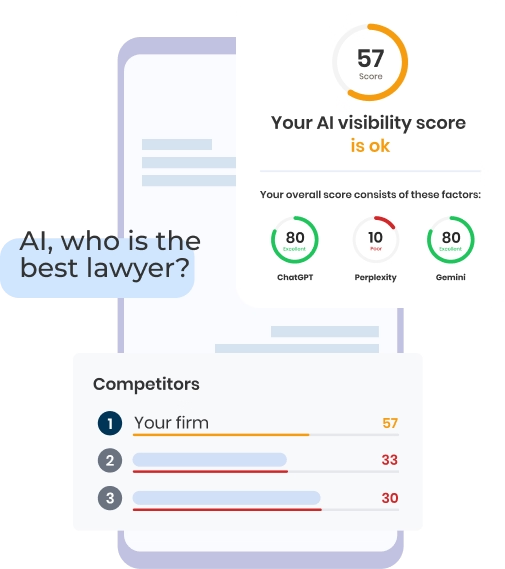
Check Your AI Visibility Instantly
Find Out What AI Is Telling Your Potential Clients
Run our free AI Visibility Report to:
See how often top AI tools mention your law firm
Spot which competitors show up first
Get the next steps to capture more cases
Run My Free AI Report
.avif)
.avif)
.avif)

