


Table of Contents
Say hello to the next evolution of SEO: generative engine optimization (GEO)!
In 2026, ranking on Google isn't enough. AI is now directly talking to prospects and giving them lawyer recommendations. Are you in the conversation?
With GEO, you could get your firm mentioned in the most popular AI tools like Google's AI Overviews, ChatGPT, Perplexity, and other generative search engines.
And given the growing popularity of AI (ChatGPT is now used by over 100 million people a week!), this is not up for debate. Either you get those prospects or your competitors do.
So, let's hop to it! Here are 9 AI search optimization tricks to use today before your competitors catch on!
Key Takeaways
- Use strong SEO signals to get on AI’s radar; build your SEO first, add GEO on top.
- Craft question-based pages with direct answers to get cited by AI tools.
- Build clear practice area pages to help AI feature your services, locations, and legal processes.
- Ensure consistent language and definitions across your pages to gain AI's trust.
- Create fresh, well-maintained content; that way, AI is more likely to reference your firm.
What Is GEO for Law Firms?
GEO (or generative engine optimization) is the process of getting your firm featured by AI tools like ChatGPT.
Think of traditional SEO (search engine optimization) as the foundation. It’s the "brickwork" that makes your firm visible on traditional search engines like Google.
GEO is the "amplification" layer that builds on top of SEO. Think of it as the stairs. It helps AI walk through your site and easily extract your legal content.
Remember, AI cannot browse websites like humans do. It needs to scan, break things apart, and extract the answers it feels confident repeating.
If your site is vague or messy, AI will skip you.
Will this really make a difference? Absolutely! In fact, you might already be on the back foot.
Around 27% of people now skip Google and go straight to AI tools like ChatGPT, Perplexity, and Gemini when researching problems (even legal ones!).
The Game is On
As we speak, AI is sending new clients to your competitors. Let's fill your caseload with a rock-solid GEO plan in 2026!
Book a Free Consultation

Why SEO (By Itself) Won't Save You
Search used to look like this:
You rank on Google. People click on your site. They contact you.
Unfortunately, that funnel just got hairier.
Today, users ask questions and AI tools provide instant answers. Those answers are stitched together from multiple websites (typically the ones ranking high on Google)!
That pretty much sums up why generative engine optimization is critical. AI:
- Answers questions before users even see organic results
- Extracts and summarizes content instead of driving direct clicks
- Chooses which sources get quoted, referenced, or ignored
Will GEO replace SEO? No, no, and no!
GEO depends on SEO. It typically pulls from pages that already rank well. If your site isn’t properly structured for SEO, your GEO efforts will ultimately fail.
9 Criminally Simple GEO Tactics For Lawyers in 2026
We're about to drop 9 tactics to get your law firm on ChatGPT the next time a prospective client asks for a lawyer.
P.S. These might sound suspiciously simple, but trust us, there's more to it. Make sure to scroll to the very end for the full context!
1. Answer Client Questions Directly
Every potential client has fears.
“Do I have a case?” "Am I too late?” "Is this going to cost me a fortune?”
That's right. Clients do NOT search like they used to. They use voice search and AI tools and ask full, conversational questions.
AI platforms are built to extract clear answers. How can you take advantage of this?
- Add FAQ sections to each practice area page
- Answer in 2–4 direct, plain-English sentences
- Put the short answer first, then clarify
- Use bullet points or numbered steps when possible
- Avoid long paragraphs or legalese
- (Bonus) Use the FAQ schema, that way, AI understands the context faster
For example, when we Google, "Do I need a lawyer for a DUI in Miami", Google's AI Overview cites info from this website, Parks and Braxton. Guess how they structured their page? That's right! They used an FAQ-style format.
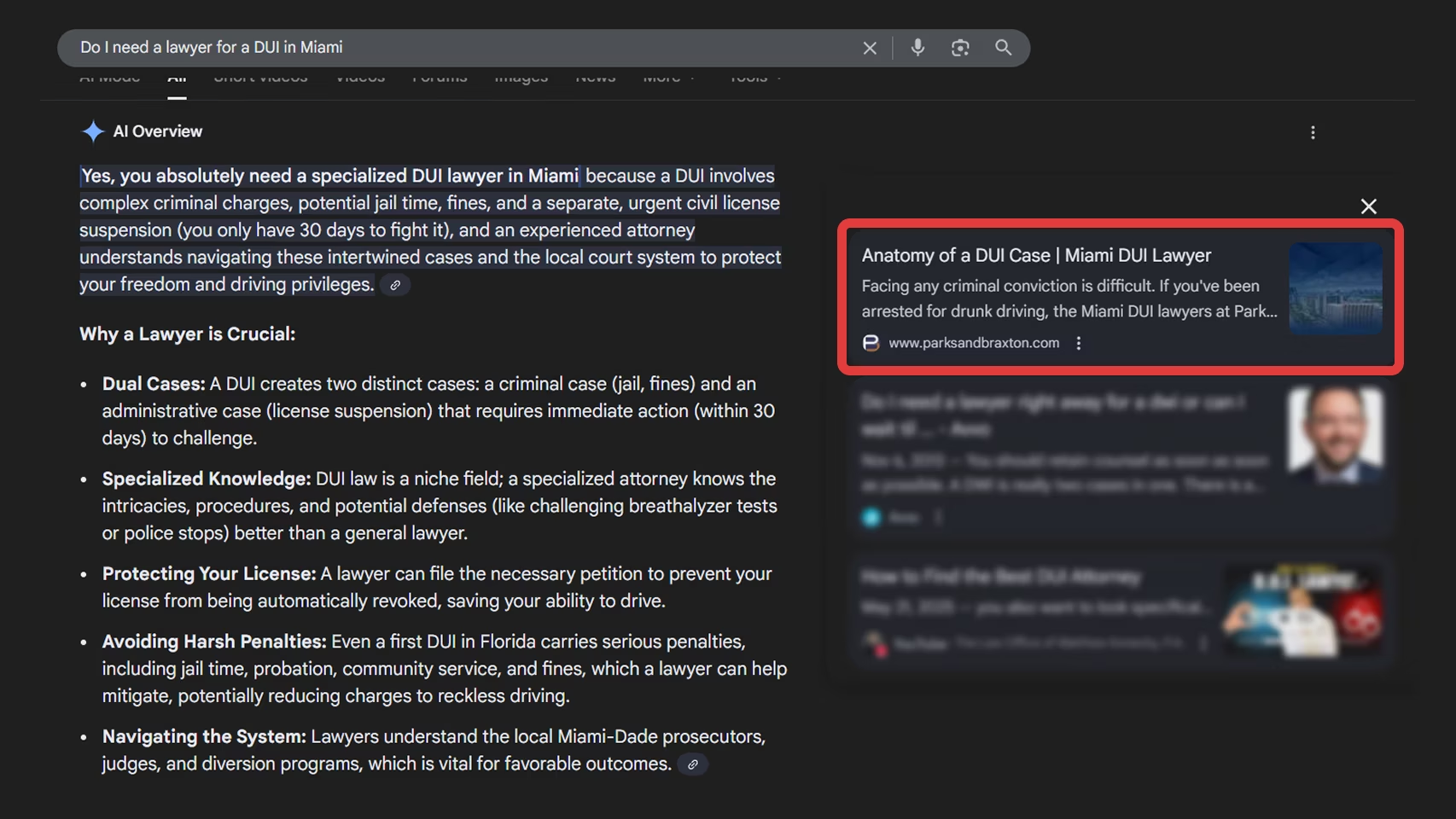
But don't stop there. Go a step further.
2. Write for Answer Extraction
Fun fact: AI uses something called query fan-out to answer complex legal questions.
This means AI breaks a single question into multiple smaller sub-questions, gathers answers for each, and then combines them into one response.
For example, when someone asks, “Do I need a lawyer after a car accident?” ChatGPT may silently fan that out into:
- What injuries require legal representation?
- How long do accident claims take?
ChatGPT then looks for clear, direct sections that answer each of those sub-questions.
What does this tell you? Position your content for topical depth! In a single blog, answer as many related questions as possible.
And as a callback to point #1, sections that open with a question and immediately resolve it give AI a clean entry point! To make your content more extractable:
- Use question-based headings that clearly define the problem being addressed
- Use explicit, unambiguous language (skip those “it depends” openings)
- Keep one idea per section to prevent AI from blending concepts
- Use lists and short paragraphs to reduce parsing errors
- Update statistics and references so AI doesn’t label the page as outdated
For instance, when you Google "How much does a PI lawyer charge in New York?", Frekhtman & Associates pops up in the AI-generated summary.
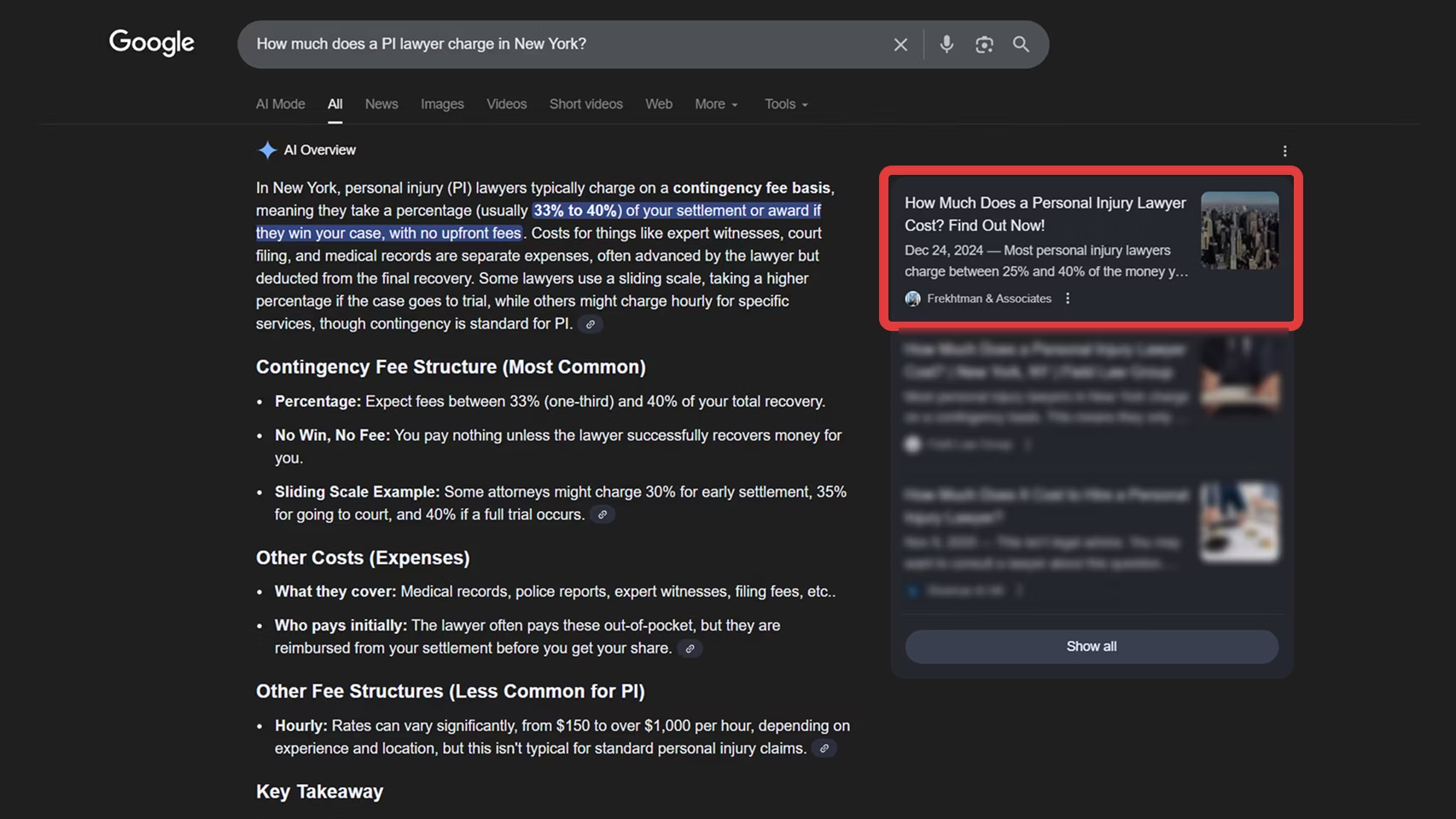
You'll notice they break their content into short, readable sections, and, most importantly, give a very specific answer in the intro itself.
Concise and to the point. AI loves to see it!

Tired of Reading?
Yeah, optimizing for AI is super nerdy. But you need it to fill your caseload. Let us build you a strong GEO plan!
Book a Free Growth Call
3. Build Entity Authority
Think of this as Content for Dummies 101.
AI tools like ChatGPT cannot “read between the lines.” They need you to spell things out clearly and consistently.
What on earth does that even mean? That means your site has to make 3 things obvious:
- What you do (specific practice areas, not just “legal services”)
- Where you do it (cities, states, jurisdictions spelled out the same way)
- How your services relate to each other (e.g., personal injury includes car accidents, slip and falls, and wrongful death)
For example, don’t assume AI knows the difference between terms. State it plainly:
- A personal injury claim is a type of civil lawsuit
- A DUI defense falls under criminal defense law
- This service applies in [City], [State] only
We'll say it again: Use the same names, same definitions, and same framing across all pages.
Need an example? Check out Stracci Law Group's main menu. Instead of lumping services under one “Personal Injury” page, they break it down into clear mini-categories — car accidents, truck accidents, etc. This is what AI loves to see!
4. Use Organized Headings
Do your headings look like this: “Our Services”, “More Information”, “Learn More”?
AI tools lean on headings to understand what your page is about. When your headings are vague, repetitive, or out of order... well, you know what happens next.
No, don't pull out your hair yet! The fix is simple. Write your headings like this:
- One clear main topic at the top of the page: Personal Injury Lawyer in Austin (not “Welcome” or “Our Practice”).
- Logical sections underneath that topic: Car Accidents, Truck Accidents, Wrongful Death.
- Supporting sub-sections: Under Car Accidents, use Who Is Liable?, What Compensation Covers, and How Long Claims Take.
The upside? Humans love this too! 80% of people only read headings, so make them count.
A solid real-world example is Jacob D. Fuchsberg. Look at their homepage. Right away, they spell it out with literal headings: Who We Are, Client Testimonials, Communities We Serve, etc. Nicely done!
5. Use Easily Readable Content Formats
AI runs on something called attention.
No, not the “pay attention in class” kind.
AI scans your content and constantly asks: “What matters most here?” It doesn’t read left to right like a human.
It weighs words, sentences, and sections against each other and locks onto what’s clear, repeated, and well-structured.
So, what gets AI’s attention? Glad you asked! Here's what we've noticed with generative engine optimization:
- Short paragraphs that stay on one idea
- Clear sentence structure (subject → verb → point)
- Examples that explain relationships (“this applies when…”)
- Lists that separate concepts instead of mashing them together
What loses AI instantly:
- Mega paragraphs trying to do 5 things at once
- Long storytelling before the actual answer
- Clever phrasing that hides meaning instead of clarifying it
A great real-world example: Roberts Markland’s blog post on “Understanding Statute of Limitation in Personal Injury Cases.” Each section covers one idea, and it's clearly labeled. We personally LOVE the shorter paragraphs!
6. Build Topical Authority
We can feel your eyes glazing over. Stay with us!
Topical authority is when AI tools look at your site and think: “This firm clearly owns this topic.”
Translation: You are the clearest and most complete source on that subject!
A TON of law firm websites are a legal junk drawer. Personal injury, DUI, immigration, “we also do wills,” plus 47 random blog posts.
Shaun Anderson wrote a great blog about this called Topical Authority. He basically says:
- Tighten your site focus: Choose one primary practice area you want AI to associate your firm with
- Shrink your site radius: Remove, rewrite, or isolate pages that drift away from that core topic
- Build a clean content cluster: Create supporting pages that clearly expand on the main pillar (not random side topics)
Neinstein Personal Injury Lawyers does a great job of this!
They list highly specific areas like motor vehicle collisions, slip-and-fall cases, product liability, dog bite injuries, etc., under the PI umbrella, proving they are "the" PI authority in Ontario.
7. Use Schema Markup
Want to become an AI whisperer?
Use the ultimate cheat code: schema markup!
These are "labels" you attach behind the scenes. It tells ChatGPT and Google AI: This is a law firm, these are the attorneys, this page is an article, etc.
We'll drop the most useful schema types for GEO:
- Organization: Who you are and where you practice
- Person: Your lawyers, roles, credentials
- Article: What this page is actually about
- FAQPage: Answers AI can lift word-for-word
Oh, and by the way, most law firms ignore this. It's your window! Do this right, and you'll have a way higher chance of being pulled into AI responses.
8. Update Your Content Frequently
Did the work? Now keep it fresh!
Nerd alert: Google calls this concept the Query Deserves Freshness (QDF). This means that when a topic can change over time, newer or recently updated content is more likely to surface.
A HubSpot analysis found that updating existing content led to 106% increases in traffic. Crazy but true!
Here's what “fresh” actually means in generative engine optimization:
- Update the publish or “last updated” date only when meaningful changes are made
- Replace old stats with current data (new studies, current-year numbers)
- Refresh legal examples, procedures, or regulations that evolve over time
- Add new FAQs based on what clients are asking right now
Our advice: Refresh your key pages every 3–6 months (practice area pages, high-traffic blogs, etc.) Also, run a content audit once per quarter to spot outdated stats, laws, examples, or weak sections. For a deeper breakdown, see our guide to an SEO content audit for law firms.
9. Earn Mentions Across the Web
SEO is obsessed with backlinks.
GEO cares about links, too, BUT it also cares about cross-source consistency. In plain English: AI doesn’t trust a single source. It cross-checks.
When tools like Google and ChatGPT scan the web, they look for the same story about your firm. That means:
- The exact same firm name
- The exact same practice area
- The exact same location and services
- The exact same way you describe your attorneys
This info should be identical across their website, legal directories (like Avvo), news articles, podcasts, interviews, and more. That UPs your chances of popping up in AI-generated answers.
Your homework this week: Clarify your business name, location, and service areas. Now check them everywhere: your website, Avvo, Justia, Google Business Profile, LinkedIn and make sure they are identical!
Last Chance to be a Winner
Your competitors are already signing cases in 2026. Do NOT get locked out of AI search.
Book a Free Growth Call
Practical GEO Examples by Practice Area
— Personal injury lawyers
AI loves high-intent and outcome-driven content.
- Use question-based headings tied to real injury searches: “How much compensation can I get for a car accident?” or “Do I qualify for a wrongful death claim?”
- Answer immediately under each heading with plain outcomes: compensation types, timelines, and eligibility basics.
- Be explicit about jurisdiction limits: “This applies to accidents in California only.” AI needs that boundary spelled out.
- Break big topics into micro-injuries (car accidents, truck accidents, slip and fall) so context is instant.
— Family law attorneys
This space is emotional; AI needs careful, grounded language.
- Use process-focused questions people actually ask under stress: “What happens first in a divorce?” or “How does child custody get decided?”
- Keep a neutral, non-promissory tone. No guarantees. AI avoids citing absolute claims.
- Structure content step-by-step to reduce ambiguity, but do not oversimplify complex situations.
- Clearly separate topics like divorce, custody, and support.
— Criminal defense lawyers
Speed, clarity, and restraint are the top winners!
- Lead with urgent, action-oriented questions: “What should I do after a DUI arrest?”
- Give direct answers immediately under each heading.
- Avoid speculative or absolute language (“always,” “never,” “guaranteed”).
- Clearly define charge types and jurisdiction, so AI doesn’t misapply advice.
— Real estate lawyers
AI needs definitions, categories, and clean separation.
- Clearly distinguish transactional vs. regulatory work.
- Separate residential vs. commercial contexts.
- Use headings that honestly explain the risk, compliance, and process.
- Define entities plainly: “A commercial lease is a contract between…” before going deeper.
Win Over the Next Wave of Clients with AI!
You're at an exciting moment in history.
The window to capitalize on AI and get more clients is OPEN... but it won't stay that way forever. Follow the rules we covered:
- Write clear, structured content that AI can quote
- Build a tight practice-area focus that signals authority
- Create consistent signals everywhere (site, directories, mentions)
- Commit to regular updates that way, AI doesn’t flag content as outdated
But hey, this is a LOT to manage while working 50+ hour weeks.
Meanwhile, your competitors are already optimizing for AI, locking in their visibility for 2026, and building highly profitable caseloads.
You literally cannot afford to sit this out. Join forces with Grow Law! 72% of our legal clients now appear in Google's AI Overviews.
It's part of the reason clients like Texas Horizons saw a 494% increase in qualified leads and gained the freedom to focus on running their business.
Ready to conquer the AI wave? Visit our GEO page, and if you'd like highly qualified leads from AI, book your free consultation today.
FAQ

Compare Your Practice Instantly
Stay Ahead of the Competition!
Compare your law firm's performance to Local competitors with our instant assessment tool
Get a clear picture of your firm's performance
Boost your online presence
Compare My Firm
Compare Your Practice Instantly
Stay Ahead of the Competition!
Compare your law firm's performance to Local competitors with our instant assessment tool
Get a clear picture of your firm's performance
Boost your online presence
Compare My Firm
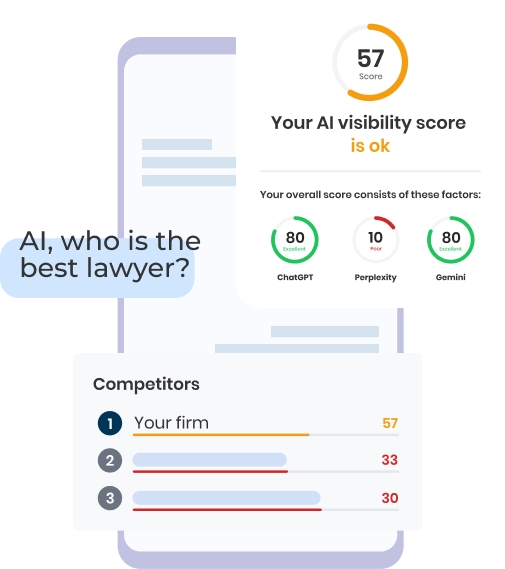
Check Your AI Visibility Instantly
Find Out What AI Is Telling Your Potential Clients
Run our free AI Visibility Report to:
See how often top AI tools mention your law firm
Spot which competitors show up first
Get the next steps to capture more cases
Run My Free AI Report
.avif)
.avif)
.avif)
- Generative Engine Optimization (GEO) https://en.wikipedia.org/wiki/Generative_engine_optimization
- Large Language Models (LLMs) https://en.wikipedia.org/wiki/Large_language_model
- Practice of law (Legal practice areas) https://en.wikipedia.org/wiki/Practice_of_law

