

AI Search Visibility for Workers' Comp Firms
GEO for Workers' Compensation Lawyers to Build a Stronger AI Search Presence
Claimants now ask ChatGPT, Google AI Overviews, Gemini, and Perplexity who handles denied claims, how benefits work, and what a case is worth. Our GEO for workers' compensation lawyers builds the authority signals and attorney-reviewed content AI needs to cite your firm.
Law firms only · Attorney-reviewed content

Recognized by industry experts:



The Real Problem
AI Search is Trickier for Workers' Comp Claims
After an injury, workers panic, search urgently on mobile, and use question-based, long-tailed AI prompts around lost wages, denial, and employer retaliation. Effective AI search optimization for workers' compensation lawyers has to account for a multi-part decision cycle around eligibility and state-specific rules.
01
State & Jurisdiction
Workers' comp rules vary by state, from filing deadlines to benefit caps to which injuries qualify. AI systems need to see accurate, state-specific detail to route a claimant's question to the right firm instead of a state-wide answer.
02
Claim-Stage Intent
A claimant who just filed asks AI different questions than one facing a denial or appeal. Content built around these stages helps AI match your firm to the exact moment they need a lawyer. They don't need a general practice description.
03
Medical & Benefits Language
Claimants ask about wage replacement, medical treatment approval, and permanent disability ratings using their own words. AI visibility for workers' compensation lawyers needs content that mirrors that language (while staying accurate) to help AI connect real questions to real answers.
04
Local Trust & Intake
Injured workers want a lawyer who knows their state and can respond fast. Clear local signals and a frictionless intake path help AI systems and claimants recognize your firm as a credible, reachable option nearby.
Ultimately, AI systems synthesize dozens of sources to answer a claim question. A generic page can't cover every state, injury, benefit, denial, or attorney choice. GEO for workers' comp lawyers starts with a diagnostic of your current positions.
What AI Systems Weigh
What Signals AI Systems Look At
AI systems go beyond your website, and cross-check it against every other online mention of your firm. Workers' compensation lawyer GEO builds those signals consistently, everywhere AI looks.
Signal 01
Firm's Identity
Your firm's name, attorneys, phone number, and address need to match word for word, across your site, directories, and profiles. Inconsistent details make it harder for AI systems to confirm you're a real, verifiable firm.
Signal 02
Jurisdiction & Service Area
AI systems need to know which states and counties you practice in. Vague or outdated service-area claims make it hard for AI to confidently match your firm to a claimant's location-specific question.
Signal 03
Topic & Claim-Stage Depth
Answering "what is workers' comp" isn't enough. AI systems favor firms whose content addresses specific claim stages (like initial filing, denial, and appeal) in enough depth to answer a claimant's real-world question.
Signal 04
Attorney Expertise & Review
Content should carry a named attorney's byline, credentials, and bar admission. No generic "our team" authors. AI systems look to verify a real, credentialed person behind the content instead of trusting an anonymous page.
Signal 05
External Corroboration
To confirm what your site claims, AI looks for reviews, bar association listings, and mentions on reputable legal sites. It cross-checks your content against these outside sources. One without the other isn't enough.
Ultimately, no single tag, citation, or blog post secures a citation. Generative AI optimization for workers' compensation law firms aligns all 5 signals to strengthen and defend your visibility.
AI Visibility Report
See Where Your Firm Stands in AI Search Today
Before you invest in GEO, you need a clear baseline. Our AI visibility for workers' compensation lawyers report shows where your firm currently appears across top AI platforms, including:
This is not a guarantee of results. It shapes the content, entity, authority, and technical work behind our workers' comp lawyer GEO system, covered next.
1.
Visibility across mapped workers' comp claim questions
2.
Mentions and citations across the top AI platforms
3.
How you compare to competitors and cited sources
4.
High-impact, priority fixes to close the gaps
2 minutes, and you'll see exactly where you stand in AI search.
Your AI visibility baseline
What your workers' comp report covers
01 · Mapped workers' comp claim questions
Where your firm appears
02 · Mentions & citations across top AI platforms
What AI pulls from
03 · Competitors & cited sources
How you compare
04 · High-impact, priority fixes
What to close first
05 · AI-referral baseline
How much traffic today
Your AI visibility score
?? /100
Free report. No card required. Ready in 2–4 minutes.
One Connected System
What's Included in Your GEO Engagement
Our GEO for workers' compensation law firms covers 6 concrete workstreams. AI systems weigh your firm on multiple signals at once. Gaps in any one area limit how much the others can accomplish.
BASELINE
AI Visibility Baseline and Prompt Map
Your baseline gets built. We map a set of prompts by state and claim stage, plus a record of where your firm currently appears, or doesn't, across AI platforms. This map directs every workstream that follows.
Explore GEO
CONTENT
Answer-Led Content Optimization
ChatGPT optimization for workers' compensation lawyers requires content built to answer real-world claimant questions directly, rather than try to rank for keywords. We produce and refine your pages (with an in-house attorney review), making it easy for AI systems to extract and cite clearly.
ENTITY
Entity and Technical Clarity
AI systems don't trust a firm they can't pin down. We audit and correct your firm's name, address, phone number, attorney credentials, and schema markup across your site and key directories. That way, AI systems see a single, consistent version of your firm across the web.
LOCAL
State and Local Relevance
Workers' comp is hyper-local. Every state has its own rules, deadlines, and benefit caps. We build and refine your state- and county-specific content to reflect your service area and local claim rules, keeping your firm matched to the exact jurisdictions a claimant asks about.
AUTHORITY
Authority and Reputation Development
Your own site can only say so much about your firm. We pursue mentions, reviews, and listings on reputable legal directories and platforms that reinforce your firm's credibility, giving AI systems outside confirmation to weigh alongside your own content.
CITATIONS
Citation Opportunity Expansion
More verified sources give you more chances to be cited. With generative AI optimization for workers' compensation law firms, we identify and pursue additional citation-worthy placements (like legal resource pages and reputable industry mentions) to build more sources pointing back to your firm.
How It Works
The 5-Step Workers' Comp AI Visibility System
Generative engine optimization for workers' compensation lawyers is an ongoing system. Our experts start with your current baseline and build toward consistent, verifiable visibility across AI platforms with month-to-month optimization.
Step 1: Diagnose
We run a full AI visibility audit to see which claim questions cite your firm vs. your competitors, and where you're missing. This workers' comp lawyer GEO baseline becomes the input for every step that follows, and sets the priorities for what gets built first.
Step 2: Map Questions
We map the real questions claimants ask by state and claim stage, from eligibility to denial to appeal. This question map is the backbone of GEO for workers' comp lawyers. It tells us exactly which content gaps to close (and in what order) so every single move has a clear purpose.
Step 3: Build and Clarify
Using the question map, our writers draft content (reviewed by an in-house attorney), using your firm's information to close the identified gaps, while keeping your existing SEO and local foundations intact. Your team gives the final sign-off on every piece before it goes live.
Step 4: Corroborate
Our experts identify and pursue mentions on reputable legal sites, directories, and review platforms to reinforce what your site already states. These external signals give AI systems outside confirmation to weigh alongside your own content, strengthening what Step 3 built.
Step 5: Measure and Improve
Finally, we track a stable set of claim-related prompts across platforms, logging mentions, citations, and source domains. Where available, we connect this to AI-referred traffic and qualified inquiries, then feed those findings back into Step 1 to refine the next cycle.
As you just saw, each step feeds the next, from diagnosis to measurement and back again. Mentions and citations show growing visibility. Qualified inquiries show it's translating into real interest from potential clients.
Accuracy & Review
How We Protect Your Firm's Online Reputation
To protect your credibility, everything we publish passes through rigorous accuracy and reputation checks.
Attorney Quality Check & Final Approval
Every piece of content is drafted, then reviewed and approved by an attorney on our team, and by your firm before it publishes.
Every publication date and review ownership stays visible. It's always clear when your content was checked and who signed off on it.
Jurisdiction-Aware, Plain-English Answers
Content is written for each specific state's rules. We do not just swap between states with a find-and-replace.
Answers stay clear and general, explaining how workers' comp works without crossing into individualized legal advice, which creates a real risk for your firm.
Reputation-Safe Authority Building
We only pursue credible mentions and citations from legal directories, publications, and platforms your firm would actually want to be seen on.
We prioritize a smaller number of credible placements over a high volume of low-quality ones that could undermine your firm's standing.
Reporting You Can Check
How We Measure AI Visibility for Workers' Compensation Lawyers
Every month, we track your AI visibility for workers' compensation lawyers report against a stable prompt set, measuring what AI systems actually say about your firm and whether it turns into inquiries.
01
Citation and Mention Share
The share of tracked answers where your firm gets mentioned or cited by name, plus which source domains AI pulls from, reported monthly against your baseline audit.
02
AI-Referral Traffic
Where available, sessions attributable to AI platforms sending claimants to your site, tracked separately from organic and paid traffic sources each month.
03
Qualified Leads and Signed Cases
Qualified leads and signed cases, with assisted-conversion context, so you see how AI-driven visibility connects to real interest from potential clients rather than visibility metrics alone.
04
Accuracy and Correction Checks
A monthly review of what AI platforms are actually saying about your firm, flagging any inaccurate claims for correction before they compound.
Source for methodology: Generative Engine Optimization
Proprietary Technology
A Report That Tells You If Marketing Created Cases.
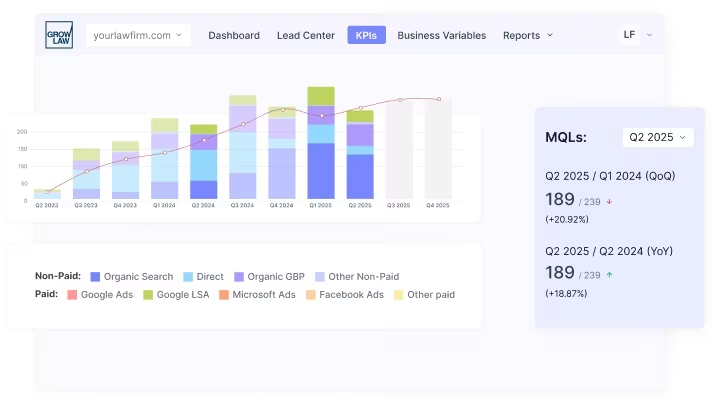
Our Proprietary Growth Portal is one live view of lead quality, signed cases, cost, and AI visibility.
01
Every lead scored
Separate qualified prospects from spam and noise.
02
Every case verified
Connect your CRM to confirm which leads signed.
03
Every dollar accountable
Compare true cost per case by source and campaign.
04
Every AI engine monitored
Track visibility as search behavior changes.
Real Client View ·
Built by Grow Law
Client results
Real Clients. Documented Proof.
“We hired Grow Law to improve the quality of leads from our website and keep our content fresh with ongoing articles and blog updates. Their team is highly responsive and stays engaged. They don’t sign you up and forget about you. Regular monthly meetings make a real difference in keeping everything on track.”

Anna Hardy
Partner since 2022
Lehmbecker Law
Washington · Personal Injury, Workers' Compensation
Lehmbecker Law is a long-standing personal injury and workers’ compensation firm serving clients across Washington State. Our workers’ comp lawyer marketing services helped the firm translate its established reputation into a modern digital presence and a predictable flow of high-quality cases.
- 733% MARKETING ROI
- +1,425% QUALIFIED LEADS
- +2,556% ORGANIC TRAFFIC
“They've been helping us to rank higher on Google. We come up earlier in search results. We've increased our number of retained cases and the quality and strength of the cases. They've delivered over 1,000% ROI in marketing.”

Eli Fuchsberg
Partner since 2022
Jacob D. Fuchsberg Law Firm
New York City · Personal injury, medical malpractice & civil rights · 10–20 attorneys
A respected New York personal injury, medical malpractice, and civil rights practice with three generations of history and $295 million recovered in settlements — but a digital presence that showed none of it. Through a broader engagement covering SEO, AI search optimization, web design, content, and conversion tracking, the firm turned its courtroom reputation into qualified case flow.
- 980% MARKETING ROI
- +196% NON-PAID QUALIFIED LEADS
- +606% AI-DRIVEN TRAFFIC
* Integrated campaign that included AI search optimization among other non-paid channels, not from GEO working in isolation. Every month, we track your AI visibility for workers' compensation lawyers report against a stable prompt set, measuring mentions, citations, and source domains, share of tracked answers, AI-referred traffic (if available), and qualified calls or form submissions with assisted conversion context.
Explore what's possible when AI search work is one part of a broader, coordinated strategy.
Get a free 30-minute growth plan. No obligation, and you keep the plan.
Why Choose Us
Why Law Firms Trust Grow Law
Our GEO for workers' compensation law firms runs on our expertise in AI search and how legal marketing operates.
What a Typical Agency Does
Same in every market
A general-practice agency that picked up a few law firms along the way, with no feel for how injury clients actually choose a firm.
Content published straight from a writer's draft, with no attorney sign-off, no sources, and no review dates on medical or statute claims.
A rotating pool of generalist freelancers writing about injury claims for the first time, with no view of how AI search keeps changing.
Content, tracking, and directory logins held in the agency's accounts, so leaving means rebuilding your AI footprint from zero.
A monthly PDF of visibility screenshots, with no way to tell which channel produced a single signed case.
A separate AI workstream that never talks to your SEO or analytics setup, duplicating work in the best case and contradicting it in the worst.
What Grow Law Does
Built for workers' comp
Law-Firm-Only Focus. We've worked exclusively with law firms since 2008. Every process (from content review to reporting) is built around the complexities of legal marketing. No generic playbooks.
Workers' Comp Context. We intimately understand the claim stages, state variation, and claimant urgency of workers' compensation. That context shapes every piece of content and every signal we build.
95+ Marketing Experts. Our team includes 95+ marketing experts across content, SEO, and AI search, giving your firm dedicated specialists rather than a single generalist.
Attorney-Reviewed Content. Every piece of legal content goes through a quality check from an attorney on our team before it publishes. Your firm retains final approval, so nothing goes live without your legal sign-off.
AI Visibility Reporting. You get ongoing visibility into mentions, citations, and tracked answers across AI platforms, over just a one-time report. This keeps your firm's progress measurable month over month.
Integrated Foundations. GEO doesn't work in isolation. We build it on integrated SEO, local, authority, and conversion foundations, so your AI visibility strengthens your broader marketing.
Below, see where your firm stands today, and what generative AI optimization for workers' compensation law firms does for you.
Meet the Team
The People Dedicated to Your Success
Founded in 2008, Grow Law has a team of 95+ marketing experts who understand how to drive qualified cases consistently, even in cutthroat markets.
Read our story
Free GEO growth plan
Is AI Recommending You or a Competitor? Find Out Now.
Your free AI visibility report shows where your firm sits: which claim questions surface you versus your competitors, and which sources AI systems are citing instead of yours.
From there, you'll get a prioritized list of steps to fix your visibility.
Get a clear baseline and prioritized next steps, delivered directly to you.
This report doesn't promise a specific placement, but it shows exactly where to focus.

Mary Grinnan
Growth Expert, she'll be leading your session
Questions, Answered
Frequently Asked Questions About Workers' Comp GEO
Got questions about AI search and your workers' comp practice? Here are direct answers on what you can realistically expect.
Still deciding? Call (954) 859-1712 and talk to a real person.
What is GEO for workers' compensation lawyers?
GEO for workers' compensation lawyers optimizes your firm's content and online presence so AI systems like ChatGPT and Google AI Overviews can find, understand, verify, and cite you. It builds on your existing SEO foundation and adds workers' comp-specific content, entity consistency, local relevance, authority signals, and ongoing measurement, turning your firm into a source AI systems can confidently draw from when a claimant asks about their case.
How does generative engine optimization work for workers' compensation lawyers?
We start by establishing your current AI visibility baseline, then map the questions claimants ask by state and claim stage. From there, we build and refine your content (reviewed by an attorney) and entity information, pursue external corroboration from reputable sources, and measure results. Your firm reviews and approves every piece of legal content before it publishes. Results vary by platform, since each AI system pulls from different sources and updates on its own schedule.
How is GEO different from SEO for workers' compensation lawyers?
SEO focuses on rankings and clicks in traditional search results. GEO cares about something different: whether AI systems mention, cite, or reference your firm when they answer a claimant's question directly. The two work together, not against each other. GEO builds on the same content, entity, and authority foundations SEO relies on, extending them to work for AI-generated answers instead of replacing what SEO already does for you.
How can workers' compensation lawyers appear in ChatGPT?
Start with content that directly answers pressing claimant questions, clearly scoped to your state and practice area. When you build attorney-authored or reviewed content, consistent information across the web, reputable external mentions, and technical accessibility, you give ChatGPT more reason to point to your firm. No agency, including ours, controls what ChatGPT ultimately generates or which sources it chooses to reference.
How can workers' compensation law firms get cited by AI?
Get cited by being a clear, extractable, and consistently verified source. That means content that directly answers specific questions, named attorneys behind it, consistent firm details across your site and directories, and corroboration from reputable outside sources. AI systems weigh these signals differently depending on the question and context, so no single factor earns you a citation on its own.
How do workers' compensation lawyers appear in Google AI Overviews?
It starts with strong SEO fundamentals. This includes indexed, well-structured content that directly answers common questions, organized into clear topic clusters with defined scope. Authority signals and structured data help Google's systems make sense of your content, but they won't guarantee inclusion. Content that's current, specific to your state, and easy to extract gives your firm the best shot at showing up in an AI-generated answer.
What should workers' compensation GEO services include?
Look for an AI visibility baseline and prompt map, a content and entity audit, attorney-reviewed content optimization, technical and local relevance work, external authority development, citation opportunity analysis, and ongoing reporting tied to lead context. If a proposal skips the baseline or the measurement piece, it's missing the parts that make everything else verifiable.
How do you measure AI visibility for workers' compensation law firms?
We track a stable set of claim-related prompts monthly across platforms, logging mentions, citations, and source domains, along with the share of tracked answers where your firm shows up. Where platforms allow it, we connect this to AI-referred traffic and qualified calls or form submissions. Since not every platform exposes complete referral data, we treat some of this attribution as directional rather than exact.
Page last reviewed
9/3/2026
Reviewed by Sasha Berson, CGO @ Grow Law
Explore more ways we can help: