


Table of Contents
Law firm content marketing is critical in 2026.
Every day, your ideal clients Google their legal problems, read articles, watch videos, and even talk to ChatGPT before choosing a lawyer.
To ensure they find you first, you need high-quality content. It builds your organic visibility and lead flow, and it’s even behind the success of our law firm SEO services here at Grow Law.
Since 2008, we’ve executed robust SEO content strategies for over 100 law firms like Yarborough Law Group, who then saw a 452% increase in qualified leads.
Today, we’ll give you that proprietary 3-step system to master content marketing for lawyers.
Key Takeaways:
- What content marketing is (and isn't) and why lawyers should invest in 2026.
- How content marketing is more lucrative than paid ads over the long term.
- Why salesy "hire me now" service pages will turn away 80% of your audience.
- Every content type ranked: what drives consultations vs. what just looks good.
- The pillar-cluster model: this is the content architecture behind every big success.
- The content repurposing trick that took one attorney from 120 to 640 email subscribers.
- How to choose between DIY vs expert content (the honest pros and cons).
How to track the one metric that influences your caseload; this is important.
What Is Law Firm Content Marketing?
Law firm content marketing is the strategic creation of accurate, authentic, and expert-led content to inspire confidence in your law firm and get people to contact you. It prioritizes high-converting, long-form depth over generic AI copy. For the next step, see law firm content automation.
Why is legal content marketing so critical in 2026? Because your clients don't impulse-buy legal services.
There’s a "silent research phase" where 92% of legal consumers research their problems before contacting a lawyer. They ask AI chat, Google, and consume articles and videos.
And the stakes are high. A DUI charge alone can cost $10,000 in fines, legal fees, and lost income, plus a criminal record that follows someone for life.
Your content must guide their entire journey to booking that consultation with you.
Google also holds legal content to a higher standard; what they call YMYL (Your Money or Your Life). That means thin, generic content by a copywriter on Fiverr won’t rank.
You must prove real expertise, real attorney authorship, and real-world answers using attorney content marketing.
So, what does content marketing for law firms include?
- Blog articles and FAQ pages targeting what anxious clients in a crisis are looking up
- Practice area service pages built to rank on page one of Google and convert
- Videos that put a human face to your firm and assure clients of your credibility
- Downloadable guides that attract leads who aren't ready to consult with you yet
- Email and social content that works on top of your on-site content to spread the word

As you can see, content marketing for lawyers and legal content marketing share one goal: Get the right people to contact you.
With SEO content, Grow Law’s own clients have seen a 1,200% average traffic increase, proving its efficacy.
Why Content Marketing Drives More Leads Than Ads Alone
Most law firms spend ~$5,000 per month on ads.
But once you pause your ads, your leads stop. Every dollar you spend is gone. There’s no residual value.
On the other hand, a well-optimized blog post you publish today can rank on page one for the next 10 years, pulling in thousands of leads.
Also, blogs don’t charge you per click like paid ads. And the more content you publish in a single topic area (like DUI charges in Chicago), the stronger your entire site ranks.
Google calls this "topical authority" and starts treating you as an expert in that space.
And the returns with content marketing for lawyers are there! Genesys reports that content marketing yields a 300% ROI on average, whereas paid ads yield a 200% ROI, as per Firework.
— Content Marketing vs. Paid Ads: The Comparison
But there’s a new player in 2026: AI search.
Google's AI Overviews and ChatGPT are increasingly the first place people look for legal answers.
These tools pull from well-structured, authoritative content. If you have a strong content library, you’ll get cited in AI responses that your competitors aren't even visible in.
— Content in Action: How Yarborough 4X’d Their Leads
One of our clients, Yarborough Law Group, a top family law firm in Oklahoma, had almost no digital presence and very few qualified leads coming in.
We built them a targeted content and SEO strategy from the ground up with semantic keyword research, clear attorney-authored answers to urgent questions, and a distribution plan that got their content in front of the right people.
The results: They now rank among the top results for searches like "child support lawyer Norman OK" and "Woodward OK attorney."
Yarborough saw a 452% increase in qualified leads, 2,938% increase in organic traffic, and a 857% marketing ROI.
Below, we’ll walk through how you can pursue these results with content marketing for attorneys.
1. Build a Content Strategy That Drives Cases
After working with 100+ law firms, from personal injury to immigration law, we’ve tested and refined a near-perfect content strategy for law firms.
Most attorneys do not have a writing problem. They have a system problem.
Revenue Memo even reports that a proper content framework generates 3x more leads per dollar.
Here's what that structure looks like.
— Define Goals With Hard Numbers
"Publish more content" is a very vague and hard-to-measure goal. Get specific with your content strategy for law firms:
"Rank in the top 3 positions for 'Chicago personal injury lawyer' and generate 20 qualified consultation requests per month within 12 months."
That kind of specificity lets you work backwards with your content marketing for attorneys: How many pieces to post, what keywords to target, and over what timeline.
From there, you can track what connects to revenue, like keyword rankings, qualified leads, and consultation bookings.

— Map Your Content to How Clients Make Decisions
Clients don't go from "I think I have a legal problem" to "I'm ready to hire you" in one step.
They move through many stages. Your lawyer content marketing needs to meet them at each one.
Most law firms only create content for the decision stage, i.e., the people who are ready to hire.
That's the smallest slice of your audience. You must target all three.
We followed this system for a mid-size personal injury firm in Chicago. They were publishing two or three blog posts a month with no keyword targeting and no internal linking.
Traffic was flat. We restructured their attorney content marketing around journey stages. Our team built informational posts for early searchers ("what to do after a car accident in Illinois"), and high-intent service pages for ready-to-hire visitors.
Six months later, they saw qualified leads shoot up by 180%, and consultation bookings by 40% with SEO content marketing for attorneys.
— Build a Publishing Calendar Your Team Can Maintain
American author, Robert Collier, once said, "Success is the sum of small efforts, repeated day in and day out."
He was onto something. In the 1920s, Collier generated $200 million in book sales just by consistently mailing out sales letters every day.
In essence, consistency beats volume. One well-optimized post per week, published reliably, will outperform three rushed posts followed by a two-month gap.
Use a simple content calendar (like Google Sheets) to assign topics, keywords, due dates, and review steps. If your team is small, batch content in monthly sprints. If you're working with a content partner, make sure there's a review process in your content strategy for law firms to keep your voice in the final product.
2. The Best Content Types for Law Firms in 2026
Thankfully, you don't need to create 20+ types of content every month.
You just need to use a small but powerful mix of attorney content marketing for your practice area and clients:
— Blog Articles
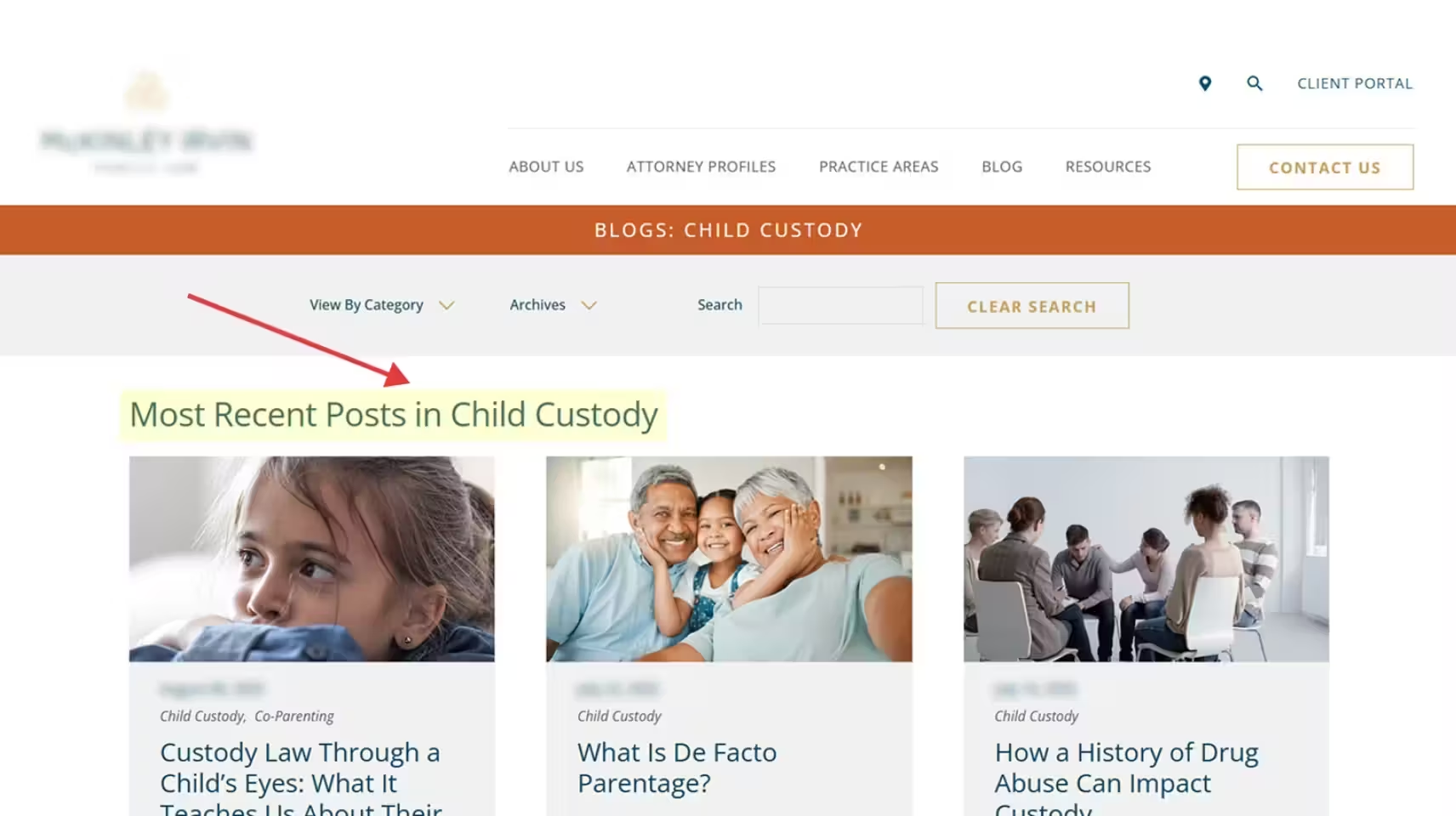
The best blog framework for legal content marketing is the pillar-cluster model (more on this below!)
This is one broad pillar page, like "Personal Injury Law in Texas: A Complete Guide," linking to specific cluster posts:
- "What to Do After a Car Accident in Houston”
- "Average Settlement for Soft Tissue Injuries”
- "How Long Does a Personal Injury Case Take in Texas”
For Newlin Law Offices, we did exactly this, mapping their SEO blog content around specific client journey stages and keyword clusters. Within 10 months, they saw a 300% surge in qualified leads.
Best for: Organic search traffic and early-stage client education.
— Service Pages
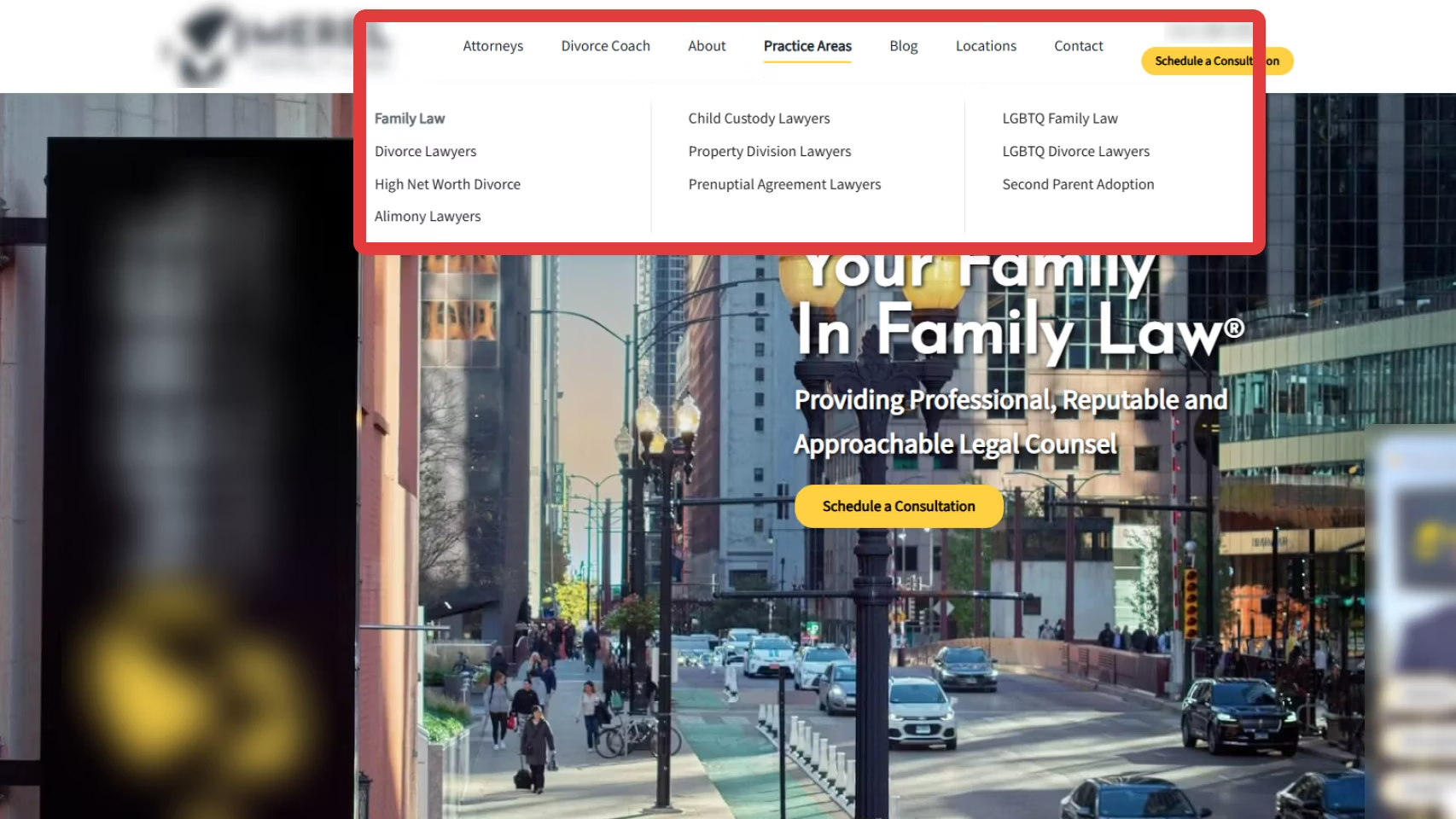
If your personal injury page says, "We handle personal injury cases. Contact us today," it’s bad.
The best service pages cover the following:
- A clear process breakdown: What happens from the first call to case resolution, step by step
- Realistic expectations: Honest timelines, how fees work, what outcomes look like
- Objection handling: Answer the questions they're too nervous to ask: "Is my case worth it?" "Can I afford this?" "What if I lose?"
- Obvious next step: What happens the second they hit "contact us"
A criminal defense firm in Denver rewrote their DUI service page using this exact structure, adding a step-by-step process section, 3 client testimonials, and a clear FAQ block.
Organic leads from that single page increased by 90% within four months.
Best for: Serious searchers who are close to hiring.
— Video
Only 30% of law firms use video to market their services.
Show your team. Share a client win (with permission). Film a 90-second explainer on the most common question you hear.
Attorney Jay Ruane, who's been practicing DUI defense for over 24 years, credits much of his firm's social traction to personal storytelling and community-focused video, gaining thousands of views on Instagram and YouTube.
Best for: Social platforms, attorney bio pages, and overall trust-building.
— Downloadable Guides and Checklists

Create a PDF called "Your Rights After a Workplace Injury" or "5 Steps to Take After a Car Accident.” You’ll get valuable email addresses in return.
These are fantastic for nurturing leads who aren't ready to call yet.
Best for: Building your email list and staying in front of warm leads.
— Podcasts

Most law firms skip podcasting entirely. This is your edge.
A family law firm in Phoenix we know launched a weekly 20-minute podcast answering common divorce questions and added 340 new organic leads in its first year without paying for ads.
Best for: Building authority and staying top-of-mind with clients who aren't ready to hire yet.
— Infographics
A personal injury firm in Atlanta turned its most-read blog post, "What to Do After a Car Accident," into a single shareable infographic.
It got picked up by two other law firms, earning them 2 backlinks and driving a 40% spike in traffic to their service page that month, all with smart content marketing for attorneys.
Best for: Simplifying complex legal processes and earning backlinks to boost search rankings.
— AI-Optimized Content in 2026
This is newer but increasingly critical in SEO services for law firms.
More and more clients are using AI tools that prioritize E-E-A-T (Experience, Expertise, Authoritativeness, Trustworthiness).
Google's AI Overviews and ChatGPT pull answers from expert-written, well-structured content with clear Q&A formatting, schema markup, and strong sourcing.
We’ve written legal content that directly answers pressing questions, used FAQ schema, and made sure our authorship signals were strong and clear. Today, 98% of our clients get AI-driven leads.
AI optimization is table stakes for lawyer content marketing in 2026.
3. Promote, Measure, and Update Your Law Firm Content
Publishing is not the finish line.
To seriously drive cases, you must measure what happens after your content goes live.
— Distribution: Push Don't Just Publish
Every piece of content you publish deserves a distribution plan:
- Social media: LinkedIn for referral networks and professional audiences, Facebook for consumer practice areas, YouTube for video content.
- Email: Mailchimp reports that law firms see an average email open rate of 22%, one of the highest in any industry.
- Legal directories: Syndicate top posts to Avvo, HG.org, and Lawyers.com for backlinks and additional visibility.
- Outreach: Strong original pieces can earn coverage in legal publications or local media, both of which drive referral traffic and authority.
— Repurposing: One Piece, Five Uses
Content repurposing improves ROI by 32% on average.
A solo estate planning attorney came to us with a great blog, about 20+ posts, and pretty solid content, but zero distribution strategy.
They published articles, then let them collect dust.
We implemented a simple repurposing system: blog posts became LinkedIn carousels, email newsletter snippets, video scripts, and downloadable checklists.
Within 4 months, their monthly organic leads surged by 85%, and email subscribers grew from 120 to 640.
— Tracking: Measure What Drives Cases
Let’s say you open Google Analytics and see that your traffic is up by 100%. Great. But are those visitors turning into consultations?
We always insist on tracking what connects to revenue:
- Qualified leads: people who match your ideal client profile, not just any form submission
- Consultation bookings: the direct output of content that is working
- Keyword ranking movement: are you ranking higher for terms that drive cases?
- Conversion rate by page: which pages turn visitors into consultations?
For one of our clients, Texas Horizons Law Group, we treated their performance data as optimization input, carefully tracking the above metrics every single month.
With that approach and using solid SEO, they saw a 510% marketing ROI, 494% increase in qualified leads, and 377% increase in organic traffic.
How SEO and Content Marketing Work Hand in Hand for Law Firms
Would you open a law office in the middle of the desert? Then why would you publish content that is not SEO-ready?
As we said earlier, the framework we use is the pillar-cluster model.
A pillar page covers a broad practice area comprehensively. Think about: "Personal Injury Law in Texas." It answers the big questions, establishes authority, and links out to deeper subtopic pages.
Cluster pages go deep on specific subtopics: "What to Do After a Car Accident in Houston?" "Average Settlement for Soft Tissue Injuries in Texas." "How Long Does a Personal Injury Case Take?" Each cluster page links back to the pillar.

Why should you bother? Because Google cares about topical authority. When you publish consistently across a related set of topics, Google recognizes your site as the authoritative source in that area.
As a result, your rankings improve across the whole topic cluster, not just individual pages. You can go from 10 visits a month to 10,000.
What makes a piece of content SEO-ready for law firms:
- Target a specific keyword phrase; "what to do after a car accident in Houston" pulls more relevant leads than "personal injury.”
- Match the search intent; someone Googling "how long does a divorce take" wants a quick, expert-led answer.
- Structure headings the way clients think; your H2s should be the questions in your client's head: "How Much Does It Cost?" "What Are My Chances?"
- Link internally; every blog post should point to your service page, and every service page links to supporting blogs.
- Put a real attorney's name on it; add the attorney's name, photo, and a two-line bio; Google treats unattributed legal content with suspicion.
- Make it fast and mobile-first; over 60% of legal searches happen on a phone; if your page takes longer than 3 seconds to load, most visitors are gone.
- Add schema markup; FAQ, Local Business, and Article schema will improve Google rankings and AI visibility.
Every result you've seen in this article: Yarborough's 2,938% traffic increase and Newlin's 300% lead growth, came from this exact lawyer content marketing model applied consistently across their practice areas.
Even our law firm SEO services follow these basic content rules. Google will disregard anything less.
When to Hire a Law Firm Content Marketing Agency vs Do It Yourself
The honest answer to "should I DIY or hire someone?" depends entirely on two things: your market and your ambition.
DIY makes sense when:
- You're a solo attorney or small firm in a low-competition market
- You have genuine bandwidth to write one or two strong, keyword-targeted posts per week
- Your growth goals are modest, and your timeline is flexible
In lower-competition markets, a consistent self-managed content calendar (4 to 8 posts) per month, properly keyword-targeted, with basic internal linking, can generate decent results over 12 to 18 months.
Hire a specialist when:
- You're in an aggressive market; personal injury, criminal defense, family law in any major metro
- You're already publishing, but traffic is flat or declining
- You want a system that runs without pulling attorneys off billable work
- You need results in weeks or months
A pro content program will include keyword research tied to your specific market, in-house attorney-reviewed content creation, full on-page SEO, distribution, and performance tracking. They will all run as one coordinated system.
If you’ve made a decision or have questions, contact Grow Law today. We’re an attorney SEO agency with 80+ years of combined SEO experience, built exclusively for law firm growth. Our typical client ROI runs 400% to 800%+.
But the ceiling is much higher for firms that go all-in.
One of our top PI clients, Omar Ochoa Law, saw a 3,345% marketing ROI, 1,000% increase in qualified leads, and 2,592% increase in organic traffic.
Curious to see what growth looks like for your market? Book a free strategy session today.
Frequently Asked Questions

Compare Your Practice Instantly
Stay Ahead of the Competition!
Compare your law firm's performance to Local competitors with our instant assessment tool
Get a clear picture of your firm's performance
Boost your online presence
Compare My Firm
Compare Your Practice Instantly
Stay Ahead of the Competition!
Compare your law firm's performance to Local competitors with our instant assessment tool
Get a clear picture of your firm's performance
Boost your online presence
Compare My Firm
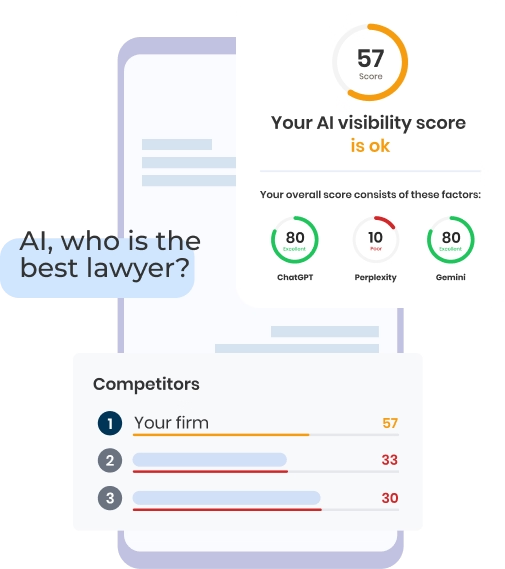
Check Your AI Visibility Instantly
Find Out What AI Is Telling Your Potential Clients
Run our free AI Visibility Report to:
See how often top AI tools mention your law firm
Spot which competitors show up first
Get the next steps to capture more cases
Run My Free AI Report
.avif)
.avif)
.avif)
- Content marketing https://en.wikipedia.org/wiki/Content_marketing
- Law firm https://en.wikipedia.org/wiki/Law_firm
- Search engine optimization https://en.wikipedia.org/wiki/Search_engine_optimization

