

GEO for Personal Injury Lawyers
GEO for Personal Injury Lawyers to Build Your AI Visibility & Citations
Our GEO for personal injury lawyers positions your firm on AI systems like ChatGPT, Perplexity, and Google AI to get found by qualified prospects.
We build around the questions that matter — accident liability, claim value, which PI firm to hire — and turn your content, case results, and credentials into evidence AI systems can cite.
Law-firm-only focus. Trusted since 2008.
.avif)
Recognized by industry experts:
.svg)
.svg)
.svg)
.svg)
.svg)
The Real Problem
Why AI Search Is Different for Personal Injury
AI search for personal injury lawyers is higher stakes. It tackles more complex questions than most legal categories. Your prospects want specifics on their accident, their injury, their state's rules, and their odds. You need content that speaks directly to those specifics with a solid AI visibility for personal injury lawyers system.
01
Accident and Injury Type
Your prospects ask AI systems what to do after a specific accident: car crash, slip and fall, workplace injury, defective product. You need content that addresses each scenario by name. Vague coverage gets skipped, and that potential consultation goes to a competitor.
02
Medical and Treatment Context
Your prospects ask about recovery timelines, treatment costs, and how injuries affect a claim early in their research. You need content that explains these connections clearly, reviewed for medical accuracy. Skip this, and you lose that critical moment they decide to call.
03
Claim Value, Timing, and Jurisdiction
Your prospects want to know what their case is worth, how long it takes, and what rules apply in their state. You need jurisdiction-specific answers, since limitations and fault rules vary by location. Cookie-cutter national content takes second place to state-specific content.
04
Attorney Selection
Once your prospects understand their situation, the next question is which firm to trust and hire. AI systems weigh credentials, case history, and third-party validation when forming an answer. This is your moment to get named.
At this point, the question is not whether AI search is important for personal injury cases. It is whether your firm gets named when these questions come up.
The 5 AI Trust Signals
The Signals AI Systems Check First
There are 5 signals AI systems look for before they name your firm. These are key in your GEO for personal injury law firms plan. Every signal needs a source you control and an owner who keeps it current.
Signal 01
Practice and Injury Clarity
Do you handle car accidents, slip and falls, workplace injuries, and defective products? You need a dedicated page for each one. With that specificity, AI systems will favor your firm over a single catch-all PI page. Your content team owns these pages as case types evolve.
Signal 02
Attorney Credentials and Review
Why should AI systems trust your firm's claims? You need a named, verifiable attorney who stands behind every one. Bios, bar admissions, case results, and published legal content all signal credibility. Your managing attorney owns review and sign-off, keeping the credential trail accurate.
Signal 03
Jurisdiction and Office Consistency
Does your firm's name, address, and phone number match exactly across your website, directories, and legal citations? Inconsistent details confuse AI systems and weaken trust. Your marketing team owns this consistency across every listing and location page you maintain.
Signal 04
Corroborating Legal, Medical, and Local Sources
Go beyond your own website when executing generative AI optimization for personal injury law firms. Why do bar listings, legal directories, local press, and medical references matter? Because AI systems weigh that third-party validation. Your content and PR contacts own outreach to build these sources.
Signal 05
Current, Extractable Answers
Still running long narrative pages instead of clear, direct answers? AI systems can't extract and cite what's buried in prose. Outdated statistics or stale case results weaken your standing further. Your content team owns a review cadence that keeps every page current and citable.
AI Visibility Report
Is AI Search Already Recommending You?
You cannot fix your AI visibility for personal injury lawyers unless you know your current mentions. Before you invest in content or ChatGPT optimization for personal injury lawyers, you need a baseline.
Results vary by platform, location, and how prospects phrase their questions. This report shows your starting point — it's not a promise of where you'll rank.
2 minutes, and you'll see exactly where you stand in AI search.
Your AI visibility baseline
Where your firm stands today across 5 checks
01 · Question coverage & firm mentions
Which PI questions surface you
02 · Cited source domains
What AI pulls from
03 · Competitor share
Who's named most
04 · Answer accuracy
Is your firm described right
05 · AI-referral baseline
How much traffic today
Your AI visibility score
?? /100
Free report. No card required. Ready in 2–4 minutes.
Trust. Clarity. Results.
Our 3-Step Personal Injury AI Visibility System
There are 3 phases in our generative engine optimization for personal injury lawyers. Each builds on the last to solidify your results.
Diagnose
We start with your AI visibility audit, investigating which queries surface your firm, which name competitors, and which sources AI cites instead of you. From there, we build your question map (the exact accident types, medical scenarios, and jurisdiction rules your prospects ask AI). This phase is owned by our strategy team who creates a documented baseline.
Build
Our personal injury lawyer GEO lives or dies on content. This is what AI systems extract and trust. We build attorney-reviewed pages for your specific injury types, credentials, and case results, each one designed to answer the right questions. At the same time, we clean up your entity and schema markup: your name, location, and practice areas stay identical everywhere AI systems check. Our content and technical teams own this phase.
Prove & Improve
Once your content goes live, we build the third-party authority AI systems weigh most: legal directories, local press, corroborating sources. Then we monitor your visibility every month, correcting bad mentions and tracking new questions you appear for. Where attribution data exists, we connect AI-referral traffic straight to qualified leads. Our growth and analytics teams own this phase.
One Connected System
The Services You Get In Our Personal Injury GEO
6 key deliverables make up our personal injury attorney GEO at Grow Law, each with a clear owner and handoff. We never use vague “optimization” language.
AUDIT
AI Visibility Audit
We test how ChatGPT, Perplexity, and Google AI Overviews answer pre-hire questions in your practice area and market. Our GEO strategist handles this, using your site content and competitor answers as input. The output becomes the baseline every later phase builds on.
Explore GEO
QUESTIONS
Conversational-Intent Question Map
We build a structured map of the injury, treatment, and claim-value questions your prospects ask AI before hiring a lawyer. Your account strategist owns this, drawing on the audit findings and your practice area focus. This map becomes the content brief for every page we write next.
CONTENT
Extractable, Attorney-Reviewed Content
We write practice-area content so AI systems can pull direct, accurate answers, then route every page through our attorney review and your team before publishing. Our content team owns drafting; your reviewing attorney owns final sign-off. This is where AI search optimization for personal injury lawyers becomes content AI can cite.
SCHEMA
Schema, Entity, and Local Consistency
We implement Attorney and LegalService schema and align your firm's name, address, and credentials across your site and every legal directory AI platforms reference. Our technical team owns implementation, using your current NAP data as input. Consistent entity signals help with third-party authority building.
CITATIONS
Third-Party Authority and Citations
We strengthen your presence on Avvo, Justia, FindLaw, and state bar directories; the sources AI systems treat as trustworthy references. Our GEO team owns outreach and directory management, building on the entity consistency work from the previous phase. This work compounds over the months.
PORTAL
Tracking, Correction, and Lead Attribution
We monitor your citation rate monthly, flag any inaccurate AI-generated claims about your firm for correction, and connect AI-driven visibility back to lead volume. Our reporting team handles this phase, using live citation data as input. This is where generative AI optimization for personal injury law firms turns into a measurable number you can see.
Proprietary Technology
A Report That Tells You If Marketing Created Cases.
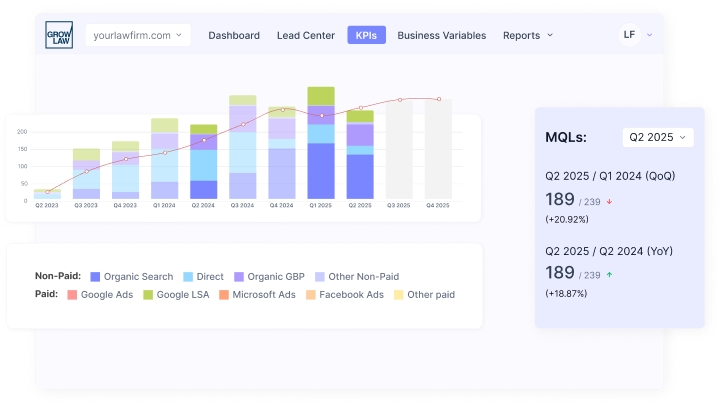
Our Proprietary Growth Portal is one live view of lead quality, signed cases, cost, and AI visibility.
01
Every lead scored
Separate qualified prospects from spam and noise.
02
Every case verified
Connect your CRM to confirm which leads signed.
03
Every dollar accountable
Compare true cost per case by source and campaign.
04
Every AI engine monitored
Track visibility as search behavior changes.
Real Client View ·
Built by Grow Law
Accuracy & Review
How We Protect Your Reputation
✓
Built for the Risk Level of a PI Claim
GEO for personal injury law firms has higher stakes than most industries. Prospects research medical treatment, claim value, and legal deadlines before they hire an attorney. Getting an AI-generated answer wrong isn’t a minor SEO miss; it can snowball into a trust issue. We prevent that.
✓
Attorney-Reviewed Before It Publishes
Every page we write passes through your reviewing attorney before it goes live. Our content team drafts against the conversational-intent map; your attorney owns final sign-off on legal accuracy, tone, and any claim-specific language. Nothing goes live without that approval, and nothing we write constitutes legal advice.
✓
Source and Date Controls on Every Claim
Medical and jurisdictional information changes. We attach a source and last-reviewed date to every statement involving treatment timelines, statutes of limitations, or claim value ranges. Our content team flags any page past its review window for a fresh attorney check before it stays live. Stale information doesn’t sit unaddressed.
✓
No Guarantees, No Overreach
We don’t promise recovery amounts, search rankings, AI citations, or placement inside any named AI product, and we don’t control what ChatGPT, Perplexity, or Google ultimately generate. What we control is the accuracy, structure, and attorney sign-off on everything we publish under your firm’s name.
Client result
Documented Success for Our Clients
“They've been helping us to rank higher on Google. We come up earlier in search results. We've increased our number of retained cases and the quality and strength of the cases. They've delivered over 1,000% ROI in marketing.”

Eli Fuchsberg
Partner since 2022
Jacob D. Fuchsberg Law Firm
New York City · Personal injury, medical malpractice & civil rights · 10–20 attorneys
A respected New York personal injury, medical malpractice, and civil rights practice with three generations of history and $295 million recovered in settlements — but a digital presence that showed none of it. Through a broader engagement covering SEO, AI search optimization, web design, content, and conversion tracking, the firm turned its courtroom reputation into qualified case flow.
- 980% MARKETING ROI
- +196% QUALIFIED LEADS
- +200% ORGANIC TRAFFIC
* These results reflect the firm's broader non-paid engagement, market, starting position, and execution. They illustrate what's possible, but do not guarantee results. Data last verified June 2026.
Want numbers like these for your firm?
Get a free 30-minute growth plan. No obligation, and you keep the plan.
Reporting You Can Check
How We Measure AI Visibility for Personal Injury Lawyers
We report on whether AI systems actually mention your firm, and whether that visibility turns into cases.
01
Citation and Mention Share
The percentage of tracked practice-area and location queries where your firm gets mentioned or cited by name, reported monthly against your baseline audit.
02
AI-Referral Traffic
Sessions attributable to AI platforms sending visitors to your site, tracked separately from organic and paid traffic sources each month.
03
Qualified Leads and Signed Cases
Where attribution allows, we connect AI-driven visibility to qualified leads and signed cases, beyond just visibility metrics alone.
04
Accuracy and Correction Checks
A monthly review of what AI platforms are actually saying about your firm, flagging any inaccurate claims for correction before they compound.
Source for methodology: growlaw.co/generative-engine-optimization.
Meet the Team
The People Dedicated to Your Success
Founded in 2008, Grow Law has a team of 95+ marketing experts who understand how to drive qualified cases consistently, even in cutthroat markets.
Read our story
Why Choose Us
Why Choose Grow Law
What a Typical Agency Does
Same in every market
A general-practice agency that picked up a few law firms along the way, with no feel for how injury clients actually choose a firm.
A rotating pool of generalist freelancers writing about injury claims for the first time, with no view of how AI search keeps changing.
Content published straight from a writer's draft, with no attorney sign-off, no sources, and no review dates on medical or statute claims.
A monthly PDF of visibility screenshots, with no way to tell which channel produced a single signed case.
Content, tracking, and directory logins held in the agency's accounts, so leaving means rebuilding your AI footprint from zero.
What Grow Law Does
Built for personal injury
Law-Firm Exclusive. We've run legal marketing exclusively since 2008. No contractors. No retail. Just legal. This is why our generative engine optimization for personal injury lawyers holds up under scrutiny.
95+ Trained Experts. Every strategist, writer, and analyst on your account is trained specifically for legal marketing and stays current as AI search evolves, tracking platform changes and new standards as part of the job.
Attorney-Quality Workflow. Every piece of content passes through a rigorous review across every practice area we serve with sourced claims, dated statements, and attorney sign-off before going live.
Full Transparency. Our live Growth Portal shows you which channel (including AI search) is producing your leads and cases. You see the same data we do, updated in real time, not just a monthly summary.
You Own Everything. Your website, content, analytics, and accounts stay in your name once paid for. If you ever leave, you take everything we built. No locked-down assets you have to rebuild from scratch.
Source: growlaw.co/about-us.
Free GEO growth plan
Ready to Turn AI Search Into a Steady Case Flow?
Personal injury firms working with Grow Law are being named, cited, and recommended across ChatGPT, Google AI Overviews, and Perplexity — while their competitors stay invisible.
You'll walk away with a clear read on which injury questions surface your firm today, which competitors AI recommends in your market instead, and a prioritized GEO plan for more signed cases and measurable ROI.
If we are not the right fit, we will say so.
No obligation. No pressure. Keep the plan.

Mary Grinnan
Growth Expert, she'll be leading your session
Questions, Answered
Frequently Asked Questions
Have a question? We've probably answered it here. These are the top queries personal injury firms ask when exploring AI search.
Still deciding? Call (954) 859-1712 and talk to a real person.
What is GEO for personal injury lawyers?
GEO for personal injury lawyers is the practice of structuring your firm's content, entity signals, and third-party corroboration. That way, AI systems like ChatGPT, Perplexity, and Google AI Overviews can accurately mention and cite your firm when prospects ask injury-related questions. It builds your visibility and citation readiness. It is not a guaranteed placement in any specific answer. See our broader GEO for lawyers service for the full picture beyond personal injury.
How does generative engine optimization work for personal injury lawyers?
The process runs as a loop. We audit which questions and citations AI platforms currently surface for your practice area, then create extractable, attorney-reviewed content and entity signals to close the gaps. From there, we strengthen third-party corroboration through legal directories and authoritative sources, then monitor results monthly and correct inaccurate claims. We cannot guarantee results as third-party AI systems remain outside any agency’s direct control.
How is GEO different from SEO for personal injury lawyers?
SEO and GEO target different surfaces but share the same foundation. SEO builds your discoverability and authority in traditional search rankings. GEO focuses on how AI answer systems interpret, cite, and mention your firm in generated responses, a separate mechanic with separate measurement. Neither replaces the other. To get the strongest results, run an integrated program covering both. It's not an either/or choice between them.
How can personal injury lawyers appear in ChatGPT?
Your firm can appear in ChatGPT by relying on controllable inputs: a clear, consistent firm identity, content that directly answers real pre-hire questions, third-party source corroboration, and technical accessibility that lets AI crawlers read your site. Ongoing monitoring tells you whether those inputs are working. No agency, including ours, can guarantee a ChatGPT mention or control how the underlying model generates its answers.
How can personal injury law firms get cited by AI?
Getting cited comes down to a specific evidence chain: original, useful content that directly answers prospect questions, visible attorney credentials and proof, consistent entity and location signals across your site and directories, and reputable third-party references AI systems favor. Keep in mind, citation behavior varies by platform and by query, so results differ across ChatGPT, Perplexity, and Google AI Overviews even with the same underlying content.
How do personal injury lawyers appear in Google AI Overviews?
Appearing in Google AI Overviews depends on whether your content is indexable, trustworthy, and directly relevant to the query context Google is answering. There’s no inclusion switch to flip. What actually moves the needle is a combination of solid technical SEO, clearly structured content, and consistent local and entity signals, paired with the third-party corroboration that helps Google treat your firm as a credible source.
What should personal injury GEO services include?
A complete personal injury GEO program should include 6 core deliverables: an AI visibility audit, a conversational-intent question map, extractable attorney-reviewed content, schema and entity consistency, third-party authority building, and ongoing tracking with correction and lead attribution. Before you launch any engagement, make sure deliverables, ownership, review cadence, and reporting definitions are agreed on upfront. Do not leave these ambiguous.
How do you measure AI visibility for personal injury law firms?
You can measure AI visibility with a baseline audit, then rely on monthly tracking across question coverage, mention and citation share, and which domains AI systems cite alongside you. From there, we track AI-referral traffic and, where attribution allows, tie that back to qualified leads or signed cases. We separately report directional visibility indicators and actual business outcomes, so you always know which number reflects which stage.
Page last reviewed
8/25/2026
Reviewed by Sasha Berson, CGO @ Grow Law
Explore more ways we can help: