


Table of Contents
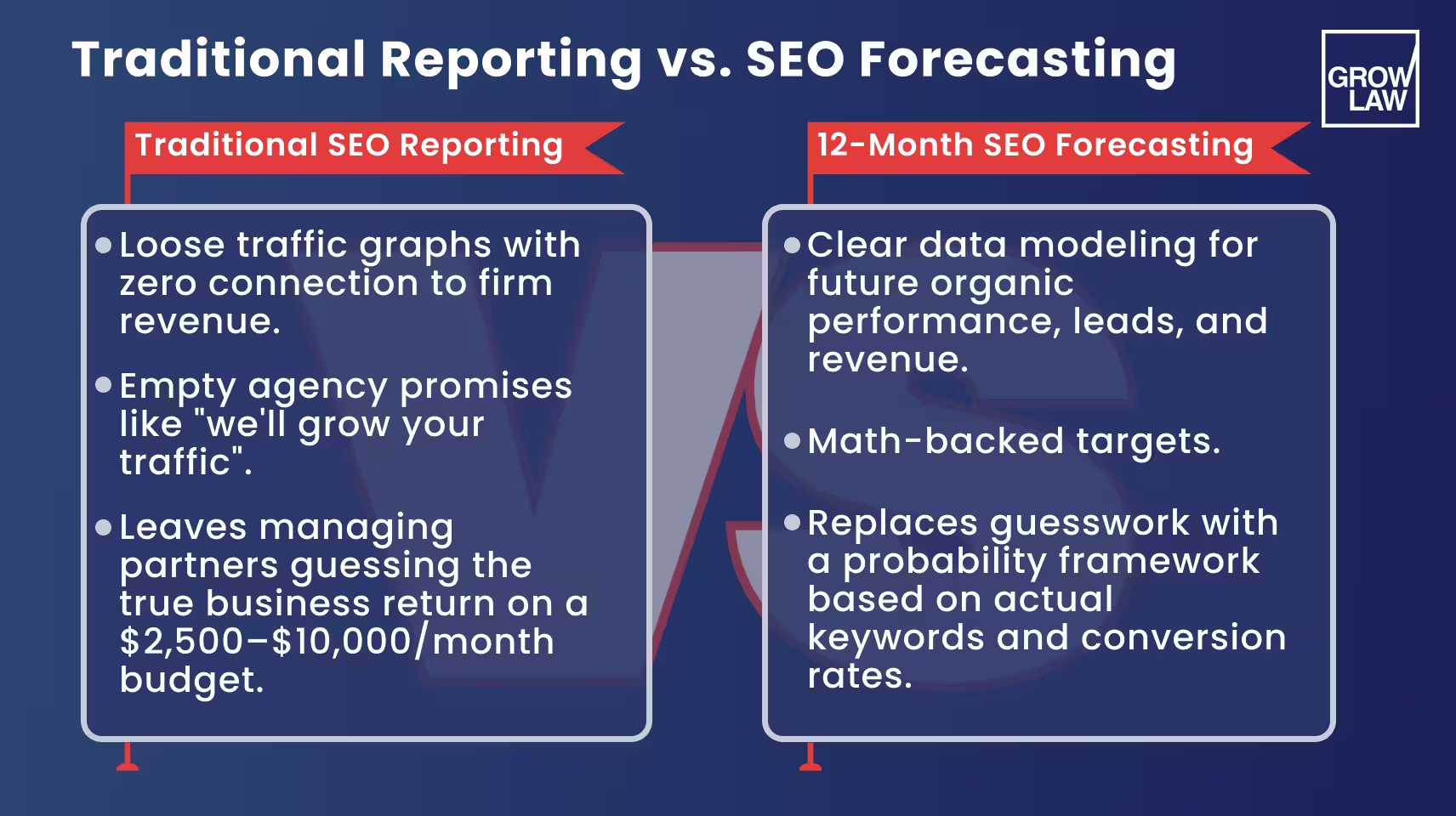
SEO forecasting gives law firms a structured way to project what organic search will produce — in traffic, leads, and revenue — before the results arrive. Most firms invest in SEO on faith. Forecasting replaces that guesswork with a data model so you can hold your agency accountable and make budget decisions based on projected returns, rather than promises.
This article explains how SEO forecasting works, what inputs it requires, and how to build a 12-month projection your firm can actually use.
Want to work with an agency that can model your expected returns? Explore our law firm SEO services.
What Is SEO Forecasting and Why Law Firms Need It
SEO forecasting is the process of projecting future organic search performance — traffic, rankings, leads, and revenue — using current keyword data, historical conversion rates, and competitive research. It's not a guarantee; it's a probability model.
The goal is to replace vague promises ('we'll grow your traffic') with specific projections ('we expect 140–180 monthly organic visitors by month 12, producing an estimated 4–6 qualified leads per month based on your current conversion rate').
Most law firms invest $2,500–$10,000/month in SEO without a clear model for what that investment should return. That's the gap forecasting closes. The managing partner who approves an SEO budget deserves the same analytical rigor they'd apply to any other business investment. SEO forecasting provides that framework.
What Data Goes Into an SEO Forecast for a Law Firm
A reliable forecast requires four inputs: keyword ranking trajectory, search volume, click-through rate by position, and your site's conversion rate. Each input introduces variance — the more accurate each data point, the tighter the projection range.
Keyword ranking trajectory estimates where your pages can realistically rank over 12 months given current competition. If you're ranking #12 for "personal injury lawyer Chicago," moving to #5 is achievable in 6–9 months with the right content and link strategy. Moving to #1 in a market with three funded PI firms requires 18–24 months. These timelines affect the forecast meaningfully.
The return on investment calculation comes from applying CTR benchmarks to search volume by rank position. Standard industry CTR curves: position 1 captures roughly 28% of clicks, position 3 around 11%, positions 5–10 average 2–5%. Multiply estimated monthly clicks by your site conversion rate (form submissions or calls ÷ sessions) to project leads. Multiply leads by your average case value and close rate to project revenue.
Understanding how to produce an organic traffic forecast from keyword and CTR data is the core skill; translating that forecast into SEO revenue forecasting is the step that turns the model into a budget conversation. Benchmarks from high-performing firms — where marketing returns compound at 400–800%+ — should anchor the revenue side of the model.
How to Build a 12-Month SEO Traffic Forecast
The mechanics of a 12-month forecast: start with your target keywords and current positions, then model rank progression month by month based on competitive data. Apply CTR benchmarks at each projected position to calculate estimated monthly clicks. Multiply by your conversion rate to get leads. Multiply leads by average case value and close rate to get projected revenue.
A personal injury firm in a mid-size market (500K population) started SEO from scratch with zero organic leads per month, relying entirely on referrals.
Grow Law built a 12-month traffic forecast using current SERP competition data and historical CTR benchmarks for that market. By month 9, organic traffic hit 73% of projected targets and the firm was receiving 18–22 qualified leads per month — within 15% of the forecast. That level of accuracy is realistic when the input data is current and the competitive landscape is properly modeled.
Most forecasts should include three scenarios: conservative (slower rank progression, lower CTR), base (expected outcomes given normal execution), and aggressive (assumes competitive wins and content velocity). This gives the firm a realistic range rather than a single number that becomes a false promise.
Translating Traffic Forecasts into SEO ROI
Traffic projections only matter if they connect to your business outcomes. The revenue side of the model: projected monthly visitors × conversion rate = projected leads. Projected leads × close rate × average case value = projected monthly revenue. Project over 12 months and divide by the total SEO investment to calculate projected ROI.
Newlin Law Offices ran this math before committing to their SEO investment. The results came in 10 months later: 575% organic traffic growth, 106% conversion rate increase, 550% ROI. The forecast wasn't perfect, but it gave the firm a baseline to evaluate whether actual results were on track or falling short.

Grow Law's average 3-year client ROI is 526%. Forecasting gives you a framework to hold your agency accountable to that number — not just wait and hope.
At the high end, Omar Ochoa Law achieved a 1,087% increase in qualified leads and a 655% increase in organic traffic. These outcomes weren't predicted in advance — they reflect a competitive personal injury market in Texas where demand and execution aligned exceptionally well. Forecasts for a new client in that market should model realistically, not around outlier results.
Using SEO Forecasts to Set Budget Expectations
SEO forecasting turns "can we afford SEO?" into "what is the expected return?" That reframe changes the budget conversation. Instead of evaluating cost, a managing partner evaluates projected ROI — the same way they'd evaluate hiring another associate or opening a second location.
An immigration law firm was evaluating whether to invest $3,000/month in SEO. The forecast projected 140–180 monthly organic visitors by month 12, with a 3.2% conversion rate and $2,800 average case value — translating to $12,500–$16,000/month in projected revenue. The firm approved the budget. Actual results: 162 organic visitors by month 11, with 5 signed cases that month. The forecast gave the firm a rational basis for the decision and a benchmark to evaluate performance against.
See how an attorney SEO agency builds forecasts tied to real revenue outcomes. Explore our attorney SEO agency.
Require any SEO agency you evaluate to provide a data-backed forecast with assumptions listed — not just traffic projections. A good forecast includes: current position baselines for target keywords, month-by-month rank progression assumptions with rationale, CTR benchmarks by position, and projected revenue at your close rate and case value. If an agency can't produce this, they're not running a data-driven campaign.
Forecast Accuracy: What to Expect and How to Track It
SEO forecasts are probabilistic models, not commitments. Algorithm updates, competitor content surges, technical site issues, and changes in search behavior all affect actual outcomes. A well-built forecast with documented assumptions should land within 20–30% of actual results at the 12-month mark. Significant variance — either direction — should trigger a review of inputs and assumptions.
Track forecast vs. actuals monthly. The most useful metrics: organic sessions (GSC → Performance), keyword rank positions (rank tracker), form submissions and calls attributed to organic, and CPL from organic vs. paid
Barr & Douds achieved a 29,340% increase in organic traffic with an 88% reduction in cost per lead over a decade of consistent monthly tracking. Sequoia Legal hit a 1,053% marketing ROI and 276% increase in qualified leads — results that started from a conservative forecast and grew as actuals exceeded projections each quarter.
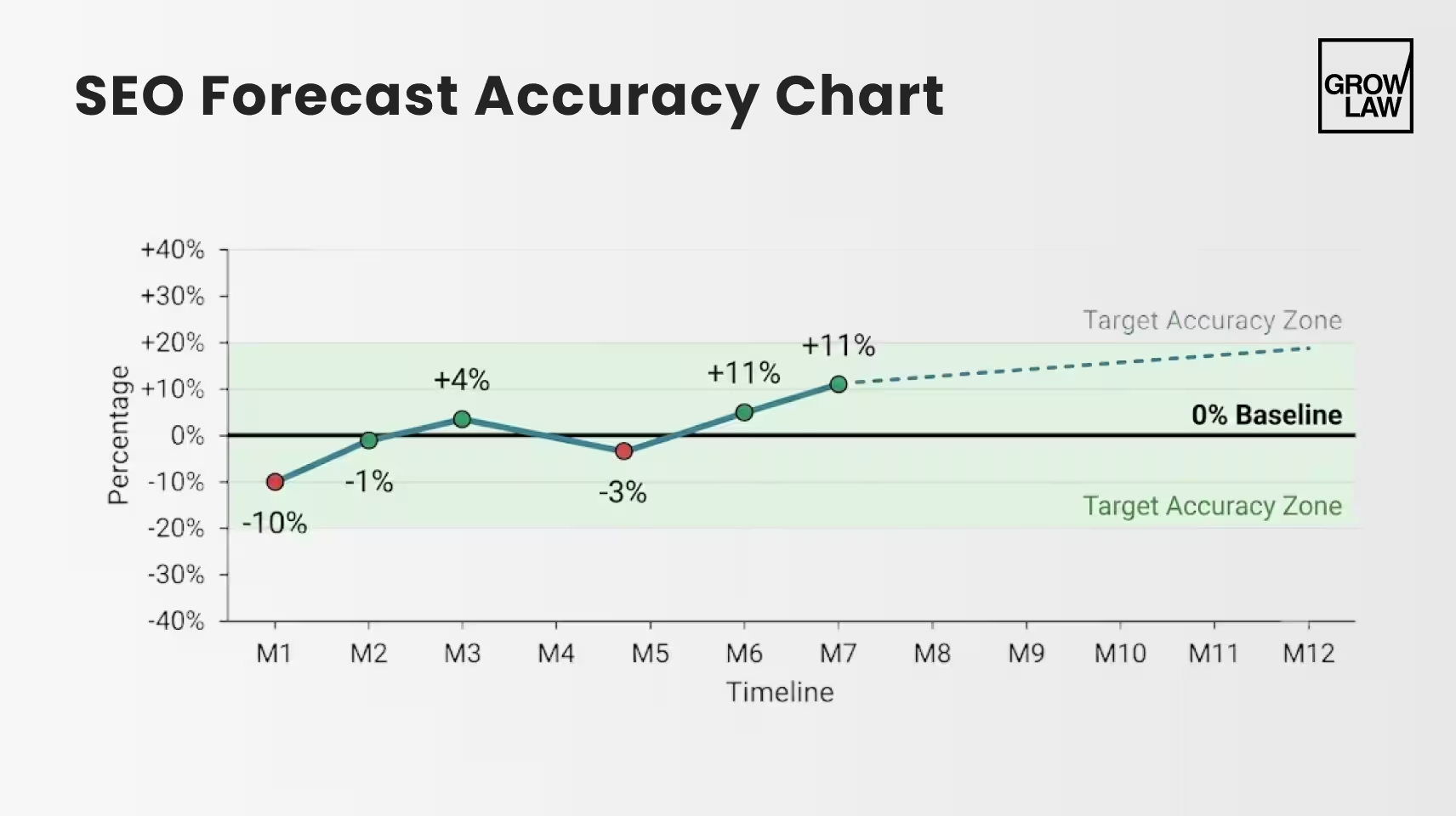
If your agency doesn't compare forecast vs. actuals monthly and adjust strategy accordingly, the forecast was theater, not planning. A live dashboard that connects SEO activity to lead volume and revenue in real time is the infrastructure that makes forecasting actionable rather than retrospective.
Summary
- SEO forecasting projects future organic traffic, leads, and revenue using keyword data, CTR benchmarks, and your conversion rate
- The four forecast inputs: keyword ranking trajectory, search volume, CTR by position, and site conversion rate
- Model three scenarios (conservative, base, aggressive) to give the firm a realistic outcome range, not a single number
- Translate traffic forecasts into revenue by applying close rate and average case value to projected lead volume
- Require any SEO agency to provide a data-backed forecast with documented assumptions before signing
- Track forecast vs. actuals monthly and adjust strategy when variance exceeds 20–30%
Ready to build a forecast for your firm's SEO growth? Explore our SEO for law firms.
Frequently Asked Questions

Compare Your Practice Instantly
Stay Ahead of the Competition!
Compare your law firm's performance to Local competitors with our instant assessment tool
Get a clear picture of your firm's performance
Boost your online presence
Compare My Firm
Compare Your Practice Instantly
Stay Ahead of the Competition!
Compare your law firm's performance to Local competitors with our instant assessment tool
Get a clear picture of your firm's performance
Boost your online presence
Compare My Firm

Check Your AI Visibility Instantly
Find Out What AI Is Telling Your Potential Clients
Run our free AI Visibility Report to:
See how often top AI tools mention your law firm
Spot which competitors show up first
Get the next steps to capture more cases
Run My Free AI Report