


Table of Contents
An SEO content audit is a systematic review of every page on your law firm's website to determine what's driving rankings and leads, what's stagnant, and what may be actively hurting your performance. Most law firms with 50 or more blog posts are carrying a significant volume of underperforming content that dilutes their site's authority and wastes crawl budget.
In this guide, we explain how to audit your content, what criteria determine whether to keep, refresh, or remove a page, and how law firm-specific factors like practice area staleness and outdated legal references make this process different from generic content auditing.
Need a content strategy tied to qualified lead growth? Explore our law firm SEO services.
What Is an SEO Content Audit and Why Do Law Firms Need One?
An SEO content audit is a structured review of all URLs on a website, evaluated against performance data: organic impressions, clicks, average position, backlinks, and conversion metrics. The goal is to segment every page into one of three categories: pages performing well that should be protected and strengthened; pages with potential that should be refreshed; and pages that are dead weight and should be consolidated or removed.
Like most law firm websites, yours might accumulate content problems over time: practice area pages with outdated statutes, blog posts written for keywords no one searches anymore, duplicate location pages with thin unique content, and FAQ pages that haven't been updated since 2019.
Each of these pages signals to Google that your site contains low-quality content. A well-executed content audit removes that signal and concentrates authority on the pages that matter.
Content Decay: Why Older Law Firm Pages Lose Rankings
Content decay is the gradual loss of rankings as a page becomes outdated relative to fresher, more comprehensive competitor content.
It happens in three ways: the legal information becomes outdated (statute changes, court ruling updates), competitors publish stronger content on the same topic, or the page loses backlinks over time as referring sites update their own content.
A criminal defense firm's "DUI lawyer" practice area page had ranked at position 4 for 14 months, then slipped to position 9 over 4 months without any changes on the firm's site.
An audit revealed that three competitor posts had been updated with current state statute data and recent DUI sentencing statistics. After refreshing the page with updated legal references and FAQ additions targeting current search intent, the page recovered to position 5 within 8 weeks. The decay wasn't caused by anything the firm did. It was caused by what competitors did.
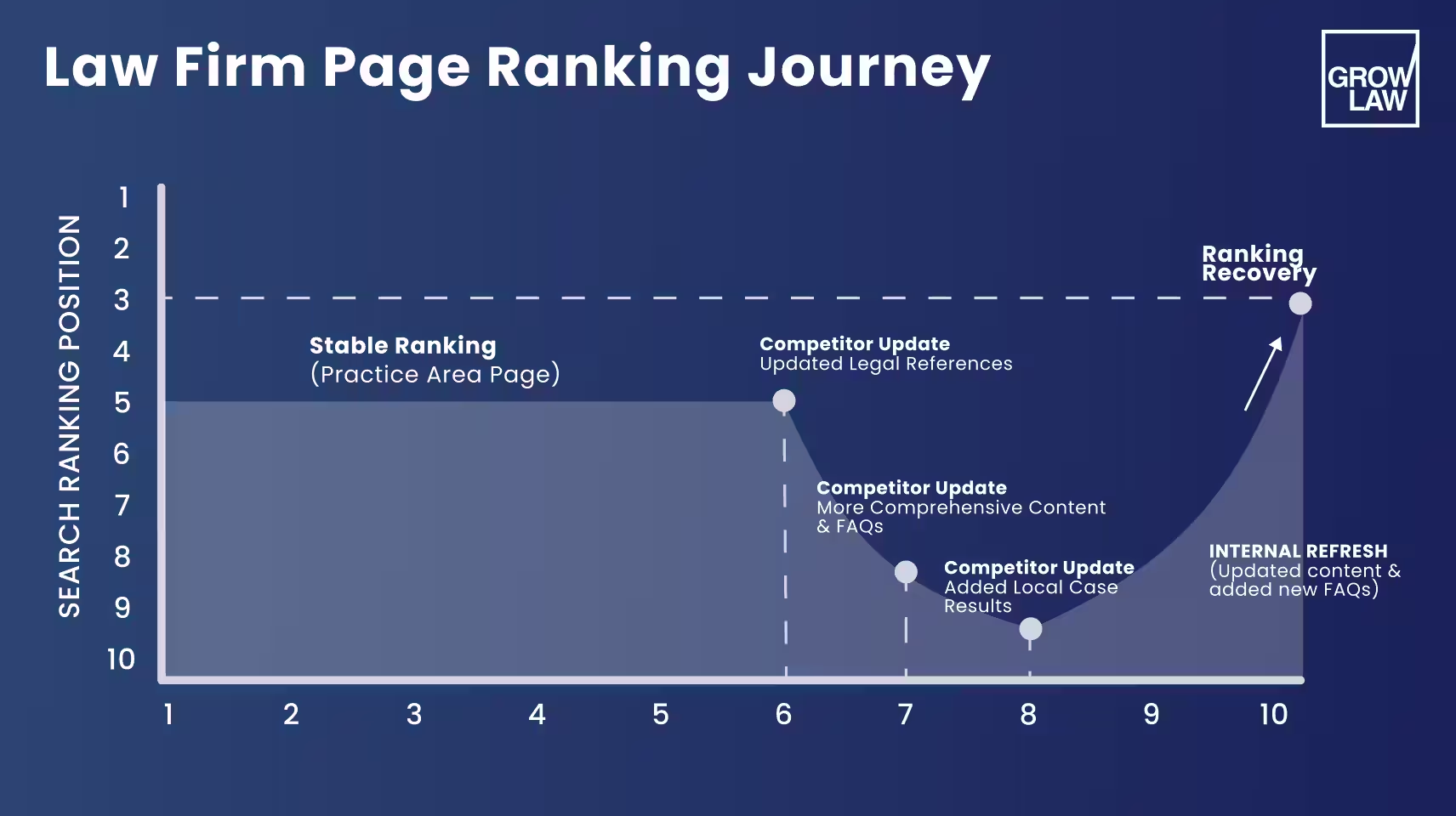
Content decay SEO is an ongoing process, not a one-time event. A page that ranks well today can decay in 6 months if competitors update aggressively. The firms that sustain rankings treat content maintenance as a recurring operational task, instead of a one-time project.
How to Run an SEO Content Audit for a Law Firm
The process has four steps: inventory, analyze, segment, and act.
Step 1 — Inventory: Export all URLs from Google Search Console (Performance → Pages). Include every URL with at least one impression in the past 12 months. Add a crawl export from Screaming Frog or a similar tool to capture pages Google has found but isn't indexing.
Step 2 — Analyze: For each URL, record: 12-month impressions, 12-month clicks, average position, click-through rate, number of referring domains (from Ahrefs or SEMrush), word count, and last-modified date. This data determines which segment each page falls into.
Step 3 — Segment: Apply these thresholds to classify each page. Adjust thresholds based on your site's traffic scale.
Step 4 — Act: Execute the refresh and pruning decisions systematically. Don't prune and refresh simultaneously. Google needs time to process each change.
Use both "content audit SEO" and "SEO content audit" terminology when documenting the process for your team. Different stakeholders use different terms and your documentation should match how each team searches internally.
Content Pruning for Law Firm SEO: What to Remove or Consolidate
Content pruning SEO is the deliberate removal or consolidation of low-value pages to concentrate crawl budget and link equity on pages that matter. The mechanism: when Google crawls a site, it allocates crawl budget based on site authority. Every low-quality page it has to crawl is bandwidth not spent on your best pages.
Three pruning decisions: (1) 301 redirect to a stronger related page — use when the pruned page covers a topic better addressed on another URL; (2) Consolidate — merge two thin posts covering the same topic into one comprehensive page; (3) Delete — use only when there are zero backlinks, zero organic sessions over 12 months, and the topic is fully covered elsewhere.
A family law firm had 140+ blog posts, 60% receiving fewer than 5 organic sessions per month. After a content audit using Google Search Console data, Grow Law identified 38 posts for consolidation or removal and 22 for full refresh. Within 6 months, the top 30 remaining pages saw a 41% average increase in impressions. Removing the dead weight allowed Google to allocate more crawl budget and authority signal to the pages that deserved it.
Never delete without a redirect unless the URL has zero inbound links and has never ranked. A deleted page with backlinks that doesn't redirect loses those links permanently.
What Content Should Law Firms Update vs. Delete?
The update-vs-delete decision comes down to three factors: search volume, existing authority signals, and uniqueness of coverage.
Update if the page covers a topic with real search volume (500+ monthly searches), has at least one referring domain or 10+ monthly impressions, and is the best URL on your site for that topic.
Updating is almost always cheaper than building authority for a new URL from scratch. Newlin Law Offices saw a 575% surge in organic traffic and a 106% increase in conversion rate after Grow Law optimized and refreshed their existing content, not by publishing more pages, but by making the right pages significantly better.
Delete/redirect if: the topic has no measurable search volume, the page has no backlinks and no organic traffic, and the topic is covered more comprehensively on another page. Outdated content SEO doesn't just affect the specific page. Google's quality assessment of a site is holistic. A site with 40% thin, outdated pages is evaluated differently from one with 90% strong pages. Sequoia Legal compounded a 6,700% increase in organic traffic by consistently weeding out underperforming content while strengthening pages that earned the traffic.
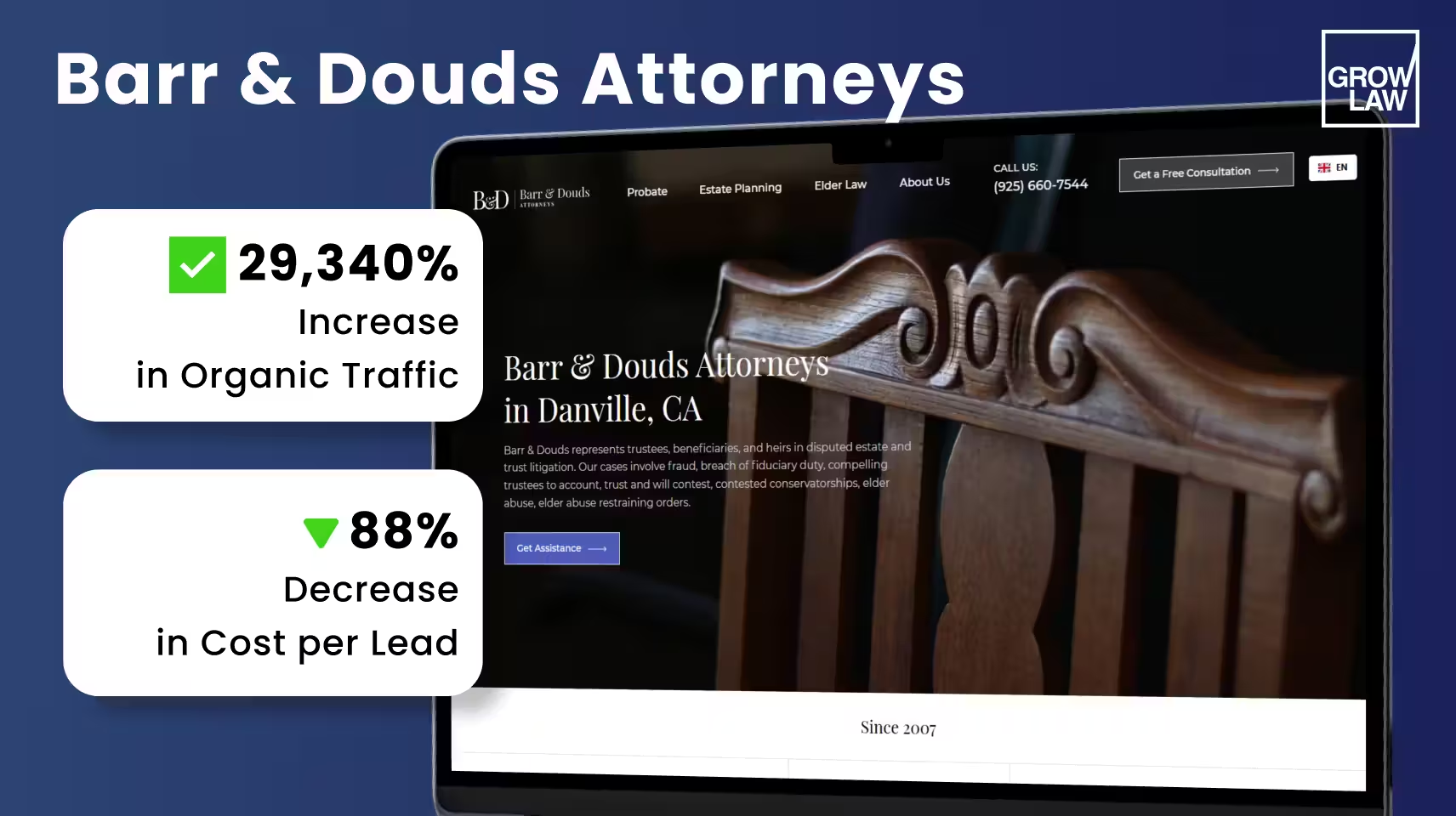
Barr & Douds has worked with Grow Law since 2016 and achieved a 29,340% increase in organic traffic with an 88% reduction in cost per lead. That compounding result isn't explained by any single campaign action. It's a decade of consistent content quality management: removing what doesn't work, strengthening what does, and building new content on validated topics.
Want a content audit tied to qualified lead growth for your firm? See our SEO for attorneys.
How Often Should Law Firms Audit Their Content?
Two cadences: a quarterly light review of your top 20–30 pages in GSC (look for impressions or position drops over 30 days), and a full annual audit covering every indexed URL. Triggers for an immediate audit: a significant ranking drop after a Google core update, a site redesign, or a sudden drop in organic leads that can't be explained by seasonality.
Summary
- An SEO content audit segments every page into Perform, Refresh, or Prune based on impressions, clicks, position, backlinks, and content freshness
- Content decay is caused by competitor updates and legal information becoming outdated; it's ongoing, not one-time
- The pruning decision: update if there's search volume and existing authority; redirect or delete if there's neither
- Never delete a page with backlinks without a 301 redirect
- Full audit annually; light review of top pages quarterly; immediate audit after core updates or site migrations
- Content quality management is a recurring operational task — firms that treat it as a one-time project don't sustain rankings
Build a content strategy that compounds over time, not just one that generates traffic with our attorney SEO agency.
Frequently Asked Questions

Compare Your Practice Instantly
Stay Ahead of the Competition!
Compare your law firm's performance to Local competitors with our instant assessment tool
Get a clear picture of your firm's performance
Boost your online presence
Compare My Firm
Compare Your Practice Instantly
Stay Ahead of the Competition!
Compare your law firm's performance to Local competitors with our instant assessment tool
Get a clear picture of your firm's performance
Boost your online presence
Compare My Firm
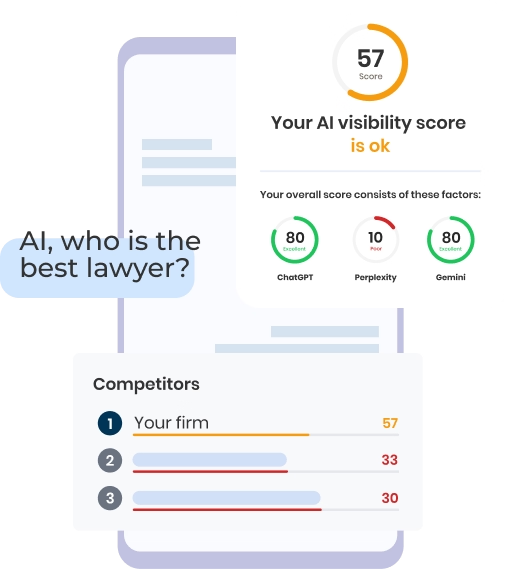
Check Your AI Visibility Instantly
Find Out What AI Is Telling Your Potential Clients
Run our free AI Visibility Report to:
See how often top AI tools mention your law firm
Spot which competitors show up first
Get the next steps to capture more cases
Run My Free AI Report
.avif)
.avif)
.avif)

