


Table of Contents
Schema markup for law firms is structured data added to a website's HTML that tells search engines and AI systems exactly what the page content means — not just what words it contains. For your law firm, this means telling Google that your page represents a specific attorney with specific bar admissions, a specific practice area in a specific location, with verified reviews. Our law firm practice area pages guide covers the content structure that the markup should describe.
The direct benefits are measurable: legal websites with structured data experience 20–30% improvements in click-through rate. Beyond CTR, schema markup is the technical implementation layer of E-E-A-T — the same attorney credentials that build human trust also signal expertise to Google and to AI systems that decide which law firms to cite.
In this guide, we cover what schema markup does, how it benefits law firm SEO and local search, which schema types every law firm website needs, and how to implement them correctly.
What Is Schema Markup for Law Firms and Why Does It Matter?
Schema markup for law firm content is defined by the Schema.org vocabulary as a shared standard developed by Google, Microsoft, Yahoo, and Yandex for communicating structured information about web content.
For law firms, it works like this: without schema, Google reads your attorney bio page and extracts meaning from the text. With schema, you explicitly tell Google "this person is a licensed attorney, admitted to the State Bar of Texas in 2009, bar number 12345, practicing personal injury law in Austin." The difference in how Google treats those two signals is significant.
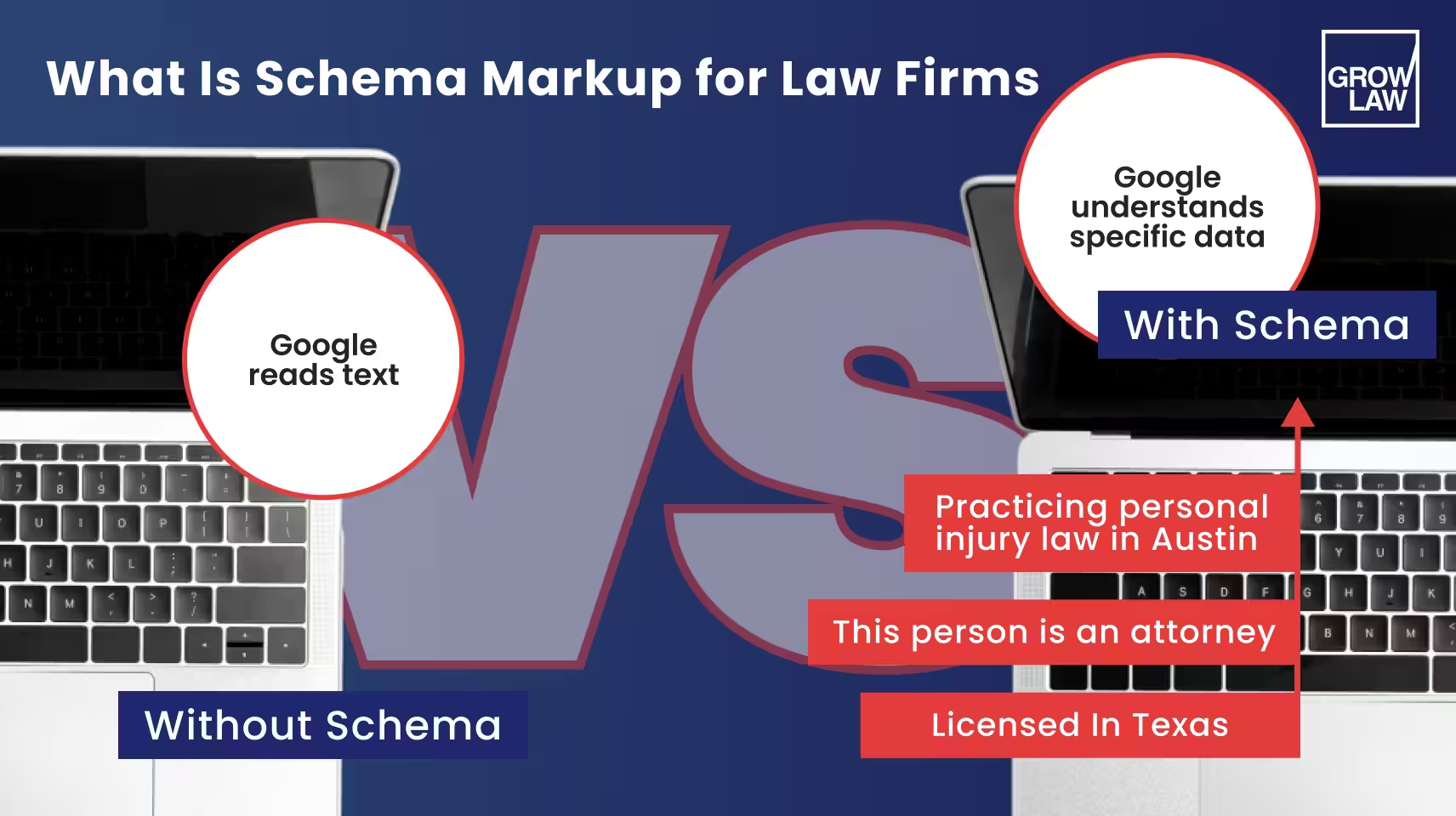
The business case for schema comes down to two direct outcomes.
First, rich results — star ratings, attorney name, practice area, and FAQ boxes that appear directly in the SERP and make your listing visually distinct from every competitor without schema.
Second, entity recognition — Google and AI systems build a more complete, more confident understanding of who your firm is, what it does, and where it operates. Both outcomes compound over time as the structured data accumulates authority.
Schema markup is part of every Grow Law SEO build: law firm SEO services
Schema Markup Benefits for Law Firms SEO: CTR, Rich Results, and SERP Visibility
The most immediate schema markup benefits for law firms SEO are visible in the search results: rich results that make your listing take up more visual space, display star ratings, and show the attorney's name alongside the practice area. These visual enhancements drive click-through rates that compound every ranking position you've earned.
A family law firm had 14 practice area pages ranking on page one, but with an average CTR of 1.8%, well below the 3.2% legal industry average.
A technical audit found zero schema markup sitewide. After implementing LegalService, Attorney, and Review schema across all pages, average CTR increased to 3.1% within 6 weeks, without any change in ranking position. The structured data enabled rich results (star ratings, attorney credentials) that made the firm's listings visually distinct in the SERP.
Schema markup doesn't improve your rankings directly. It improves how your existing rankings perform — by making your listings visually distinct, surfacing review data, and enabling rich results that competitors without schema can't access.
What Schema Markup Should Your Law Firm Website Use?
The complete list of schema types relevant to law firms is documented at Schema.org. Seven types cover nearly every page on a law firm website:
Attorney Schema: Your Firm's Strongest E-E-A-T Signal
Attorney schema — implemented as Person type with legal-specific properties — is the technical layer that makes attorney credentials machine-readable. It's where the E-E-A-T advantage of real, verifiable credentials gets communicated to Google and AI systems in structured form.
A criminal defense firm had invested heavily in GEO content but appeared in zero AI-generated answers for their target queries. An audit revealed they had no Attorney schema, no Review schema, and no structured data connecting the attorney's name to the firm's practice area and location.
After implementing the Attorney schema with bar admissions, practice area, and city fields, plus the LegalService schema on all practice area pages, the firm began appearing in Perplexity and ChatGPT answers for their primary practice area + city combination within 8 weeks.
Jacob Fuchsberg Law Firm implemented Attorney schema as part of a comprehensive technical SEO build with Grow Law. The result: 980% marketing ROI, 196% increase in qualified leads, 200% organic traffic growth — along with a 606% increase in AI-generated traffic. The AI traffic figure reflects the firm’s broader SEO and AI search program, supported by website and conversion improvements.
.avif)
Grow Law implements Attorney schema as part of every SEO program: attorney SEO
Schema Markup Benefits for Law Firm Websites: Local SEO Impact
The schema markup benefits for law firm websites extend directly into local search through two mechanisms: LocalBusiness schema that supports GBP connection and local pack signals, and Review schema that makes star ratings visible in both organic and map results.
Your LocalBusiness schema for law firms should include: exact NAP matching your GBP listing (name, address, phone), service area definition (areaServed property), office hours, geo coordinates, and a sameAs link to your GBP profile URL. These fields don't replace GBP optimization — they reinforce it. Google treats consistent NAP across GBP, website schema, and legal directory listings as a local authority signal.
Newlin Law Offices achieved a 575% organic traffic increase and 106% conversion rate improvement through a full SEO program with Grow Law — schema markup was part of the technical foundation that made that performance possible. Omar Ochoa Law achieved a 1,087% increase in qualified leads and 655% organic traffic growth through sustained technical SEO, including schema implementation.
Should Law Firms Add Schema Markup to Blog Content?
Yes — and most law firms that invest in blog content skip this entirely, leaving E-E-A-T attribution on the table. Blog posts without Article schema and author attribution are processed by Google as anonymous content.
Blog posts with Article schema that links the author property to a credentialed Attorney entity are evaluated as expert-authored YMYL content — a meaningful difference in how Google assesses quality.
The author bio SEO loop works through schema: the blog post's Article schema has an author property pointing to the attorney's Person schema (via URL reference). The attorney's Person schema includes bar admissions, education, and sameAs links to authoritative directories. Google follows that chain and attributes the blog content to a verified legal expert.
Without the schema connection, the chain breaks — even if the attorney byline is visible in the page text.
How to Add Schema Markup to Your Law Firm Website
Google recommends JSON-LD as the preferred schema implementation format — it's added to the <head> section of each page and doesn't affect visible HTML, making it easier to maintain and update. The alternative formats (Microdata, RDFa) are embedded in the page HTML and are significantly harder to manage across a large law firm website.
Grow Law's team implements Attorney schema with all legally-specific fields (bar number, sameAs links to bar directory) as part of every SEO engagement — with 80+ years of combined SEO experience in legal markets. Grow Law's SEO clients see 400%–800% marketing ROI, and schema markup is part of the technical foundation that makes that performance possible. Plugin-generated schema covers generic fields but not the attorney-specific properties that create the strongest E-E-A-T signals for law firms.
Summary
- Schema markup for law firms tells Google and AI systems exactly what your pages mean — attorney credentials, practice area, location, reviews — in a structured, machine-readable format.
- Legal websites with structured data see 20–30% CTR improvements; the mechanism is rich results (star ratings, attorney info, FAQ accordions) that make listings visually distinct in the SERP.
- Seven schema types cover every law firm page: Attorney/Person, LegalService, LocalBusiness, Review/AggregateRating, FAQPage, Article/BlogPosting, and BreadcrumbList.
- Attorney schema is the strongest E-E-A-T signal — implementing bar admissions, education, and sameAs links to bar directories creates the entity recognition AI systems use to cite law firms in answers.
- Blog content requires Article schema with an author property linked to the Attorney Person entity — without it, blog posts are processed as anonymous content regardless of the visible byline.
- Implement schema as JSON-LD in the page <head>; validate with Google Rich Results Test; monitor Search Console Enhancements for errors.
Ready to implement schema markup as part of a complete law firm SEO strategy? Explore our law firm SEO agency.
Frequently Asked Questions

Compare Your Practice Instantly
Stay Ahead of the Competition!
Compare your law firm's performance to Local competitors with our instant assessment tool
Get a clear picture of your firm's performance
Boost your online presence
Compare My Firm
Compare Your Practice Instantly
Stay Ahead of the Competition!
Compare your law firm's performance to Local competitors with our instant assessment tool
Get a clear picture of your firm's performance
Boost your online presence
Compare My Firm
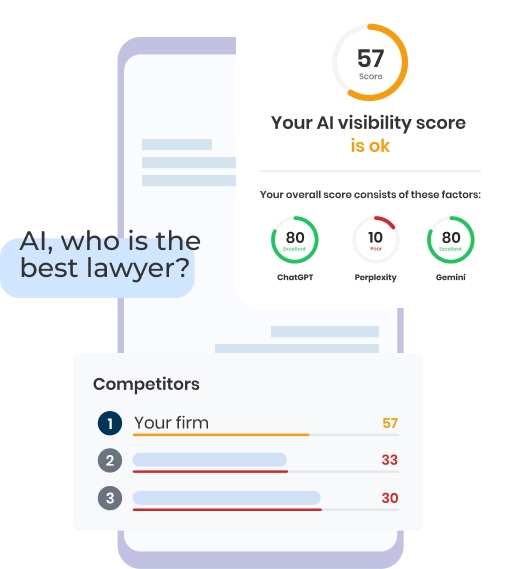
Check Your AI Visibility Instantly
Find Out What AI Is Telling Your Potential Clients
Run our free AI Visibility Report to:
See how often top AI tools mention your law firm
Spot which competitors show up first
Get the next steps to capture more cases
Run My Free AI Report
.avif)
.avif)
.avif)

