


Table of Contents
If you've been wondering how to build local citations for law firm SEO, this guide is written for you — not for a marketing director, but for the attorney or partner who keeps hearing the term and wants to understand what it actually means for the firm.
We'll walk through what citations are in plain language, why Google still cares about them in 2026, which online directories matter most for lawyers, how to check the listings you already have, how to build new ones correctly, and the small mistakes that quietly push firms out of the top three results on Google Maps. No jargon spirals. Just the parts that move the needle.
Before we start, one honest note: local citations aren't a silver bullet. They're one piece of how Google decides which law firms to show when someone in your city searches for an attorney. But they're the piece most firms get wrong — and fixing them is usually cheaper and faster than almost anything else on the local SEO to-do list.
1. What Local Citations Are (In Plain English)
A "local citation" is just any place on the internet where your law firm's name, address, and phone number show up together. Marketers call this combination your NAP — Name, Address, Phone. That's the entire concept. If your firm is listed on Avvo with its office address and phone number, that's a citation. If a local bar association website mentions your firm along with the same details, that's a citation too.
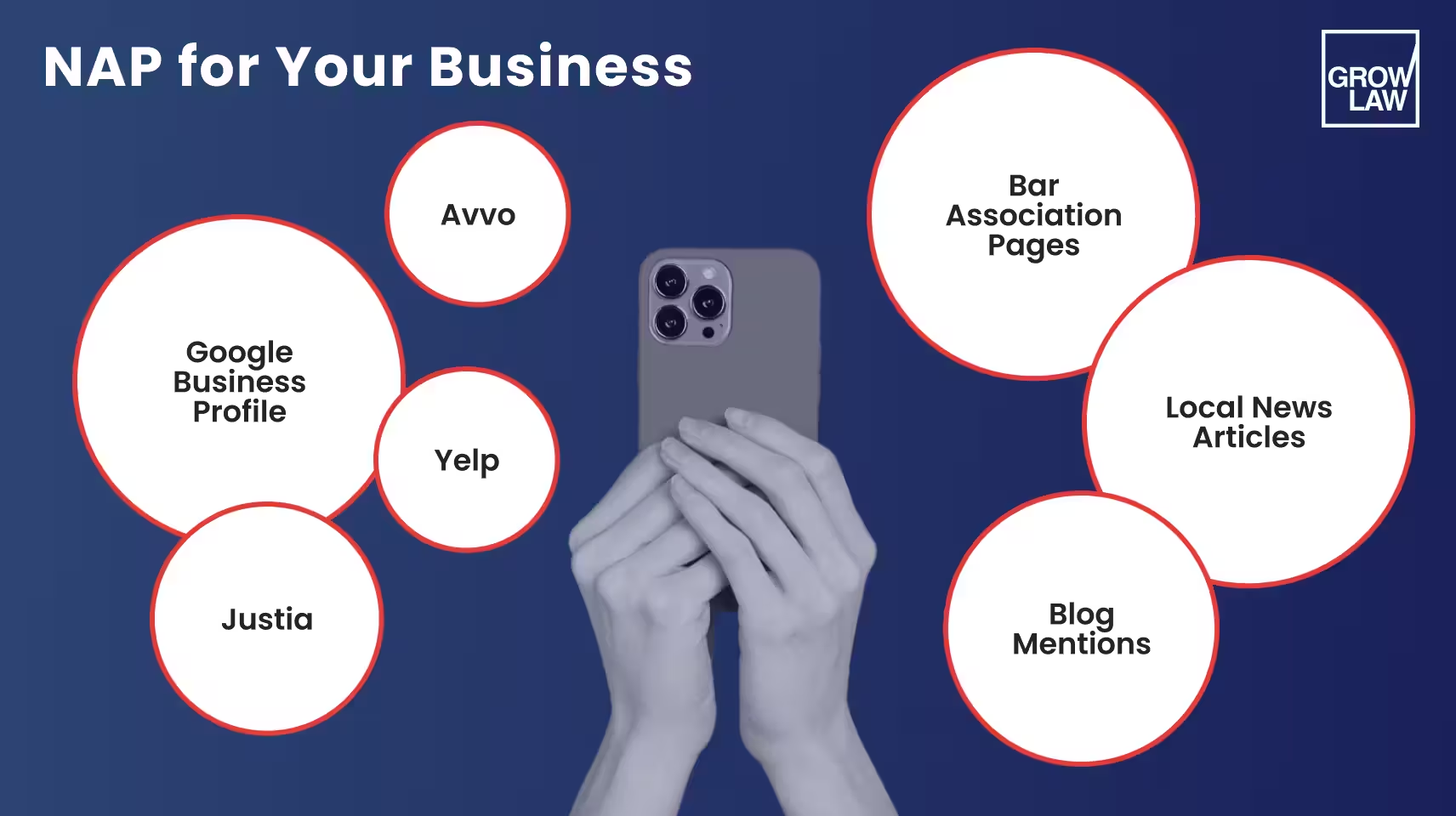
There are two flavors. The first is what we call structured citations — the clean, organized business directories like Google Business Profile, Avvo, Justia, and Yelp, where every listing follows the same format.
The second is unstructured citations — mentions inside regular web pages, like a blog post about a local legal clinic that happens to name your firm, or a news article quoting one of your attorneys. Both count. Google reads both and uses them to build a picture of your firm.
Why does Google care about all this? Before it ranks your firm on Google Maps, it wants to be confident that your firm actually exists and is what it claims to be. When Google sees your firm listed the exact same way across 40 different places, that's strong confirmation. When it sees three different versions of your address and two different phone numbers across those same 40 places, it becomes less confident — and a less-confident Google shows your competitors instead.
This is spelled out in Google's own documentation on how local search results work, where prominence — how well-known and trusted your business appears online — is listed as one of the three core ranking signals, alongside relevance and distance.
In our work with law firms, about 31% of client leads come directly through Google Business Profile, and another 42% come through organic search. Citations quietly support both. They don't generate leads on their own — they're the reason Google trusts your listing enough to show it in the first place. Think of them less as a marketing tactic and more as the paperwork that proves your firm exists.
Want the bigger picture? See how citations fit into → local SEO for law firms
2. How Citations Actually Affect Your Google Maps Ranking
Let's talk about the three-result map that shows up when somebody searches "personal injury lawyer near me" or "divorce attorney Dallas." That box is called the Map Pack (or Local Pack), and getting into the top three is where most of the local phone calls come from. The firms in positions four through ten get a tiny fraction of the clicks by comparison.
Google decides who shows up in that box using three signals. The first is relevance — does your firm actually do the kind of law the searcher is looking for? The second is distance — how close your office is to where the person is searching. The third is prominence — how well-known and trustworthy your firm appears across the web. Citations are a big piece of that third signal. Google has officially confirmed that local results are based primarily on these three factors, and prominence is the one you have the most control over.
Here's what that looks like in real life. A personal injury firm we worked with moved offices across town. They updated their new address on Google Business Profile right away, and they fixed it on their website the same week.
What they forgot about: roughly 30 directory listings — on Avvo, Yelp, Yellow Pages, a few legal-specific sites — that all still showed the old address. They didn't even realize those listings existed. Within 60 days, their ranking for the searches that mattered most to their business dropped from the top three on Google Maps down to positions seven through nine. The phone got quieter. Nothing else had changed on their end.
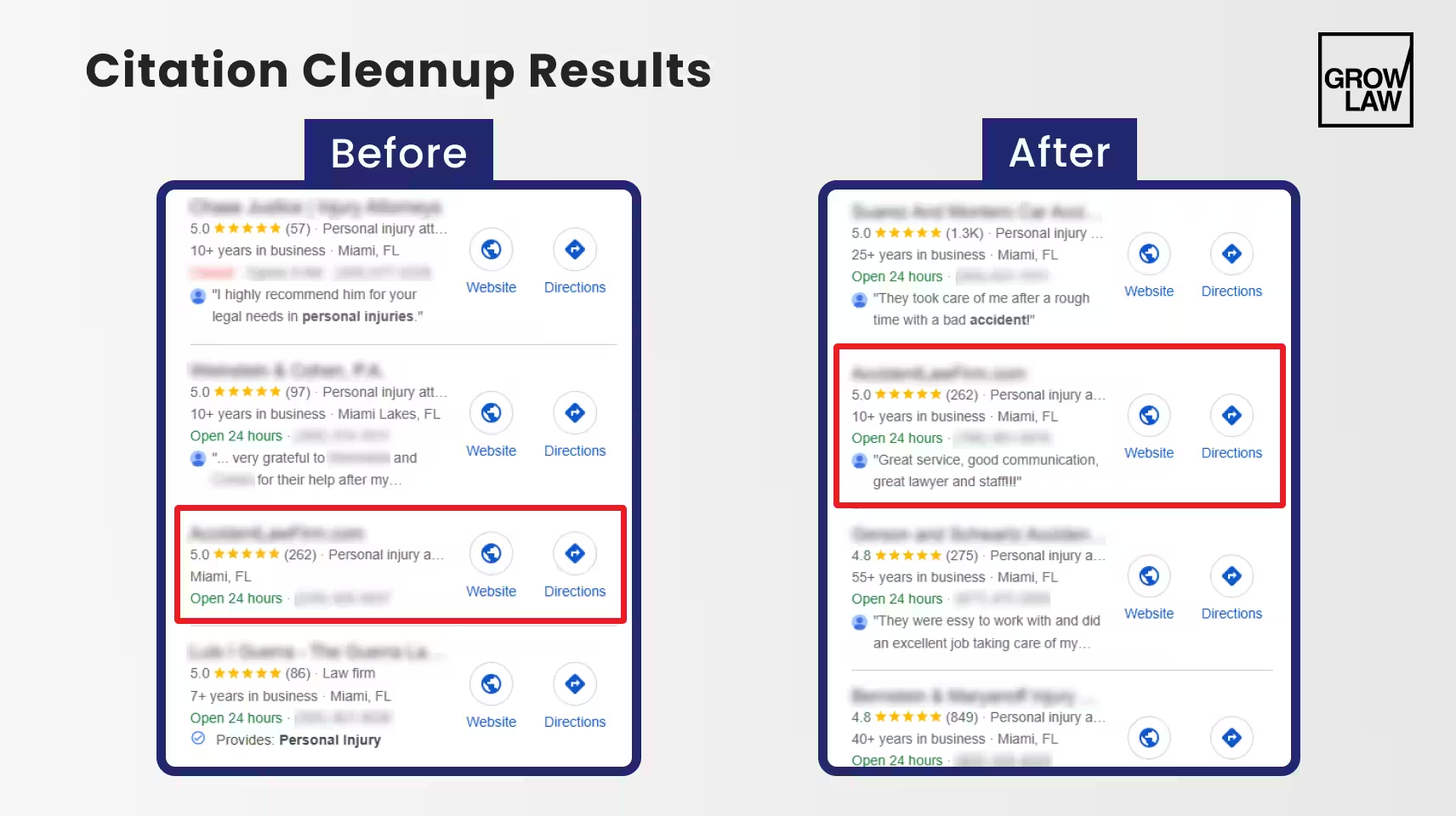
We ran a cleanup, made sure every directory listing showed the new address with the exact same formatting, and within six weeks, they were back in the top three. Same firm. Same lawyers. Same website. The only thing that had changed was the consistency of their information across the web.
A mismatch across 30 directory listings was enough to push a firm from position three to position eight on Google Maps. That's what Google means when it talks about "prominence."
This isn't just our observation. BrightLocal, one of the most widely used tools in local SEO, ran a large-scale citation study covering over 122,000 businesses across dozens of industries. They found a clear pattern: businesses ranking in the top three on local search had an average of 85 citations, while businesses ranked in position ten had 75.
That's eleven fewer citations separating the top of the map from the bottom. It's not a magic number — it's a signal of how much more settled the top-ranked firms' information is across the web.
3. Which Online Directories Actually Matter for Law Firms
Not all directories are created equal. A listing on Justia carries much more weight than a listing on some obscure local business index nobody has heard of. For law firms specifically, we divide the directories that matter into two groups.
The first group is legal-specific directories — sites built specifically for people looking for a lawyer. These are names like Avvo, Justia, FindLaw, Martindale-Hubbell, Lawyers.com, Super Lawyers, NOLO, and HG.org. They do two things at once.
First, Google recognizes them as authoritative sources about legal professionals, so a listing there counts for more in the rankings.
Second — and just as important — real potential clients use these sites to compare attorneys before they pick up the phone.
In our client data, roughly 25% of qualified client inquiries trace back to legal directories like Justia, Avvo, and Martindale-Hubbell. That's not a trickle. That's one in four of your new potential clients.
The second group is general high-authority directories — the ones that aren't about law specifically but are big and trusted enough that Google still uses them to verify your firm. Yelp, the Better Business Bureau, Apple Maps, Bing Places, and Yellow Pages. People don't usually pick a lawyer off Yelp, but if your firm is listed there with consistent information, Google counts it as another vote of confidence. Ignoring these is leaving free trust on the table.
Here's a quick-reference table of the main directories we work with, and what to expect from each:
One thing worth saying clearly: when you sign up for any of these directories, pay attention to the business category you pick.
A criminal defense firm that gets listed under the generic "lawyer" category, instead of "criminal justice attorney," is basically telling Google, "don't show me for criminal defense searches." It sounds like a small thing. It isn't. We've seen firms climb several positions just by switching the primary category on three or four listings.
4. How to Check Your Existing Listings Before You Build Anything New
Before you start creating new profiles, you need to know what's already out there. Most firms are surprised by what an audit turns up — old listings from a previous marketing agency, duplicates from someone who signed up twice by accident years ago, or profiles with a phone number from two offices ago that still rings somewhere.
An audit has three goals, in order of importance.
First, find every existing listing that has your firm's name on it, including the ones you didn't create yourself.
Second, check whether the name, address, and phone number on each listing match each other exactly.
Third, find the duplicates — the same directory showing your firm twice — and the listings with old or wrong information on them.
The two tools we reach for most often are BrightLocal and Whitespark. BrightLocal is good for running a general scan across a wide set of directories and flagging inconsistencies. Whitespark is particularly useful for something called competitor gap analysis — it shows you every directory where the top-ranking firms in your area are listed, and which of those directories you're not on yet. That's usually where the biggest ranking opportunities are hiding.
How much does consistency actually matter? More than most firms realize. BrightLocal's Local Citations Trust Report found that 68% of consumers said they would stop using a local business entirely if they found incorrect information in online directories.
Google's behavior mirrors what consumers do: inconsistent information makes Google less confident about showing your firm at all. One out of every two small inconsistencies you fix is solving a real problem, not a theoretical one.
Here's a short checklist of what an audit should actually cover:
At our agency, this kind of citation review is Step 2 of the full local audit we run for law firms — it comes right after the Google Business Profile check and before we dig into website content, backlinks, and site performance. We put citations early in the process because it's usually where the most visible quick wins are hiding, and because fixing them is cheap compared to everything else.
Want us to run this kind of check on your firm? Start with our → attorney local SEO services
5. How to Build Citations From Scratch, Step by Step
Let's say your audit is done, and it's time to build new listings. The single most important rule — and the one law firms break the most — is to lock in one exact format for your firm's information and then use it everywhere. Exactly the same. Every single time.
What do we mean by "exact"? We mean that if you write "Suite 400" on your Google Business Profile, you also write "Suite 400" on every directory — not "Ste. 400" on Avvo and "#400" on Yelp. If your legal name is "Smith Law Firm LLC," you don't shorten it to just "Smith Law" on directories where the form feels tight. It sounds obsessive. But Google reads your 40 listings looking for a match, and every difference is a small vote against you.
The practical fix is simple: write your firm's information down in one document, save it somewhere everyone on the team can find, and copy from that one document every single time you add or edit a listing. That's it. That one habit prevents 80% of the inconsistency problems we see.
Once you have your master format locked in, you have two ways to actually get listings built.
The first is manual — you go to each directory, create an account, and submit the information yourself.
The second is to use what's called an aggregator service, like Yext or Neustar Localeze, which pushes your information out to dozens of directories at once.
Both approaches have trade-offs. Manual is slower but gives you full control, and the listings you build stay yours forever. Aggregators are faster and reach more smaller directories, but you're essentially renting visibility — if you stop paying, a lot of those listings can revert or disappear over time.
For most law firms we work with, we recommend a hybrid approach: do the top legal-specific directories manually (you want full control over how your firm appears on Avvo, Justia, and Martindale-Hubbell), and then let an aggregator handle the long tail of smaller general directories where it doesn't matter as much.
When you fill out each profile, don't stop at just the name, address, and phone number. Fill out everything the directory will let you. Business category (pick the most specific one — go with "personal injury attorney" or "estate planning attorney" instead of the generic "lawyer" wherever that option exists).
A description of your practice areas. Office hours. Accepted payment methods. Photos of your office — even a couple of good ones. The names and profile links of your attorneys, if the directory allows it. Thin listings with just NAP and nothing else get less weight than complete ones. Google reads completeness as a signal that this is a real, active business rather than a copy-paste job by someone who submitted 200 firms in an afternoon.
Here's a concrete example from our client work.
A criminal defense firm came to us frustrated: they were stuck in positions four through six on the local map and couldn't get into the top three no matter what they tried. We ran a Whitespark audit and found the root cause quickly — they had 24 active citations, while the firm ranking number one for the same query had over 65. Their footprint was about a third the size of their biggest competitor's.
We built out 40 priority directories with consistent NAP information and the correct legal-specific business categories. Within 90 days, they were ranking in the local top three for their main practice area plus city keyword. No other changes during that window. Just citations, done carefully.
.avif)
For some context on the bigger picture: when citation work is part of a full local SEO strategy — not a standalone project — we see law firms get 40% to 60% more phone calls within six months of the first cleanup. The cleanup itself is usually the cheapest part of the engagement. The returns just take a few months to catch up and show in the call volume.
6. The Common Mistakes That Quietly Hurt Your Rankings
After running citation audits for a lot of law firms, we see the same handful of mistakes come up over and over. None of them is complicated. All of them are fixable. Here are the six we run into most often.
- Different address formats across directories. This is the most common mistake by a wide margin. "Suite 400" on Google, "Ste. 400" on Avvo, "#400" on Yelp. To a human, these all mean the same thing. To Google's matching algorithm, they can look like three different locations for the same firm name — and Google gets less confident about which one to trust.
- Firm name inconsistency. "Smith Law" on one listing, "Smith Law Firm LLC" on another, "Smith & Associates" on a third. Pick exactly one version of the name and use it everywhere — even if the shorter version feels more natural on your website.
- Duplicate listings. At some point over the years, someone at the firm (or a past marketing agency) submitted the firm twice to the same directory. Now there are two profiles splitting attention, and neither one ranks as well as a single clean listing would.
- Wrong or missing business category. A personal injury firm listed under the generic "attorney" category, instead of "personal injury attorney," is throwing away an easy relevance signal. This one takes five minutes to fix and can move rankings surprisingly fast.
- Citations pointing to an old website URL. If your firm rebranded, redesigned, or switched to a new domain in the last few years, there's a good chance some of your directory listings still link to the old URL. The traffic that would have come to your new site leaks away to a 404 or an outdated page.
- Unclaimed listings. If you've never claimed the directory profile for your firm, anyone technically can edit it. We've seen competitors mark unclaimed listings as "permanently closed." It's rare, but it happens, and the only real defense is claiming every profile you find during your audit.
The reason these mistakes pile up isn't carelessness — it's that the same firm has usually been touched by multiple people over several years. A founding partner who set up the first Google listing. An office manager who added Yelp. A marketing agency that created 20 more. A new hire who updated two of them when the office moved. Nobody has the complete picture, and nobody wrote down which directories hold the firm. Fixing it isn't glamorous. It's a spreadsheet, a handful of logins, and a few hours of careful attention. But the ranking lift is real and lasting.
Summary
Everything we just covered, stripped down to the parts that matter:
- Citations are online mentions of your firm's name, address, and phone number. Google uses them to verify that your firm is real and trustworthy.
- They affect your Google Maps ranking through a signal called prominence — one of the three signals Google uses to decide who shows up in the top three.
- Consistency matters more than volume. One format for your firm's information, used everywhere, no exceptions.
- Legal-specific directories (Avvo, Justia, FindLaw, Martindale-Hubbell) drive about a quarter of qualified client inquiries. Start there before anything else.
- Audit what already exists before you build new listings. Use BrightLocal or Whitespark.
- Treat citation management as ongoing maintenance, not a one-time project. Update them every time something at the firm changes.
Ready to turn your local footprint into Map Pack rankings? Explore → law firm local SEO
Frequently Asked Questions

Compare Your Practice Instantly
Stay Ahead of the Competition!
Compare your law firm's performance to Local competitors with our instant assessment tool
Get a clear picture of your firm's performance
Boost your online presence
Compare My Firm
Compare Your Practice Instantly
Stay Ahead of the Competition!
Compare your law firm's performance to Local competitors with our instant assessment tool
Get a clear picture of your firm's performance
Boost your online presence
Compare My Firm
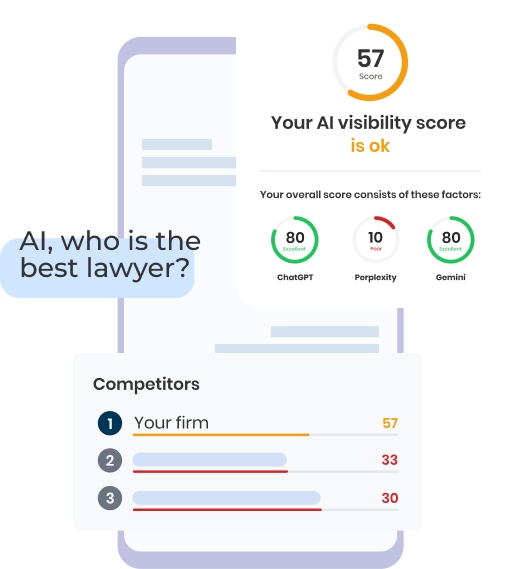
Check Your AI Visibility Instantly
Find Out What AI Is Telling Your Potential Clients
Run our free AI Visibility Report to:
See how often top AI tools mention your law firm
Spot which competitors show up first
Get the next steps to capture more cases
Run My Free AI Report
.avif)
.avif)
.avif)

