


Table of Contents
Case results are the proof that converts legal prospects at the moment they're deciding which firm to hire. A visitor comparing your law firm with another will choose the one whose website demonstrates outcomes — specific settlements, dismissed charges, custody wins — over the one that only describes services.
A well-built legal case study page is one of the most effective trust assets your law firm website can have. Incorporating case studies and client testimonials into your law firm website content improves conversion rates by 34%, and Grow Law's goal is a 4X return on every web design investment — case results pages are a core part of how that return is achieved.
This guide covers why case results pages work, what to include, how to design and structure them, their SEO value, how to organize them by practice area, and what disclaimers and ethical rules apply.
Why Law Firms That Publish Case Results Convert Better
The core reason case results work is simple: legal services are high-stakes decisions made under uncertainty. A prospect evaluating a personal injury attorney doesn't know if the firm can actually win their type of case.
Case results remove that uncertainty. They show, with specific outcomes, that your firm has handled similar situations and produced results.
A personal injury firm with strong SEO rankings but a high cost per lead ran a content audit and found zero published case outcomes on their website.
A competitor's site displayed 12 specific results with settlement amounts, injury types, and timelines. After building a dedicated case results page with 15 anonymized outcomes, the firm's contact form completion rate increased 28% within 8 weeks, and cost per lead dropped 35% without changing ad spend or traffic volume.
72% of people say positive reviews make them trust a business more. Case results function as a stronger signal than reviews — they're not just social proof, they're outcome proof.
The question shifts from "Do other clients like this firm?" to "Can this firm win cases like mine?" That's the question that drives the hiring decision, and case results are the only content that answers it directly.
Building a law firm website that converts requires the right trust signals in the right places: law firm website design
What to Include on Your Law Firm Case Results Page
An effective law firm case results page entry answers four questions a prospect brings to every case outcome: what type of case was it, what was the challenge, what was the result, and how long did it take. Every entry should address all four — in that order, as briefly as the case allows.
What to exclude on the initial case results page: identifying client information without written consent, opposing party names, case-specific facts that could be used against the firm in future proceedings.
The safest format: "[Case Type] — [City/State] — [Outcome]" with a paragraph of context. Cameron Law overhauled their content strategy in April 2024 — including adding case outcome content — and saw a significant increase in qualified leads as a direct result of the trust signals the new content provided.
When presenting dollar amounts and specific results, follow your state bar's advertising rules. The ABA Model Rules of Professional Conduct Rule 7.1 and your jurisdiction's specific rules govern what claims can be made in attorney advertising.
Case Results Page Design: How to Present Outcomes in a Compelling Way
The design of a case results page determines whether a prospect reads it or bounces. Case outcomes are high-value content — but only if they're presented in a format that communicates the result immediately and supports easy scanning across multiple entries.
Consider before-and-after case result graphics. These add credibility and help prospects understand the real impact of your firm's work. A graphic showing "$45,000 initial offer → $1.2 million settlement" is more viscerally impactful than the same information in text. For practice areas where outcomes are quantifiable — personal injury settlements, workers' comp awards, tax debt reductions — before-and-after visuals should be standard.
The most effective case results page doesn't just list wins — it shows the gap between what the prospect would have gotten without legal representation and what the firm achieved. That gap is the value proposition.
Grow Law designs case results pages built for conversion and trust: law firm web design services
The SEO Value of Your Law Firm Case Study Pages
Individual legal case study pages are among the highest-value SEO content a law firm can produce — not because they target high-volume keywords, but because they target high-intent, low-competition long-tail queries that convert at exceptional rates.
A criminal defense firm published 10 detailed legal case study pages — one per sub-practice area (DUI, drug charges, assault, white-collar crime, expungement, and others) — each describing the charge, the defense strategy, and the outcome.
Within 5 months, 7 of those pages ranked on page one for their target queries. The pages collectively generated 380+ organic sessions per month and became the firm's highest-converting content: visitors who read a case study contacted the firm at 3x the rate of visitors who only read practice area pages.
Individual case study pages also attract inbound links from legal publications, bar association directories, and case law databases — sources that don't typically link to generic "our services" pages. Each inbound link from a legal authority source strengthens the domain's overall E-E-A-T profile. Adding LegalService structured data to case results pages further strengthens entity recognition and improves how AI search systems categorize the outcomes.
For SEO tracking, set up Google Search Console to monitor impressions and clicks for case study pages separately from practice area pages. The conversion rate differential will confirm which format is producing leads — and justify continued investment.
How to Organize Your Case Results by Practice Area
The architecture of your law firm case results section determines how easily prospects can find outcomes relevant to their specific situation — and how effectively the content supports the firm's SEO structure.
Newlin Law Offices restructured their practice area content — including embedding case outcomes within each practice area page — and achieved a 106% increase in conversion rate and 300% more qualified leads. The outcomes gave context to the practice area descriptions and answered the prospect's underlying question: can this firm win my type of case?

Disclaimers and Ethical Considerations for Law Firm Case Results
Don’t publish case results without proper disclaimers. This creates bar association compliance risk in most jurisdictions. The disclaimers required are not boilerplate — they're substantive communications that affect how prospects interpret the results. Getting them right protects your firm legally and, paradoxically, increases conversion by signaling transparency.
Review your state's attorney advertising rules through the American Bar Association's state-by-state rules directory before publishing case results. Disclaimer requirements vary significantly by jurisdiction and practice area.
Disclaimers don't suppress conversion — they increase trust. A firm that publishes case results alongside clear, professionally worded disclaimers signals that it operates with transparency and understands its ethical obligations. That signal is itself a trust indicator for prospects evaluating you for legal representation.
Summary
- Case results pages improve law firm conversion rates by 34% — they answer the prospect's core question ('can this firm win my type of case?') that no other content format can address.
- Every case results entry should include: practice area and case type, the challenge, the specific outcome, and the timeline. Client quotes add emotional resonance where available.
- Individual legal case study pages are high-intent SEO assets — targeting long-tail queries ('DUI charges dismissed [city]') that convert at 3x the rate of practice area pages.
- Organize law firm case results at three levels: master hub page, practice area embedded results, and individual case study pages. Each level serves a different prospect intent.
- Before-and-after graphics increase the impact of quantifiable outcomes — settlement amounts, charges dismissed, verdict vs. initial offer — and are among the highest-converting visual formats for legal websites.
- Disclaimers are required in most jurisdictions and should be specific, not boilerplate — they increase trust by signaling transparency rather than suppressing conversion.
Ready to build case results pages that convert prospects into consultations? Explore our attorney website design services.
Frequently Asked Questions

Compare Your Practice Instantly
Stay Ahead of the Competition!
Compare your law firm's performance to Local competitors with our instant assessment tool
Get a clear picture of your firm's performance
Boost your online presence
Compare My Firm
Compare Your Practice Instantly
Stay Ahead of the Competition!
Compare your law firm's performance to Local competitors with our instant assessment tool
Get a clear picture of your firm's performance
Boost your online presence
Compare My Firm
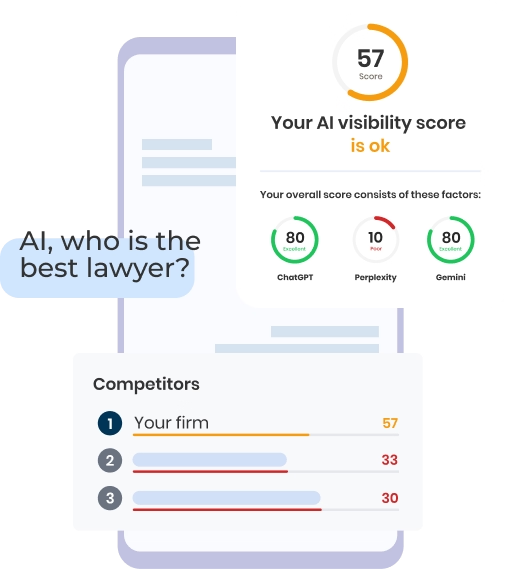
Check Your AI Visibility Instantly
Find Out What AI Is Telling Your Potential Clients
Run our free AI Visibility Report to:
See how often top AI tools mention your law firm
Spot which competitors show up first
Get the next steps to capture more cases
Run My Free AI Report
.avif)
.avif)
.avif)

