


Table of Contents
AI search visibility is now a measurable, auditable metric. 98% of Grow Law's law firm clients are already receiving AI-driven qualified leads.
That means prospects are asking legal questions in ChatGPT, Gemini, and Perplexity, getting AI-generated answers, and choosing which firms to contact based on who appears in those answers. If your firm isn't in them, a competitor is, and that prospect may never reach your website.
In this guide, we cover what an AI search visibility audit measures, how it differs from traditional SEO ranking analysis, what to check, how AI Overviews chooses which law firms to cite, how to measure your current visibility, and what to prioritize to get cited by AI search.
Why AI Search Visibility Is Now a Required Audit for Law Firms
In the last 3 years, we’ve noticed a split in the search behavior that drives legal client acquisition. A growing share of prospects now start with an AI tool rather than a Google search — asking ChatGPT "who is the best personal injury attorney in [city]" or asking Gemini "do I need a lawyer after a car accident."
These prospects form impressions about which firms are authoritative before they visit your website or click an ad. If your firm doesn't appear in those AI-generated answers, you’re missing out on potentially very lucrative cases.
Traditional SEO audits measure ranking position, backlink profiles, and keyword coverage. An AI search visibility audit measures something different: whether your firm is cited when prospects ask the questions that precede hiring an attorney.
These two measures can diverge dramatically. A firm can rank #1 organically for a high-value keyword and appear in zero AI answers for the same query.
An AI visibility audit is also the essential diagnostic step before any GEO investment. Spending on content, schema, and entity-building without knowing your current AI visibility baseline is building without a blueprint.
Before investing in GEO, get a clear picture of your current AI visibility: GEO for law firms
AI Search Visibility vs. Traditional SEO: Why Your Rankings Don't Transfer
The distinction matters enough to be explicit: Google's AI Overviews operate on different signals than traditional organic rankings.
A firm with a strong backlink profile and well-optimized pages can rank #1 and still be ignored by AI systems that prioritize content format, entity recognition, and third-party citation patterns.
Among Grow Law's law firm clients, 72% appear in AI Overviews and 28% are directly mentioned in AI-generated answers. These are two distinct levels of AI visibility with very different citation mechanics.
A personal injury firm ranking #1 organically for their primary keyword ran an AI audit and discovered they appeared in zero ChatGPT or Gemini answers for the 15 most common pre-hire questions in their practice area.
A competitor ranked #4 organically was cited in AI answers for 11 of those 15.
After a 90-day GEO program involving Q&A content restructuring, attorney schema, entity-building in legal directories, the firm appeared in AI answers for 9 of the 15 target queries and saw a 41% increase in consultation requests without changing their paid ad budget.
AI search visibility and SEO rankings are independent metrics. Auditing one tells you nothing about the other. Law firms that assume their SEO performance transfers to AI are missing gaps that a competitor is filling.
The AI Search Visibility Audit: 5 Things to Check
An AI search audit covers five components, each targeting a different layer of how AI systems evaluate and cite law firms.
Work through them in order. Earlier checks often explain failures in later ones.

1. Query mapping. Identify which legal questions in your practice area trigger AI-generated answers. Search for 20–30 target queries in ChatGPT, Gemini, and Perplexity. Document which ones produce AI answers (vs. 'I don't have that information') and which firms are cited in those answers. This becomes your benchmark.
2. Citation check. For each query that triggers an AI answer, record whether your firm is cited, which competitor appears, and what content or source the AI references. Many firms discover that a competitor with weaker traditional SEO dominates AI answers because of a better content format or directory presence.
3. Technical check — AI crawler access. Verify that GPTBot, PerplexityBot, and ClaudeBot are not blocked in your robots.txt file. This is the most common and most easily missed AI visibility issue.
A mid-size family law firm invested in AI search optimization for family lawyers for months but saw zero improvement in citations. Their robots.txt was blocking all AI crawlers, a holdover from an outdated SEO configuration set three years earlier.
After unblocking AI crawlers and resubmitting the sitemap, the firm appeared in Perplexity answers for their primary practice area within 6 weeks.
4. Schema audit. Check whether Attorney, LegalService, Review, and LocalBusiness schema are implemented and correct. Use Google's Rich Results Test to verify. Missing or malformed schema is one of the clearest signals that a firm hasn't optimized for AI citation.
5. Content structure review. Evaluate whether your key practice area pages use a Q&A format. Write direct answers to questions prospects actually ask AI.
Pages structured as service descriptions ("We handle personal injury cases across Texas") don't get cited.
Pages structured as direct answers ("If you've been injured in a Texas car accident, here's what you need to know about your legal options") do.
How AI Overviews Choose Law Firm Sources and What to Fix
The signals that determine AI citations differ from traditional ranking signals. Understanding them is the core of any generative engine optimization audit.
The distinction between answer engine optimization (optimizing for Google featured snippets and zero-click answers) and GEO (being cited inside conversational AI responses) is important for prioritization. For a deeper breakdown, see our guide to zero-click search for law firms.
AEO focuses on Google's structured answer formats. GEO extends that to ChatGPT, Gemini, Perplexity, and Copilot, which use different citation mechanics.
How to Measure Law Firm Visibility in AI Search: Metrics and Baselines
Once the audit is complete, establish a measurement framework so GEO improvements are trackable. These are the four metrics that matter for law firm AI search visibility:
Track your AI Overviews performance through Google Search Console. The AI Overviews report shows which of your pages are being pulled into AI-generated answers on Google, giving you a baseline for that specific platform without manual testing.
Generative engine optimization audit results compound over time. If your firm tracks these metrics monthly, you can see the impact of each GEO change within 4–8 weeks.
The metrics also reveal which platforms respond fastest: Perplexity typically shows new citations within weeks of content changes; Google AI Overviews take longer because they depend on the Google indexing cycle.
Grow Law tracks these metrics for every GEO client and provides monthly reporting: generative engine optimization for attorneys
What to Fix After the Audit: Prioritized GEO Actions
Translating audit findings into action requires a prioritized sequence. Not all GEO fixes have the same impact timeline. Some produce measurable citation improvement within weeks, others take months to compound.
Jacob Fuchsberg Law Firm implemented a full GEO program through Grow Law — content restructuring, schema, entity-building across legal directories — and achieved a 606% increase in AI-generated traffic alongside a 980% marketing ROI and 196% increase in qualified leads.
Rice & Kendig saw a 1,740% increase in AI-driven qualified leads through Grow Law's GEO implementation. Cameron Law generated 274% more AI-driven qualified leads and 367% more overall qualified leads. Daven Cameron noted that Grow Law stood out as the most open and honest agency they evaluated.
Use Google's AI Grader tool (ai.growlaw.co) as the starting point for your audit. It shows how often AI recommends your firm, which competitors appear ahead of you, and clear steps to improve visibility.
Summary
- AI search visibility is now measurable and auditable — 98% of Grow Law's law firm clients receive AI-driven qualified leads, confirming this is the current reality, not a future trend.
- Traditional SEO rankings don't transfer to AI citations. A firm can rank #1 organically and appear in zero AI answers — the signals are different and require separate optimization.
- An AI visibility audit covers 5 components: query mapping, citation check, AI crawler access (robots.txt), schema implementation, and content structure format.
- The most common and most easily fixed AI visibility failure: AI crawlers (GPTBot, PerplexityBot) blocked in robots.txt — a holdover from outdated SEO configurations.
- AI search visibility metrics: citation rate, query coverage, platform distribution, and competitor gap — tracked monthly against a pre-audit baseline.
- GEO fixes compound over time: Jacob Fuchsberg Law Firm achieved 606% AI traffic growth; Rice & Kendig generated 1,740% more AI-driven leads after Grow Law's GEO program.
Ready to audit your firm's AI search visibility and fix the gaps? Explore our AI search optimization for law firms.
Frequently Asked Questions

Compare Your Practice Instantly
Stay Ahead of the Competition!
Compare your law firm's performance to Local competitors with our instant assessment tool
Get a clear picture of your firm's performance
Boost your online presence
Compare My Firm
Compare Your Practice Instantly
Stay Ahead of the Competition!
Compare your law firm's performance to Local competitors with our instant assessment tool
Get a clear picture of your firm's performance
Boost your online presence
Compare My Firm
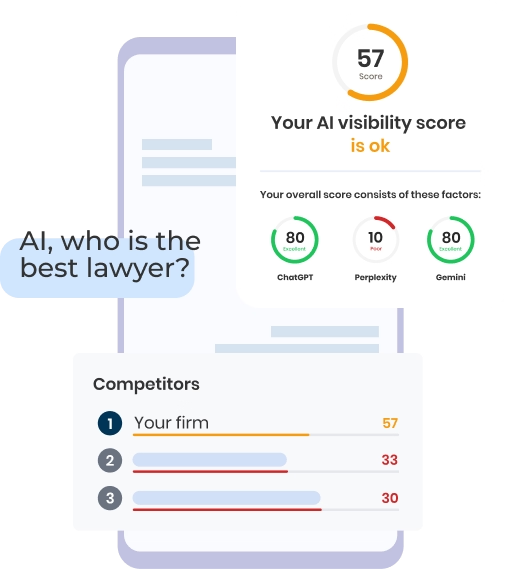
Check Your AI Visibility Instantly
Find Out What AI Is Telling Your Potential Clients
Run our free AI Visibility Report to:
See how often top AI tools mention your law firm
Spot which competitors show up first
Get the next steps to capture more cases
Run My Free AI Report
.avif)
.avif)
.avif)

