


Table of Contents
AI citation tracking is the practice of systematically monitoring whether and how often your law firm is mentioned in AI-generated answers across ChatGPT, Gemini, Perplexity, Google AI Overviews, Microsoft Copilot, and Claude. It's the measurement layer of AI search visibility — the discipline that makes your GEO (generative engine optimization) investment accountable.
Without it, there’s no way of knowing whether your investment in GEO content is producing citations, which platforms are responding, or which competitors are capturing the AI answers your prospects read before hiring.
98% of Grow Law's law firm clients now receive AI-driven qualified leads. That means AI citations are producing measurable business results — and measurable results need to be tracked.
This guide covers what an AI citation is, how to track citations manually and with tools, how often to monitor, how to build an AI brand visibility dashboard, and how to turn citation gaps into GEO improvements.
Why AI Citation Tracking Is Now a Required Marketing Metric for Law Firms
The shift in search behavior is documented and accelerating. Perplexity AI alone reports hundreds of millions of queries per month, with legal questions among the highest-volume categories. Prospects are asking AI platforms "who is the best personal injury attorney in [city]" and "do I need a lawyer after a car accident" before they run a Google search.
If AI citation tracking isn't part of your law firm's marketing metrics, your firm is flying blind in the channel that's growing fastest.
98% of Grow Law's law firm clients receive AI-driven qualified leads — confirming that AI citations already produce measurable business outcomes. Tracking those citations is what makes the connection between your GEO investment and business results visible. A firm that invests in GEO content without tracking citations cannot answer the most basic question: Is it putting me in front of qualified prospects?
AI citation tracking is built into every Grow Law GEO program: GEO for law firms
What Is an AI Citation in Legal Marketing & What Should You Track?
An AI citation in legal marketing is a mention of a law firm by name in an AI-generated response to a legal query.
Not all AI citations are equally valuable. Grow Law measures two distinct citation tiers across its client base: 72% of clients appear in AI Overviews (Google's AI-generated answer boxes that appear above traditional search results), and 28% are directly mentioned in conversational AI answers (ChatGPT, Gemini, Perplexity responses that name the firm as a recommended resource or cited source).
A personal injury firm with strong SEO rankings ran their first AI citation audit — querying 20 target legal questions across ChatGPT, Gemini, and Perplexity. The firm appeared in zero answers. Our AI search visibility audit for law firms guide explains how to establish that baseline.
A competitor ranked #4 organically was cited in 13 of the 20 queries. Without that tracking baseline, the firm would have continued investing in content without knowing they were invisible in AI search — and without the ability to measure whether GEO changes produced results.
| Citation Metric | Definition | How to Measure | Why It Matters |
|---|---|---|---|
| Citation rate | % of target queries where the firm is mentioned across tracked platforms | Manual monthly query testing; AI Grader report | Primary KPI — are you appearing in the AI answers your prospects read? |
| Citation tier | AI Overview mention vs. conversational AI mention (ChatGPT/Gemini/Perplexity) | Platform-by-platform manual testing | Different signals needed for each tier — AI Overviews vs. LLM visibility |
| Platform distribution | Which of the 6 AI platforms cite the firm | Track separately: Google AI Overviews, ChatGPT, Gemini, Perplexity, Copilot, Claude | Identifies which platforms need GEO content investment vs. which are already performing |
| Competitor gap | Queries where competitors are cited but the firm isn't | Side-by-side query testing; competitor citation count per query | Direct signal for content gaps — what do competitors have that you don't? |
How to Track AI Citations for a Law Firm: Manual and Tool-Based Methods
A complete AI citation tracking program for a law firm combines at least two methods — no single tool covers all six major AI platforms. That's why you must manually test to understand the context of citations, not just their existence.
Method 1 — Manual query testing. Build a list of 20–30 legal queries that prospects in your practice area ask before hiring an attorney. Query each platform monthly: ChatGPT, Google AI Overviews (via Google Search), Gemini, and Perplexity. Record which firms are named, what context they appear in, and what sources are cited. This is time-intensive but provides the deepest insight into why citations happen.
Method 2 — Grow Law AI Grader (ai.growlaw.co). We built an automated AI Grader that shows how often AI recommends your law firm, which competitors appear ahead of you in AI answers, and specific steps to improve visibility. This is the fastest way to establish a baseline citation rate across multiple platforms.
Method 3 — Google Search Console. The AI Overviews section in Google Search Console shows which of your pages are being pulled into Google's AI-generated answer boxes. Filters by page, query, and date — making it easy to track which practice area content is producing AI Overview citations.
Method 4 — Third-party GEO tracking platforms. Emerging tools like BrightEdge and Semrush are adding AI citation monitoring features. Coverage varies by platform and is evolving rapidly — supplement with manual testing for ChatGPT and Perplexity specifically.
| Tool | What It Tracks | AI Platforms Covered | Cost |
|---|---|---|---|
| Manual query testing | Citation presence, context, competitor mentions | All 6 platforms | Time only — 3–5 hours/month |
| Grow Law AI Grader (ai.growlaw.co) | Citation frequency, competitor ranking, and improvement steps | Google AI Overviews, ChatGPT, Perplexity | Free baseline report |
| Google Search Console | Which pages appear in AI Overviews; impressions and clicks from AI answers | Google AI Overviews only | Free |
| BrightEdge / Semrush AI features | Automated AI citation monitoring; share of voice | Google AI Overviews; ChatGPT (limited) | Paid ($200–$500+/mo) |
Grow Law's AI Grader gives law firms a free AI visibility baseline in 2 minutes: AI search optimization for law firms
How Often Should Lawyers Monitor AI Citations
Monthly monitoring is the minimum for law firms actively investing in GEO — and the reasoning is direct: AI model updates and competitor content changes can shift citation patterns within weeks. A firm that monitors quarterly discovers problems only after they've cost significant lead volume.
A criminal defense firm tracked AI citations monthly during their GEO program.
After month 3, citations had grown from 2 to 11 across their target queries. In month 5, citations dropped from 11 to 6 — a 45% decline.
Monthly tracking caught the decay immediately. A content audit identified the cause: a competitor had published 8 new Q&A pages targeting the same queries. For the next step, see auditing legal content for SEO.
After publishing 5 new conversational FAQ pages and strengthening entity signals in key legal directories, citations recovered to 14 by month 7 — higher than the previous peak. Quarterly tracking would have missed the decay entirely until it appeared as a lead volume drop months later.
| Tracking Frequency | Who It's For | What It Catches | Minimum Setup Required |
|---|---|---|---|
| Monthly | Firms actively investing in GEO; competitive markets | Citation decay from competitor content; AI model update impacts; GEO ROI measurement | 20–30 target queries; 3+ platforms; baseline from month 1 |
| Quarterly | Firms in GEO maintenance phase; less competitive markets | Major citation shifts; platform distribution changes | Same query list; comparison to previous quarter |
| Annual | Firms not yet investing in GEO | Baseline only — no trend data | Initial audit to establish starting position before GEO investment |
Monthly citation tracking is the early warning system that prevents a competitor content surge from becoming a lead volume problem before you notice it.
AI Brand Visibility Metrics: How to Build a Law Firm AI Citation Dashboard
AI brand visibility is an emerging discipline — Harvard Business Review described AI brand visibility as a critical emerging marketing metric for companies whose customers increasingly start research with AI tools rather than search engines. For law firms, the stakes are particularly high: AI-generated legal answers influence hiring decisions before a prospect reaches the firm's website.
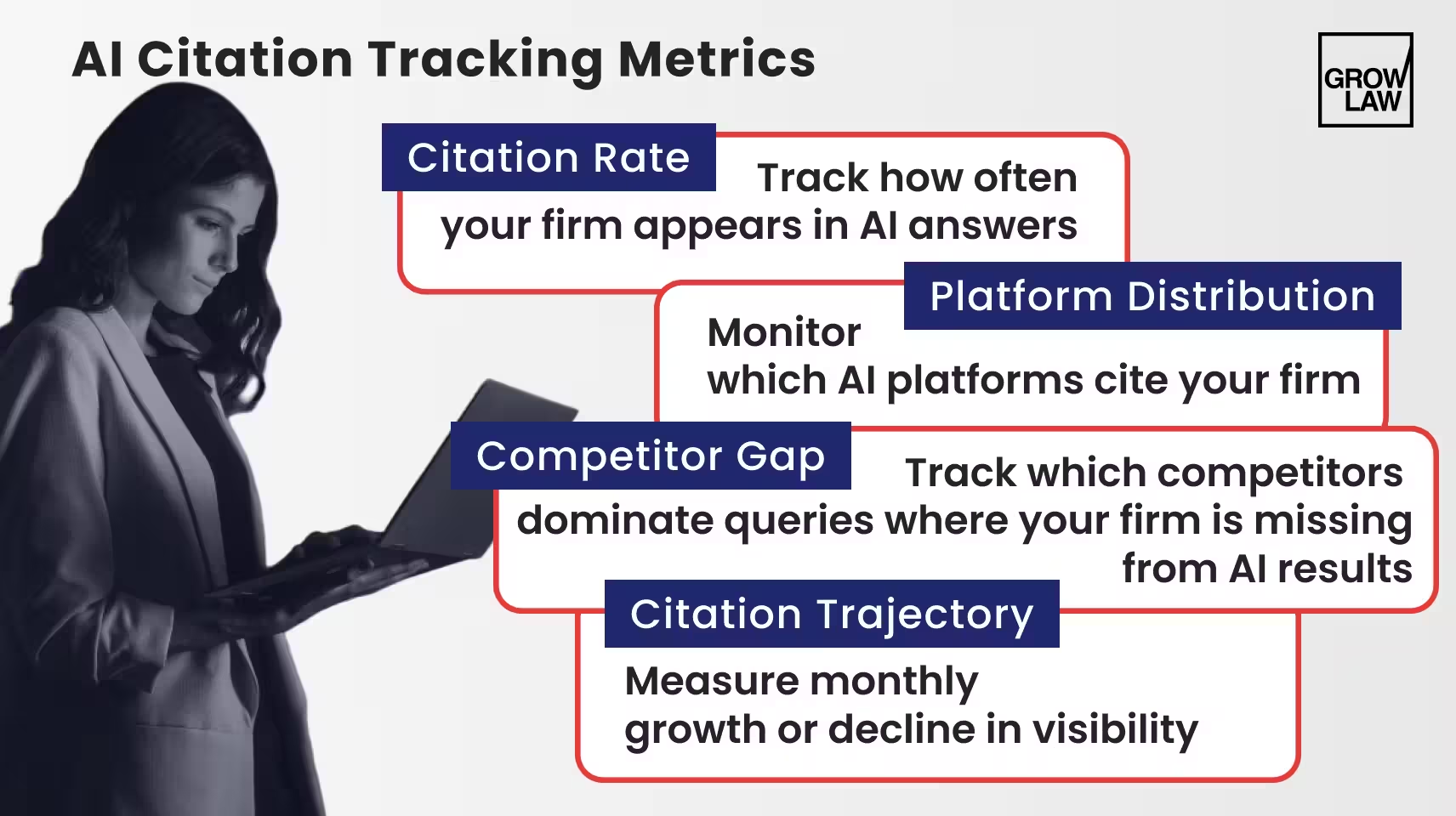
A law firm AI citation dashboard tracks four core metrics monthly:
Citation rate: % of target queries where the firm is mentioned across all tracked platforms. This is the primary KPI. Track separately for AI Overviews vs. conversational AI — they respond to different optimization signals.
Platform distribution: Which platforms cite the firm and for which query types. A firm cited heavily in AI Overviews but not in ChatGPT has a different optimization gap than a firm cited in Perplexity but not Google.
Competitor gap: For each target query where the firm isn't cited, record which competitor appears and how many queries they dominate. This directly guides content investment decisions.
Citation trajectory: Month-over-month change in citation rate. Growing = current strategy working; declining = competitor activity or AI model update requiring response; flat = baseline maintained but not improving.
Jacob Fuchsberg Law Firm tracked AI citation performance as part of their Grow Law GEO program and achieved a 606% increase in AI-generated traffic. Rice & Kendig tracked AI-driven leads separately from organic leads and documented a 1,740% increase in AI-driven qualified leads — a figure that's only attributable because the tracking was in place from the start.
How to Improve AI Citations After Tracking Reveals Gaps
Citation gap analysis turns tracking data into a GEO action plan. The improvement sequence follows the same pattern regardless of which queries are underperforming:
1. Content gaps. For each query where a competitor is cited but your firm isn't, examine what content the competitor has that you don't. In most cases, it’s Q&A-format pages that directly answer the query, or practice area pages structured as answers rather than service descriptions.
2. Technical gaps. Check robots.txt for blocked AI crawlers (GPTBot, PerplexityBot, ClaudeBot). Check Attorney schema completeness — sameAs links to a bar directory, and LinkedIn are frequently missing. These are quick, high-impact fixes.
3. Entity gaps. Check whether your firm is listed in the legal directories AI platforms reference as authoritative sources: Avvo, Justia, FindLaw, Super Lawyers, and state bar directories. Missing listings are easy to add and strengthen entity signals over 4–8 weeks.
4. Content production. Publish Q&A pages targeting the specific questions that trigger AI answers in your practice area. Structure each page as a direct answer, not a service description. This is the highest-impact, longest-lead GEO action plan for 6–12 weeks before citation impact.

Cameron Law worked with Grow Law on a GEO program that included systematic tracking and optimization. Daven Cameron noted that Grow Law stood out as the most open and honest agency they evaluated — transparency in tracking being a core part of that accountability. The result: 274% increase in AI-driven qualified leads and 367% overall qualified leads.
Summary
- AI citation tracking monitors often ChatGPT, Gemini, Perplexity, and Google AI Overviews mention your law firm — the measurement layer that makes your GEO investment accountable. For the next step, see law firm visibility in zero-click results.
- 98% of Grow Law's clients receive AI-driven qualified leads — confirming that AI citations produce measurable business results that must be tracked separately from organic leads.
- Two citation tiers to track: AI Overview appearances (72% of clients) and direct conversational AI mentions (28%) — different platforms, different signals, different optimization priorities.
- Monthly tracking is the minimum for firms investing in GEO — monthly monitoring caught a 45% citation decline in one firm before it became a lead volume problem.
- A law firm AI brand visibility dashboard tracks four metrics: citation rate, platform distribution, competitor gap, and citation trajectory.
- Citation gaps lead to specific GEO actions: content gaps (Q&A pages), technical gaps (schema, AI crawlers), entity gaps (legal directory listings), and new content production.
Ready to track and improve your law firm's AI citation performance? Start with our generative engine optimization for attorneys.
Frequently Asked Questions
-
How to track AI citations for a law firm?
How to track AI citations for a law firm requires combining two methods: manual monthly query testing (query 20–30 target legal questions across ChatGPT, Gemini, and Perplexity; record which firms are cited) and Grow Law's AI Grader tool (ai.growlaw.co), which provides an automated baseline report showing citation frequency and competitor positioning. Supplement with Google Search Console's AI Overviews report to track which practice area pages are generating AI Overview appearances specifically.
-
How do law firms know if ChatGPT mentions them?
How do law firms know if ChatGPT mentions them — through direct query testing. There's no automated notification system. Build a list of 20–30 legal questions that prospects in your practice area typically ask before hiring an attorney. Query each in ChatGPT monthly and record whether your firm is mentioned, in what context, and which competitors appear. This manual process, combined with Grow Law's AI Grader for cross-platform monitoring, provides the most complete picture of ChatGPT citation performance.
-
What tools track law firm visibility in AI search?
What tools track law firm visibility in AI search: Grow Law's AI Grader (ai.growlaw.co — free baseline report), Google Search Console (AI Overviews report — free, Google only), BrightEdge and Semrush AI features (paid, $200–$500+/month, multi-platform), and manual query testing across ChatGPT, Gemini, and Perplexity (free, time-intensive but most comprehensive). No single tool covers all six major AI platforms. A complete tracking program requires at least manual testing plus one automated tool.
-
How often should lawyers monitor AI citations?
How often should lawyers monitor AI citations — monthly, for firms actively investing in GEO. Monthly tracking catches citation decay due to competitor content updates before it becomes a lead-volume problem. The AI model update cycle means citation changes typically manifest within 4–8 weeks of content or schema changes, making monthly tracking the minimum cadence for connecting GEO actions to citation outcomes. Quarterly monitoring is sufficient for the maintenance phase after citations stabilize.
-
What is an AI citation in legal marketing?
What is an AI citation in legal marketing — a mention of a law firm by name in an AI-generated response to a legal query. AI citations appear in two forms: AI Overview appearances (Google's AI-generated answer boxes above traditional search results) and conversational AI mentions (ChatGPT, Gemini, Perplexity responses that name the firm as a recommended resource). Both produce measurable traffic and leads. 98% of Grow Law's law firm clients receive AI-driven qualified leads, making AI citations a trackable, optimizable marketing channel. For the next step, see law firm SEO for Google AI search.

Compare Your Practice Instantly
Stay Ahead of the Competition!
Compare your law firm's performance to Local competitors with our instant assessment tool
Get a clear picture of your firm's performance
Boost your online presence
Compare My Firm
Compare Your Practice Instantly
Stay Ahead of the Competition!
Compare your law firm's performance to Local competitors with our instant assessment tool
Get a clear picture of your firm's performance
Boost your online presence
Compare My Firm
Check Your AI Visibility Instantly
Find Out What AI Is Telling Your Potential Clients
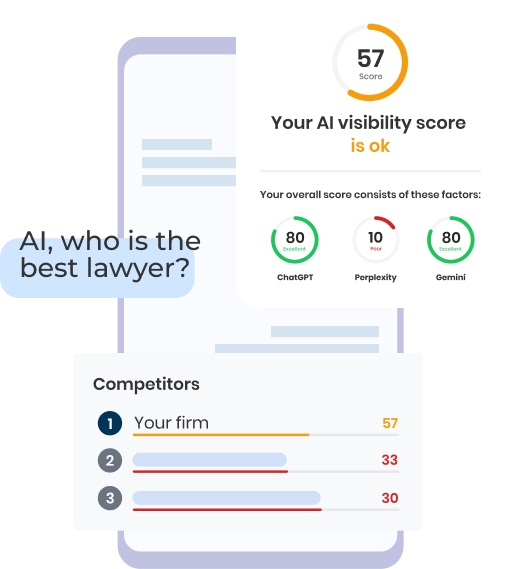
Run our free AI Visibility Report to:
See how often top AI tools mention your law firm
Spot which competitors show up first
Get the next steps to capture more cases
Run My Free AI Report
.avif)
.avif)
.avif)

